Artemis II Moon mission: Launch date, crew, flight time — all you need to know
Mission will bridge robotic tests and a new era of human lunar exploration
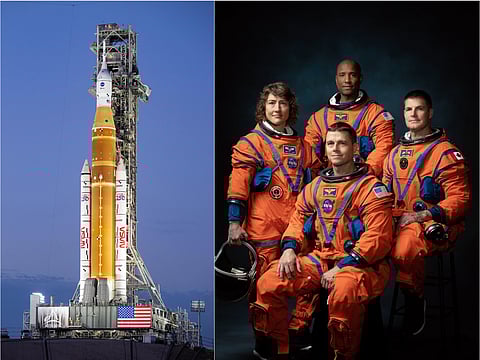
The Artemis II mission, launching in early February, is set to shine a spotlight on the Moon once again.
Potentially, it could also helpe pave the way for future missions to Mars.


Launch date
NASA is preparing to launch Artemis II as early as February 6, 2026 from Launch Complex 39B at the Kennedy Space Center in Florida, with backup launch windows extending into March and April 2026 depending on final preparations and tests.
Final countdown rehearsals — including a critical “wet dress rehearsal” to practice fueling and launch procedures — are underway ahead of liftoff.
On January 17, the stacked Artemis II rocket and spacecraft reached Launch Pad 39B after a nearly 12-hour journey from the Vehicle Assembly Building at Kennedy space centre in Florida.
Who’s going?
The mission will carry four astronauts on a roughly 10-day journey around the Moon and back — the first time humans have traveled beyond low-Earth orbit since Apollo 17, in 1972:
• Reid Wiseman (Commander)
• Victor Glover (Pilot)
• Christina Koch (Mission Specialist)
• Jeremy Hansen (Mission Specialist, Canadian Space Agency)
Mission timeline, trip details
Once launched aboard NASA’s powerful Space Launch System (SLS) rocket, the Orion spacecraft will first orbit Earth and then begin its outbound trip toward the Moon.
The crew will follow a free-return trajectory that loops around the Moon before returning to Earth — a flight lasting about 10 days total.
They will travel a path similar to the historic Apollo 8, swinging out past the Moon’s far side before heading home for a Pacific Ocean splashdown.
The above infographic is commonly displayed in NASA's launch control and broadcast coverage to help explain the incredibly rapid and precisely timed sequence that gets humanity's most powerful rocket off the ground and on its way to the Moon.
Why this mission matters
Artemis II is NOT landing on the lunar surface, but its importance can’t be overstated:
It’s NASA’s first crewed deep-space mission in more than five decades.
It will validate life-support systems, navigation, and spacecraft performance with astronauts aboard — critical checks before future landing missions.
Artemis III
More importantly, the data and experience gained will directly support Artemis III, currently planned to land astronauts (including the first woman and first person of colour) near the Moon’s South Pole and build a sustained lunar presence.
Main phases and key milestones of Artemis I launch:
Major events during the Artemis I launch (times are approximate mission elapsed time since launch):
Tower Clear & Roll/Pitch Manoeuvre (~00:00:07–00:00:79)
The rocket clears the launch tower and begins its programmed roll and pitch to follow the correct trajectory.Maximum Dynamic Pressure (MAX Q) (~00:01:10)
The point of peak aerodynamic stress on the vehicle (around 1,045 mph and ~42,555 feet altitude). The rocket throttles down slightly here to reduce structural loads.Solid Rocket Booster (SRB) Separation (~00:02:12)
The two huge side boosters burn out and separate, falling into the Atlantic Ocean. Speed: ~3,170 mph, altitude: ~158,000 feet.Launch Abort System (LAS) Jettison (~00:03:30)
The emergency escape tower is dropped as it's no longer needed.Core Stage Main Engine Cutoff (MECO) (~00:08:20)
The four RS-25 engines on the core stage shut down. The rocket has reached ~17,430 mph and ~531,000 feet.Core Stage Separation (00:08:30)
The now-empty core stage separates and later splashes down in the Pacific (01:46:00).ICPS Perigee Raise Burn (~00:51:00)
Small adjustment burn by the Interim Cryogenic Propulsion Stage (ICPS, the upper stage).Trans-Lunar Injection (TLI) Burn (~01:37:00)
The critical burn that sends Orion out of Earth orbit toward the Moon. Speed climbs to ~16,840 mph.ICPS/Orion Separation (~02:05:00)
Orion finally separates from the upper stage at ~19,625 mph and an altitude of ~2,323 miles, beginning its independent journey to the Moon.
The timeline uses a stylised trajectory arc with little rocket icons showing stage separations, while the table at the top lists time, speed, and altitude for each milestone.
The background shows the Earth curving away as the vehicle heads into deep space.

