The US House voted against Trump’s Iran war. Can it actually stop it?
Rare bipartisan rebuke raises questions about Congress, the presidency and path to peace
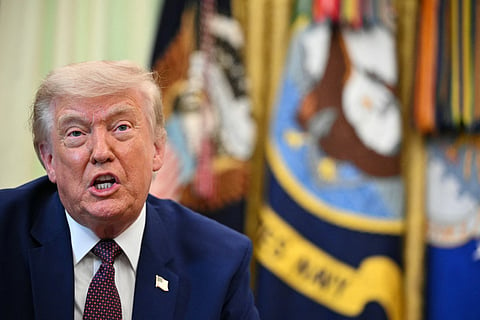
The US House of Representatives has delivered one of the strongest political rebukes yet to President Donald Trump’s handling of the war with Iran, approving a resolution that seeks to halt American military involvement in the conflict.
The vote does not immediately end the war. Nor does it guarantee any change in US military operations.
But it signals growing bipartisan unease with a conflict that has stretched into its fourth month, disrupted global energy markets, complicated US foreign policy and increasingly divided Washington.
The measure passed 215-208, with four Republicans joining Democrats in a rare break with the president. The result highlights mounting pressure on the White House as ceasefire efforts stall, violence continues and the economic impact of the conflict is felt far beyond the Middle East. Democratic Congressman Gregory Meeks, who led the effort, captured the mood among opponents of the war with a blunt message: “Enough is enough.”
Here’s what happened — and what comes next.
What did the House actually vote for?
The House approved a war powers resolution aimed at limiting US military action against Iran.
The measure argues that Congress, not the president alone, has constitutional authority to decide whether the United States should engage in prolonged military conflict.
Supporters say Trump launched and expanded military operations without obtaining explicit congressional authorisation.
The resolution seeks to reassert Congress’s role in decisions involving war and peace.
Does the vote stop the war immediately?
No.
The resolution is largely political at this stage.
It does not automatically force US troops or military assets to halt operations, nor does it compel the administration to change course overnight.
Instead, it represents Congress formally expressing opposition to continued military involvement and asserting its constitutional authority over war-making decisions.
Why is the vote significant?
Because of what it says politically.
Trump entered office promising to reduce American involvement in overseas conflicts and focus on domestic priorities.
The Iran war has complicated that message.
As the conflict drags on, lawmakers from both parties are facing growing questions from voters about rising fuel prices, inflation and the broader costs of the war. Meeks argued that Americans were “tired of suffering because of his war of choice — suffering at the gas pump, suffering at the supermarkets”, according to AP.
The fact that Republican lawmakers joined Democrats is particularly notable because public breaks with Trump on national security issues remain relatively uncommon.
What happens next?
The resolution now moves to the Senate.
That chamber has already shown signs of discomfort with the war. Last month, four Republican senators joined Democrats in advancing a similar measure.
However, the Senate has not yet held a final vote.
If senators approve their version, the issue would move closer to Trump’s desk.
Could Trump simply veto it?
Yes.
That is currently the most likely outcome.
As commander-in-chief, Trump has consistently defended his authority to direct military operations and has shown no indication that he agrees with congressional efforts to restrict that power.
Overriding a presidential veto would require a two-thirds majority in both chambers — a threshold that appears highly unlikely given current voting numbers.
If Trump can veto it, why does Congress bother?
Because Congress is fighting two battles simultaneously.
The first is political: sending a signal that support for the war is weakening.
The second is constitutional: defending its role in authorising military action.
For decades, presidents from both parties have expanded military operations without formal declarations of war, often leading to disputes over where presidential authority ends and congressional authority begins.
This vote is part of that longer-running struggle.
What is the War Powers Act?
The War Powers Resolution of 1973 was passed after the Vietnam War.
It requires presidents to notify Congress when US forces are introduced into hostilities and generally limits military engagement to 60 days unless Congress authorises continued action.
The White House has argued that the current situation is legally different because ceasefires and pauses in hostilities mean the conflict does not fall neatly into the traditional framework envisioned by the law.
Critics reject that argument and say active military operations are continuing.
What does the White House say?
The administration argues that limiting presidential authority now could weaken Washington’s negotiating position.
Secretary of State Marco Rubio warned lawmakers that Iran would conclude the United States was unable to respond militarily if Congress approved restrictions. Tehran would think “we won’t be able to do anything to them, so why make a deal?” Rubio said, according to AP.
The White House has also pointed to ongoing diplomatic efforts and Trump’s belief that a broader agreement remains possible despite repeated setbacks.
How does Iran fit into the picture?
The political fight in Washington is happening alongside increasingly difficult diplomacy.
Negotiations between Washington and Tehran remain stalled.
The United States wants Iran to curb its nuclear activities, surrender its stockpiles of highly enriched uranium and allow the full reopening of the Strait of Hormuz, one of the world’s most important energy shipping routes.
Iran says progress has been limited and has warned that any major escalation involving Israel or Lebanon could reignite wider regional conflict. Iranian Foreign Minister Abbas Araghchi said there had been “no tangible progress” in negotiations, according to AFP.
Why does the Strait of Hormuz matter?
Because roughly a fifth of the world’s oil trade passes through it.
Disruptions to shipping in the waterway have contributed to higher energy prices and renewed inflation concerns globally.
That economic impact is one reason opposition to the war has grown in Congress.
At the same time, Republican leaders argue that reopening the waterway remains a critical objective. House Speaker Mike Johnson said “the entire world has an interest in the Strait of Hormuz being reopen for commerce”.
Lawmakers are increasingly hearing concerns from voters about fuel costs, grocery prices and broader economic uncertainty linked to instability in the Gulf.
Is this the beginning of the end of the war?
Not necessarily.
The House vote does not end military operations, and negotiations remain fragile.
Trump has continued to express optimism, saying a deal with Tehran “could happen... over the weekend”, according to AFP. Yet the gap between Washington and Tehran remains wide, and violence continues to flare across the region.
For now, the House vote is best understood as a warning shot rather than a ceasefire - a sign that Congress is becoming less willing to give the White House a free hand in the war.
- with inputs from AP and AFP


