‘It’s an honour to be denounced by Daesh’
Imams in the West are countering militants via theology
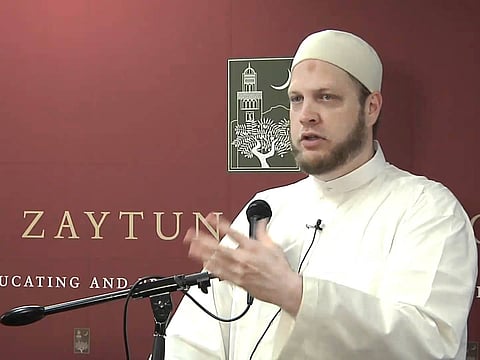
Washington As the military and political battle against the Daesh group escalates, Muslim imams and scholars in the West are fighting on another front — through theology.
Imam Suhaib Webb, a Muslim leader in the District of Columbia, has held live monthly video chats to refute the religious claims of the Daesh group. In a dig at the extremists, he broadcast from ice cream parlours and called his talks “ISIS [Daesh] and ice cream.”
Shaikh Hamza Yusuf, an American Muslim scholar based in Berkeley, California, has pleaded with Muslims not to be deceived by the “stupid young boys” of the Daesh. Millions have watched excerpts from his sermon titled “The Crisis of ISIS [Daesh],” in which he wept as he asked God not to blame other Muslims “for what these fools among us do.”
It is a religious rumble that barely makes headlines in the secular West since it is carried out at mosques and Islamic conferences and over social media.
The Daesh group, however, has taken notice.
The group recently threatened the lives of 11 Muslim imams and scholars in the West, calling them “apostates” who should be killed. The recent issue of the Daesh group’s online propaganda magazine, Dabiq, called them “obligatory targets,” and it said that supporters should use any weapons on hand to “make an example of them.”
The danger is real enough that the FBI has contacted some of those named in the Daesh group’s magazine “to assist them in taking proper steps to ensure their safety,” said Andrew Ames, spokesman for the FBI’s field office in the District of Columbia.
Death threats
The death threats are a sign Muslim religious leaders have antagonised the Daesh, according to analysts who are studying the militant group. Their growing influence also contradicts those who claim that Muslim leaders have been silent in the fight against violent extremism.
“This is what hurts ISIS [Daesh] the most. It is Muslims speaking out,” said Mubin Shaikh, a Canadian who once joined an extremist Islamist group and now advises governments on countering radicalisation. “Fear-mongering is what ISIS {Daesh] is trying to do, whether to silence these people or to silence others as a deterrent.”
Several of the targeted Muslim leaders said in interviews that, while they were taking the threat seriously, they had no intention of backing off. They have hired security guards and fortified their workplaces, and some keep guns at home.
“It’s an honour to be denounced by ISIS [Daesh],” said Webb, who frequently engages young Muslims over social media, whether on YouTube, Facebook, Periscope or Snapchat, where he uses the handle Pimpin4Paradise786. “I consider it one of my greatest accomplishments in life.”
“It has only reinvigorated me,” he said, “to provide the antivenom to the poison of ISIS [Daesh].”
These Muslim leaders say they are responding to fellow believers who are looking for a religiously based rebuke to violent movements that claim to be acting in the name of Islam. They say that extremist groups like Daesh are a threat not just to civil society and security but to the future of their faith.
Shaikh Yasir Qadhi, who is based in Tennessee and runs a popular Islamic educational institute, thundered against the Daesh group in a Friday sermon at one of Europe’s largest mosques in March, only three days after the group’s suicide bombers had attacked the Brussels airport and train station.
“None of our senior scholars of any school — any school — has justified these deeds,” Qadhi said at the East London Mosque.
He argued that the terrorist attacks of recent years had clearly violated Islamic teaching because they “cause more harm than good,” bringing more bombs, more drones and more chaos to Muslim communities, he said.
“Who has benefited? Please use the intelligence that Allah gave you,” he said. “These radical groups have harmed the image of Islam infinitely more than all of the foreign policy of Western lands combined.”
These scholars ridicule the Daesh group’s claim to have created a “caliphate” ruled by a successor to the Prophet Mohammad (PBUH). Instead, in a highly effective bit of rebranding, they call the Daesh group Kharijites, a reviled group of Muslims who killed women and children and rebelled against the caliphs in the seventh century.
The imams named by the Daesh group are based in the United States, Canada, the UK and Australia. They represent a broad spectrum of Islamic thought — from spiritual Sufis to puritanical Salafis, and even the more militant “Salafi Jihadis.”
To the Daesh group’s propagandists, it does not matter that the imams are fervent Muslims or critics of American foreign policy: They are all “unbelievers,” just like the Shiites, Christians and Yazidis that the Daesh group has killed by the thousands in Iraq, Libya, Syria and elsewhere.
This is not the first time that the Daesh group has targeted Muslim leaders in the United States, but this is the longest list yet. It includes Shaikh Hisham Kabbani, a Lebanese Sufi now based mostly in Michigan who has been warning for years about rising extremism.
Canadian convert
The list also includes Salafi-oriented preachers such as Bilal Philips, a Canadian convert who has been barred from several countries because of allegations that he preaches extremism; Tawfique Chowdhury, an Australian doctor who founded organisations and charities that propagate orthodox views of Islam; and Abu Basir Al Tartusi, a Syrian preacher based in London who has spoken in support of Al Qaida, according to news reports.
Cole Bunzel, a scholar at Princeton University studying Islamic history and jihadist ideology, said, “What ISIS [Daesh] is saying is that even if you support Al Qaida, even if you’re a supporter of someone like Tartusi, you’re still not on team Islam.”
— New York Times
News Service


