Donald Trump, with bare-bones campaign, relies on GOP for vital tasks
Republican candidate spends little on polling and made his first advertising purchase of the general election campaign only last week
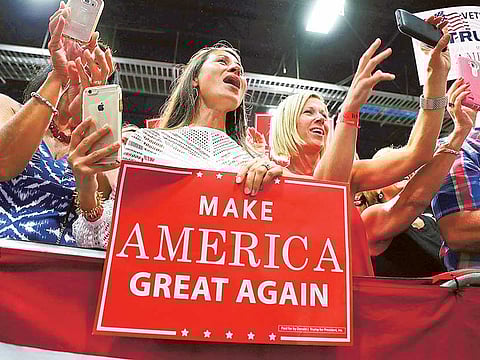
Washington: Donald Trump is leaning heavily on Republican Party organisations to provide crucial campaign functions such as getting out the vote, digital outreach and fund-raising, at a time when some leading Republicans have called for party officials to cut off Trump and focus instead on maintaining control of Congress.
Despite an influx of campaign cash from small donors in July, Trump’s operation still largely resembles the bare-bones outfit that he rode to victory during the primary season, more concert tour than presidential campaign, according to interviews and documents filed with the Federal Election Commission through Saturday night. And some Republicans believe he is effectively out of time to invest in the kind of large-scale infrastructure that the Democratic nominee, Hillary Clinton, will bring to the polls in November.
Trump spends little on polling and made his first advertising purchase of the general election campaign only last week. His rapidly growing digital fund-raising and voter-targeting operation is a partnership with the Republican National Committee, relying significantly on lists built and maintained by the party in recent years.
In July, when Clinton spent almost $3 million to field a staff of 700 people at her Brooklyn headquarters and in swing states around the country, according to Federal Election Commission payroll data, Trump spent more money on renting arenas for his speeches than he did on payroll. A senior Trump campaign official, who asked for anonymity because he was not permitted to discuss staffing publicly, said Trump’s campaign had fewer than 200 total staff members at the end of July, about evenly divided between field offices and New York.
Although he has opened offices in Ohio and Florida in recent weeks, Trump’s field efforts rely primarily on roughly 500 RNC organisers scattered across 11 swing states.
The arrangement is a kind of throwback to the pre-Citizens United era, when party organisations — not independent “super PACs” and political non-profit — assumed many of the financial and organisational burdens of national campaigns.
But it also highlights the bind in which Republican leaders find themselves as Trump’s struggles threaten to undermine the party’s Senate and House candidates in November: As dependent as Trump is on their organisation, the party is now deeply dependent on Trump’s surging base of small donors to finance it.
“There is no moving the turnout operation or the absentee ballot program away from Donald Trump and in some senator’s favour,” Reince Priebus, the RNC chairman, said in an interview Sunday with CBS’s “Face the Nation.” “It doesn’t work that way. There’s no hundred million dollars in a drawer that might not be spent on one person, but in favour of another.”
In contrast with campaign financing in 2012, there is no outside cavalry of deep-pocketed super PACs preparing to buttress Trump’s television and field efforts. Two of the largest outside groups backing Trump began August with less than $4 million combined cash on hand, according to Federal Election Commission filings, half of it from a single donor, the wealthy New York investor Robert Mercer. The primary super PAC backing Clinton, Priorities USA Action, reported $38.6 million in the bank and claimed an additional $44 million in committed funds from wealthy donors.
The Republican-aligned groups with the deepest pockets, the American Crossroads operation cofounded by the Republican strategist Karl Rove and the constellation of political groups overseen by the billionaire industrialists Charles and David Koch, have abandoned the presidential race, choosing to focus their efforts down the ballot. Republican strategists overseeing the party’s most competitive Senate races have begun crafting their own independent turnout plans, mindful that their candidates need to reach middle-of-the-road voters Trump has forsaken.
“They can’t do anything publicly — you can’t rebuke your nominee,” said Liam P. Donovan, a former aide to the National Republican Senatorial Committee. “But you could allocate resources to places where it helps up and down the ballot.”
The difficulty, though, is that as November approaches, the RNC is more reliant on Trump for cash than on other recent nominees. Millions of dollars are coming in through a small-donor-focused committee operated jointly with the RNC, which is splitting a share of the proceeds with Trump. Over half the money raised by the Trump campaign and the RNC combined in July came from donors giving less than $200, far more than for any recent Republican nominee. (That figure does not include additional small donations raised by a joint fund-raising committee that Trump’s campaign treasurer controls, which is not required to file disclosures until October.)
The campaign’s large-dollar fund-raising, also run jointly with the RNC, yielded $16 million in cash in July, but much of it is reserved under law for party accounts dedicated to the Republican convention, legal expenses, and expenditures on offices. Despite being able to collect far more from each of the biggest Republican donors under new campaign finance rules passed in 2014, the committee is well off pace from its July fund-raising in 2012, when Mitt Romney was the party’s nominee.


