Best thing is the sliced bread
A small Missouri town champions its greatest thing that has become a benchmark to measure greatness
US Route 36 stretches for 200 miles across the flat farmland of northern Missouri, connecting Kansas to Illinois. At one end is the Pony Express Bridge in St. Joseph and at the other is the Mark Twain Memorial Bridge in Hannibal.
The route is called “The Way of American Genius” because some of the nation’s best-known innovators, creative minds and a military hero spent parts of their childhood near towns along the route, including Samuel Clemens, a.k.a Mark Twain (Hannibal), Walt Disney (Marceline), Gen. John J. Pershing (Laclede) and James Cash “J. C.” Penney (Hamilton).
For ages, Chillicothe, a town of 9, 500 along the route, felt left out. As far as anyone knew, nothing had been invented there of equal stature.
Then, in 2001, a local journalist, combing through microfilm of old newspapers, stumbled upon a slice of American innovation long overlooked by local residents and state historians. The headline on an old news clipping said: “SLICED BREAD IS MADE HERE.”
It appeared on the front page of the Chillicothe Constitution-Tribune on July 6, 1928, the day before the first machine-sliced bread would be sold to customers. “The Chillicothe Baking Company,” it said, “has installed a power driven multi-bladed bread slicer which performs a feat which heretofore had been considered by bakers as being impossible - namely, the slicing of loaves.”
That bakery, run by Marion “Frank” Bench, was the first in the nation to sell commercially sliced and wrapped bread. Other bakers said it couldn’t be done without the loaves losing their freshness. The bread was first sold the same year that Disney created Mickey Mouse, just months before the Great Depression.
A Chillicothe newspaper ad promoted the breakthrough as “the greatest forward step in the baking industry since bread was wrapped.” Soon others were using the phrase “the greatest thing since sliced bread” to hype inventions that followed and, for that matter, a lot of other things.
Now Chillicothe is hoping for additional recognition - for designating July 7 as “Missouri Sliced Bread Day.”
The bread bill celebrates Chillicothe’s role in food history. But it doesn’t mention that an Iowan, Otto Frederick Rohwedder, created the bread-slicing machine used in Bench’s bakery. Although the invention forever changed the way Americans eat, it did not make Rohwedder famous or wealthy.
The US National Museum of American History also says Chillicothe was where the “first commercial bread slicing was used.” Although the initial machine didn’t survive, Rohwedder’s second machine was donated to the Smithsonian by his relatives and is on loan to the Grand River Historical Society Museum in Chillicothe.
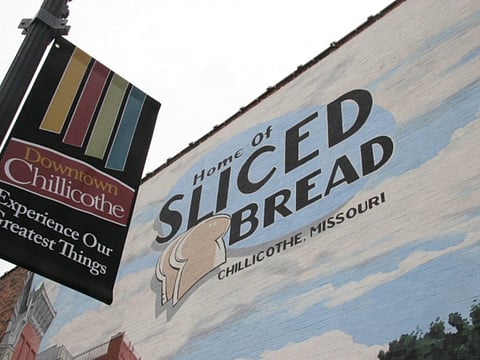
In 2003, the town adopted “Home of Sliced Bread” as its official slogan. It hosts events such as the “Sliced Jam Bluegrass Festival” and, of course, bread baking contests. Plans are in the works to turn the bakery’s original building on the corner of First and Elm streets into a visitors center highlighting the town’s claim to fame.
The national attention that sliced bread has brought the town - including appearing as a clue on “Jeopardy!” - has been helpful to the struggling rural economy because of the tourism it brings. Now, residents are hoping the legislature will also give them a boost by adopting a Missouri Sliced Bread Day.
BOX
The man who invented sliced bread
Otto Frederick Rohwedder didn’t set out to become an inventor. He earned a degree in optics in 1900 from the Northern Illinois College of Ophthalmology and Otology in Chicago. Then he moved to Missouri, where he eventually operated three jewellery stores in St. Joseph, about 70 miles west of Chillicothe.
On the side, he tinkered with a design for a mechanised bread slicer. In 1916, he sold his jewellery business and moved back to his home town of Davenport, Iowa, to focus his energy on the slicer and recuperate from an illness.
Rohwedder wasn’t the first to attempt making an automated bread slicer, according to the Atlantic: “While the earlier bread-cutting devices using parallel blades appear in America in the 1860s, they sat on the shelf for decades, awaiting the introduction of other machines capable of producing loaves of uniform shape, size and consistency.”
In 1917, Rohwedder’s prototype, including the blueprints, were destroyed in a fire at an Illinois factory. It would take nearly a decade for him to secure the funds needed to begin manufacturing again.
“It was a real story of determination,” said Ed Douglas, president of Chillicothe’s Slice Bread Corporation.
As he improved his invention, Rohwedder sought feedback from homemakers to determine how thick to cut the slices (half an inch). He also had to find a way to ensure the bread would stay fresh once it was sliced. First, he inserted large U-shaped pins at both ends of the bread to keep the pieces from separating. Then he created a process so that the bread was quickly sealed in a bag after being sliced.
Many bakers initially opposed factory-sliced bread. But Rohwedder’s baker friend in Chillicothe signed on. After a few years in business, Frank Bench had fallen on hard times and seemingly had nothing to lose, Douglas said.
The patent for the automated slicer explained how it worked, according to the Smithsonian: “The machine moved the bread into the slicer and then a series of ‘endless cutting bands’ sliced the loaf before moving it along to where it could easily be packaged by a specially designed bread wrapping machine - another patent of Rohwedder’s.”
The product was a hit. Customers appreciated the convenience and ability to make uniform sandwiches.
By 1933, the uniform-sized bread also created a demand for pop-up toasters, which had struggled to find a market until Rohwedder’s invention.
The Washington Post.


