Orange-lipped monkey confirmed as new species in Congo rainforest
Rare primate is only the fifth African monkey species identified in 75 years
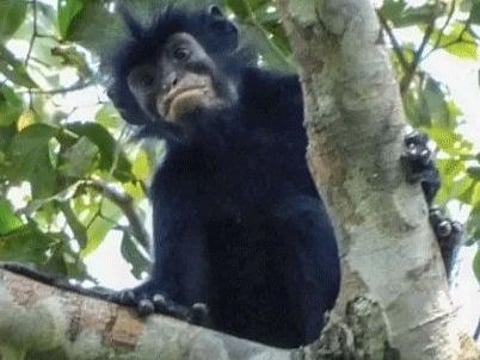
A black-furred monkey with striking orange-pink lips that has remained hidden for years in the rainforests of the Democratic Republic of Congo (DRC) has been confirmed as a new species, marking one of Africa’s most significant primate discoveries in decades.
The monkey, officially named Colobus congoensis, was first photographed in 2008 high in the canopy of Lomami National Park in eastern DRC. The image was too blurred for scientists to determine whether it belonged to a known species, and the mystery remained unsolved until another sighting a decade later prompted a dedicated search.
An international team of researchers from the DRC, the United States and Germany spent several years studying the elusive primate through field observations, photography, sound recordings and genetic analysis before confirming it as a distinct species. Their findings have been published in the journal PLOS One.
The discovery makes Colobus congoensis only the fifth new species of African monkey to be formally identified in the past 75 years.
At a glance
Species: Colobus congoensis
Common name: Likweli
Found in: Lomami National Park, Democratic Republic of Congo
Distinctive features: Black fur, orange-pink lips, mask-like face and deep roaring calls
First spotted: 2008, but confirmed as a new species after further studies
Why it matters: Only the fifth new African monkey species identified in 75 years
Conservation concern: Scientists want it assessed for the IUCN Red List because of its small range and habitat pressures
Easily recognised
Known locally as Likweli, the monkey is easily recognised by its glossy black coat, vivid orange-cream lips and long facial hair that gives it a mask-like appearance. Researchers say it also produces a deep, roaring call that often reveals its presence long before it is seen high in the forest canopy.
Junior Amboko, a PhD student at Florida Atlantic University who helped lead the research, told the BBC that encountering such a little-known animal was “an amazing feeling”. He said the monkeys were extremely shy and usually remained hidden high in the trees.
“As part of our search, we interviewed people in 52 villages close to where the animals live. And only people in eight villages had ever seen them,” he said.
Researchers note that while local communities had long known of the animal and referred to it as Likweli, formally identifying it as a separate species required scientific evidence showing it was genetically distinct from other monkeys.
Leaf-eating primate
The newly identified monkey belongs to the colobus family, a group of leaf-eating African primates that lack thumbs and play an important role in maintaining forest ecosystems by dispersing seeds. Genetic analysis showed the species diverged from its closest known relative, the black colobus monkey, between four and five million years ago.
Researchers believe the species has a limited distribution. Between 2018 and 2022, they recorded 114 sightings across an estimated range of about 1,700 square kilometres in the Lomami region.
Although local communities do not appear to target the monkey specifically, scientists say habitat loss and the species’ small range make it vulnerable. They have proposed that Colobus congoensis be assessed for inclusion on the International Union for Conservation of Nature (IUCN) Red List of Threatened Species to help secure protection.
Researchers plan further surveys to estimate the monkey’s population and better understand its behaviour, hoping the discovery will also draw attention to the rich but still poorly understood biodiversity of the Congo Basin.


