'We escaped by hours': Indian expats in Dubai recount anxious escape after Nepal flash floods disrupt Kailash return
Driver, who dropped one group, was swept away, the pilgrims got to know on their return
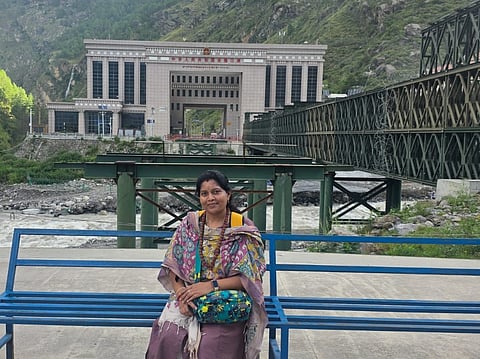
Dubai: Dubai-based Indian expats returning from the Mount Kailash pilgrimage have described the anxiety and uncertainty that followed the recent deadly floods and landslides in Nepal.
The pilgrims, who spoke to Gulf News, were travelling in different groups and had different experiences, but their accounts share one striking detail: they had passed through the affected border region shortly before the disaster struck.
A close call
Mohana Sowjanya, a homemaker in Dubai, said her group began its journey on August 17, travelling through Nepal's Rasuwa district and staying overnight in Timure before crossing into Tibet.
The border area they had passed through, including the immigration building, was devastated in just 20 hours' difference and a large part of Timure now is flattened and resembles a desert, after devastating flash floods swept through the area on August 26, killing more than 1,000 and leaving several people missing.
Get updated faster and for FREE: Download the Gulf News app now - simply click here.
"We are so, so lucky that we weren't there on the same day. It was all divine grace," said Mohana.
Her group completed the three-day Kailash pilgrimage on August 26 and was due to return through the same border crossing the following day.
"Literally, within those 20 hours, all our lives were saved," Mohana said.
Trapped by landslides
The disaster left the group unable to follow its original return plan. Roads were blocked by landslides, and the pilgrims were stranded in Saga while tour operators and authorities assessed possible routes out. Options including flying from Lhasa or using chartered helicopters were considered, but were either too expensive, impractical or affected by bad weather.
Chinese authorities eventually opened an emergency route normally used by the military, allowing the pilgrims to travel towards Nyalam. The journey was slow and uncertain, with repeated landslides and long delays.
At one point, vehicles could no longer proceed and the travellers had to leave the road and descend a hillside on foot with their luggage. They hired local people to help carry their bags and negotiate the difficult terrain.
"We were stranded on the road for a long time. Then, at one point, there were landslides, so we couldn't go by vehicle. We took our luggage and descended the hill path," she said.
The group eventually crossed the border and reached Kathmandu around 9.30pm on August 28, before travelling onwards to India the following day.
Hearts melted
The experience became even more distressing as the pilgrims learned the scale of the destruction in places they had passed through only days earlier.
"This catastrophic news made us so sad. Our hearts were melted because so many local people suffered and so many NRIs were also missing," Mohana said.
"The bus journey was also quite an adventure. On one side were the mountains, and on the other was a deep valley along the Trishuli River. The Nepali drivers are very skilled, but even then, sitting next to the window in those conditions was nerve-racking. We were literally holding our hearts in our hands at some points."
She said there were moments of panic within the group, but the pilgrims supported one another through the uncertainty.
"Somehow we motivated each other, kept our hope high, and somehow we made it."
Four Dubai residents travelled together in Mohana's group including one of her friends, that friend's husband and brother. She said the group's support helped her cope with the ordeal while travelling without her own family.
"I can't even imagine that had our return be 20 hours before, we would have been in that tragic situation. That is what made us feel very lucky. It's all a miracle. In each step of our return, I felt the divine blessing. My heart is still heavy. I just pray for the people who are affected and their families."
Trekking through mud
Another Dubai resident, Ena Banerji, was travelling with a larger 58-member group that included pilgrims from Dubai, India, Canada and Thailand.
The journey was especially meaningful for Ena, a former educator who recently retired as the head of upper primary at a Dubai school. "It was my retirement gift to myself. I travelled with my school friends from India, whom I have known for 60 years since our school days in Darjeeling, where we were known as the 'Famous Five.'"
She recalled travelling through slushy roads during one stretch of the trip. "As we got closer to Timure, the road conditions became so bad that the jeeps could no longer continue. We had to get out and walk for about 1.5 kilometres through ankle-deep mud and slush, carrying our backpacks. Some of us were still wearing slippers rather than trekking gear, and our footwear kept getting stuck in the mud. It was a difficult and exhausting walk."
Her group had also crossed the Kerung border before the floods and was already near Kailash and Lake Mansarovar when they heard the news.
But the disaster affected the group's journey home. Their return route was also thrown into uncertainty as authorities assessed the damage. The group spent an additional day in Saga and eventually used the alternative route towards Nepal approved by the Chinese authorities.
Driver swept away
For Ena, the emotional impact went beyond the disruption to their travel plans. Her group had stopped at a restaurant in Timure on their way to Kailash.
Shocking news awaited them on the way back. When they returned, the restaurant was totally flattened out. And when they asked about their driver who drove them from Kathmandu to Timure, they were told that he had been swept away in the disaster along with his vehicle.
“His name was Dev. He was no more. He was washed away. And we heard that the lady at the restaurant was also washed away. It was really shocking to us," Banerji said.
The news was particularly difficult for the pilgrims because Dev had driven them to the border only days earlier and had stayed behind to transport other pilgrims.
"We were really shocked," Banerji recalled, describing the moment they saw the destruction of the immigration building and surrounding area.
Word of caution
Both Mohana and Ena shared a word of caution for those planning Kailash pilgrimage.
"I would advise future pilgrims to avoid undertaking this kind of pilgrimage during the monsoon season. While we cannot prevent natural disasters, the risks and challenges are higher during the monsoon. Therefore, I feel it is better to make the journey before June," said Mohana.
"Actually, our trip was originally planned for July 22 to August 6. We had planned to be there during Gurupurnima, but we did not get the visa and permits in time, so the trip was postponed," she added.
Meanwhile, Ena advised prospective Kailash pilgrims not to be influenced solely by social media influencers, reels or YouTube videos, but to assess their own physical readiness. She recommended undertaking the pilgrimage before the age of 60, noting that the high-altitude journey can be extremely demanding, particularly for older travellers like her as she had struggled with her oxygen level going below 70.
Inner strength
Another Dubai resident, Kanchana Daswani, who was on her fourth Kailash pilgrimage as part of the wider group travelling with Ena, said the journey itself comes with challenges and uncertainties, but the experience this time strengthened her ability to adapt.
"We understand that this terrain has its own challenges and uncertainties. But it gave us a lot more inner strength and acceptance of change, and of the fact that nature has its own laws. We crossed through a border point recommended by the government as a safe route. There was also significant security and police protection in the area and hence we felt safe," Kanchana said.


