Indian passport services in UAE hit by legal hurdles: Real story behind delay in Alhind's takeover from BLS
Here's why Indian expats are told to visit Embassy and Consulate for consular services
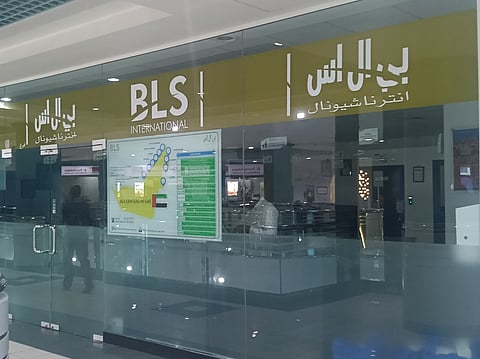
Abu Dhabi: The latest announcement requiring Indian expats in the UAE to walk into the premises of their embassy and consulate without appointments for passport and attestation services from today, July 2, was not a routine administrative reshuffle, Gulf News has learnt.
It was late on Wednesday evening that the Indian Embassy in Abu Dhabi announced new consular service rules for Indian expats in the UAE.
The mission said, due to administrative reasons, both the Embassy and the Indian Consulate in Dubai will start providing consular services — covering passport, visa, attestation and miscellaneous services — in a limited manner from their own premises from Thursday.
Gulf News can reveal that the decision in fact traces back to a legal battle playing out in Delhi, where a tender dispute has hit the handover of Indian Ministry of External Affairs’ overseas consular outsourcing contracts in multiple countries.
What was the planned handover?
In the UAE, home to 4.5 million Indian expats, the outsourcing deals held by BLS International, which provided Indian passport services, and SGIVS Global Services, which provided attestation services, expired on June 30, 2026.
Under the latest tender floated by the Indian Embassy in Abu Dhabi, which followed a series of annulled tenders, Alhind Tours and Travel LLC was picked as the new single service provider through the Indian Consular Application Centres (ICACs) and was due to take charge from July 1.
It was meant to be a clean switch, with no gap in consular services for the 4.5million Indian expats in the UAE and visa services for several foreigners flying to India from the UAE.
What went wrong in between?
That plan had run straight into litigation before the Delhi High Court, with related proceedings also reaching the Supreme Court.
Two firms, E Trav Tech and Verasys, had contested how the Indian Embassy in Abu Dhabi evaluated technical qualification criteria under the terms of the Request for Proposal (RFP) floated for the UAE contract.
What did the petitioners seek?
The companies wanted a detailed breakup of marks awarded during the technical evaluation, along with the reasoning behind their disqualification, saying this had never been communicated to them.
They initially objected to the tender terms themselves but later narrowed their case to just these two demands.
What did the court observe?
The Delhi High Court broadly backed the government's discretion in tender evaluation and turned down the demand for a detailed score breakup at that stage.
However, it agreed that disqualified bidders are entitled to reasons for their rejection.
It also noted that while the RFP requires this disclosure, it sets no deadline for when it must be shared.
How did the case reach Supreme Court?
Unhappy with that outcome, E Trav Tech took the fight to the Supreme Court.
On June 24, the apex court declined to rule on the merits but ordered status quo, directing that neither side alter the existing position while the dispute remained unresolved.
It also asked the Delhi High Court to hear the matter urgently once again.
What happened in High Court later?
The case has moved in stages. After the Supreme Court's order calling for urgent consideration, the Delhi High Court took up the matter on June 29.
It decided to club all the connected petitions together, listing them for priority hearing on July 1.
That sitting was then adjourned and pushed to July 2.
As things stand, no ruling on interim relief has been made, and the case has not been decided on merits.
Who got stuck in the middle?
With the old contracts gone, BLS and SGIVS have shut their doors to the applicants.
However, with Alhind unable to formally step in while the status quo order holds, the Indian missions in the UAE have found themselves without an outsourced partner for the time being.
The missions have cited “administrative reasons” for the walk-in arrangement in place from July 2.
The case that triggered this entire chain of events was itself born out of an administrative call made by the Embassy after the technical bid evaluation in the tender, which is what E Trav Tech and Verasys challenged in the first place.
In effect, an administrative decision on how bids were scored and communicated has now produced a disruption to services on the ground.
The missions here handle a substantial volume of consular work, having processed over 1.58 million services and transactions between January 2022 and December 2024, equivalent to roughly 1,760 transactions every working day, including more than 364,000 passport-related services in 2024 alone.
What is the stopgap in the UAE?
As announced on Wednesday, the Embassy in Abu Dhabi and the Consulate in Dubai are running passport, visa, attestation and other consular services directly from their own premises from Thursday, July 2.
This is strictly on a walk-in, first-come-first-served basis between 9am and 12.30pm.
Applicants must bring completed forms and full documentation. Only the applicant is allowed inside, barring parents accompanying minors. Fees are accepted in cash only, at the revised rates that took effect from July 1.
What happened today?
The missions have described the in-house arrangement as temporary and said that further updates regarding the migration to the new service provider, Alhind Tours and Travel LLC, will be communicated in due course.
That will happen once clarity emerges from Delhi and it is not clear when exactly it will happen.
According to advocates Nakul Sachdeva and Shreyansh Rathi from Luthra and Luthra Law Offices India, which represents E Trav Tech, the matter was subsequently heard by the Delhi High Court during court hours on Thursday, and the court reserved its judgment.
"The matter is still sub judice and the judgment is reserved. We are thankful to the High Court for a patient hearing and will await the judgment of the court," advocate Shreyansh told Gulf News on Thursday afternoon.
Since the judgement day was not announced, the legal battle is continuing.
Until the High Court rules on interim relief, and possibly the underlying merits, Alhind's takeover of the UAE's Indian Consular Application Centres remains on hold, leaving embassy and consulate staff to fill the gap.
Meanwhile, BLS and SGIVS are standing by, without making any changes to their offices and employees, keeping their facilities intact in case the outcome in Delhi opens the door for them to continue since the Supreme Court had ordered that status quo should be maintained while they were still providing the services.


