Dubai’s Shindagha Tunnel turns 50: A milestone in urban connectivity and engineering
The Shindagha Tunnel was officially inaugurated on December 19, 1975
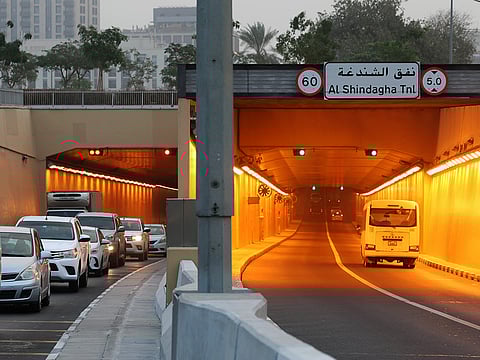
Dubai: On December 19, 1975, Dubai marked a defining moment in its infrastructure journey with the opening of the Shindagha Tunnel — the emirate’s first fixed underwater road crossing beneath Dubai Creek. Fifty years on, the tunnel stands as a lasting symbol of Dubai’s early ambition to modernise connectivity and support rapid urban growth.
Before the tunnel’s construction, movement across Dubai Creek relied largely on abras (boats) linking Deira and Bur Dubai. As the city expanded following the formation of the United Arab Emirates in 1971, traffic became increasingly common. Recognising the need for a more reliable crossing that would not disrupt maritime traffic, the late Sheikh Rashid bin Saeed Al Maktoum commissioned a feasibility study to explore long-term solutions.
British engineering firm Sir William Halcrow & Partners recommended an underwater tunnel as the most efficient option. Construction began in the early 1970s using an in-situ dry method — a complex process that involved creating a watertight excavation beneath the creek bed. The tunnel’s submerged section stretches about 550 metres, with ramp approaches on either side, and was designed to carry four traffic lanes, two in each direction, with a clearance height of around five metres and a speed limit of 60 km/h.
Over the following decades, the tunnel became a vital artery in Dubai’s road network, handling tens of thousands of vehicles daily as the emirate evolved into a global city. Regular maintenance, particularly during the late 1980s, addressed early concrete deterioration caused by saline conditions, extending the tunnel’s lifespan well beyond its original design expectations.
By the early 2020s, daily traffic volumes had exceeded 55,000 vehicles, prompting the Roads and Transport Authority (RTA) to integrate the tunnel into the wider Shindagha Corridor Improvement Project. On March 13, 2022, the tunnel reopened for traffic from Deira to Bur Dubai following the completion of linking works with new bridges, while the Bur Dubai–to–Deira direction remained operational throughout.
A key addition to the corridor is the Infinity Bridge, a landmark structure crowned by an iconic infinity-shaped arch rising 42 metres above the deck. Spanning 295 metres, the bridge carries 12 traffic lanes and a three-metre-wide cycling track, with a capacity of 24,000 vehicles per hour in both directions. Its 75-metre-wide navigation channel ensures uninterrupted marine traffic along Dubai Creek.
Alongside the bridge, the RTA has completed major intersection upgrades across the corridor, significantly improving traffic flow and connectivity.
Half a century after its opening, the Shindagha Tunnel remains more than a transport link. It is a living piece of Dubai’s engineering heritage — a reminder that visionary infrastructure laid the foundation for the city’s extraordinary transformation.


