Masdar City: A living blueprint for Net-Zero urban innovation in Abu Dhabi
Masdar City: Pioneering sustainable urban living in Abu Dhabi
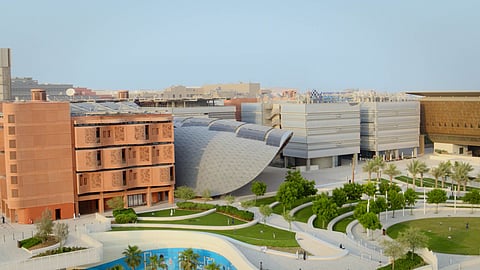
Abu Dhabi: In Abu Dhabi stands a city that treats the future as a challenge it intends to meet. Masdar City is where the UAE's net-zero ambition becomes real streets, buildings and neighbourhoods that people can live, work and learn in today.
Rooted in the vision of the late His Highness Sheikh Zayed bin Sultan Al Nahyan, the UAE's founding father, and guided today by President His Highness Sheikh Mohamed bin Zayed Al Nahyan's focus on sustainability and innovation, the city has grown into a thriving district of offices, labs, homes and start-ups.
Its founding belief is simple: technology matters, but sustainability begins with design.
Designing with the climate, not against it
Masdar City is built on the principle of passive design, an approach that works with the local climate to cut energy and water use before any technology is switched on.
The downtown core sits on a seven-metre podium and is oriented to catch prevailing winds, so it feels around ten degrees cooler than downtown Abu Dhabi. Windows are angled and shaded to keep out harsh sun while still letting in daylight. Airtight envelopes and heavy insulation do the rest, sharply reducing the need for air conditioning.
The same thinking extends to what the city is made of. Benches and street structures use low-carbon concrete. Much of the aluminium in sheeting, windows and door frames is recycled, with roughly one-eighth the carbon footprint of virgin aluminium. Timber is certified as sustainably sourced, and reinforcing steel is made from recycled scrap. An on-site facility reuses and recycles steel, concrete and timber, keeping construction waste out of landfill.
Over 11 megawatts of solar panels are installed across the city, so renewable power is part of the fabric rather than an add-on.
The Masdar story
The name Masdar carries weight far beyond Abu Dhabi. In 2006 the UAE government established Abu Dhabi Future Energy Company, known as Masdar, to build on the country's expertise and leadership in global energy while diversifying its economy and energy sources for future generations. Under Dr Sultan Ahmed Al Jaber, its founding CEO and now chairman, Masdar has taken a growing role in renewable energy, climate action and sustainability, at home and abroad.
The company has a record of firsts. It inaugurated Shams 1, the first concentrated solar plant in the Middle East, and developed the London Array, one of the world's largest offshore wind farms. Its platforms carry the conversation further: the annual Abu Dhabi Sustainability Week, and the Zayed Sustainability Prize, whose 96 winners have already improved life for more than 370 million people around the world.
A new chapter began in December 2021, when TAQA and ADNOC were announced as shareholders alongside Mubadala.
The partnership combined the renewable energy experience of TAQA, Mubadala and Masdar with ADNOC's strengths in hydrogen, infrastructure, global trading and logistics. The new structure took effect in December 2022, creating a clean energy powerhouse set to spearhead the UAE's Net Zero by 2050 initiative and strengthen the country's role in the green hydrogen economy.
Today Masdar is a global clean energy leader, with work spanning utility-scale and distributed solar, onshore and offshore wind, geothermal energy, energy storage, green hydrogen and new clean-energy technologies. Its projects and partnerships add up to a portfolio capacity above 65 gigawatts across more than 20 countries, and it is pursuing a target of 100 gigawatts of renewable capacity by 2030. To get there, the company plans to deploy roughly USD 30–35 billion in equity and project finance.
From pioneering idea to working community
Masdar City is a subsidiary of Mubadala Investment Company, and it sits at the centre of the UAE's push toward net zero. In 2021 the country became the first in the MENA region to commit to net zero by 2050, and Masdar City positions itself as a living test bed for how that goal can be met in the built environment: lower energy and water demand, more renewables, and offsets for what remains.
The city's 2024 ESG report puts numbers on the progress. Energy use fell by 31 percent, and 98.3 percent of construction waste was diverted from landfill. Emiratization stood at 54.7 percent, women made up 31 percent of the workforce, and more than 300 community events and activations brought residents and businesses together. Innovative companies and women-led businesses arrived across AI, life sciences, energy, space-tech, agri-tech and mobility.
Buildings that make more than they use
The most striking part of the story is still being written. Masdar City Square, a cluster of seven commercial buildings with 50,000 square metres of floor area, is designed around community and common purpose. All seven are on track for LEED Platinum, WELL Gold and Estidama 4 Pearl ratings.
Its centrepiece is the corporate headquarters, which would be the first net-zero energy building of its kind in Abu Dhabi. A canopy of 1,033 solar panels, tilted at 22 degrees and facing south, shades the building while generating power. The design cuts energy use by 102 percent against international baselines and produces 109 percent of its annual needs. It is on track for Zero Energy certification from the International Living Future Institute.
Nearby, The Link, a cluster of five commercial and residential buildings totalling 30,000 square metres, adds to the mix of workplaces and homes. Both projects were listed with a 2025 target completion on the city's project pages, so check Masdar City for their current status.
Moving differently
Transport accounts for about 15 percent of global carbon emissions, and Masdar City has long used its streets to experiment. It has pioneered two generations of new mobility systems, with a third on the way, built on the belief that future transport will be shared, electric and autonomous.
The city also hosts the Smart and Autonomous Vehicle Industries (SAVI) cluster, which aims to shape smart mobility across air, land and sea.
A place for ideas
Beyond buildings, Masdar City wants to be an engine for climate innovation. Its partnership in the Innovate for Climate Tech platform, alongside Tencent and Catalyst and supported by COP28, links startups, investors and corporates, with a focus on bringing the Global South into the climate-tech conversation. Companies of every size, from startups to multinationals, work here on practical solutions.


