Advancing military medicine: Global congress in Abu Dhabi explores AI integration and national readiness
UAE leads the way in AI-driven medical advancements for national preparedness
Abu Dhabi: Faster diagnosis and quicker decisions are the promise of artificial intelligence in medicine, but for the UAE’s military doctors the starting point is still the human being. As the 46th World Congress of Military Medicine opened in Abu Dhabi, Ministry of Defence officials said success of the congress will be measured not only by crowds, but by the recommendations, partnerships and readiness that outlast the five days.
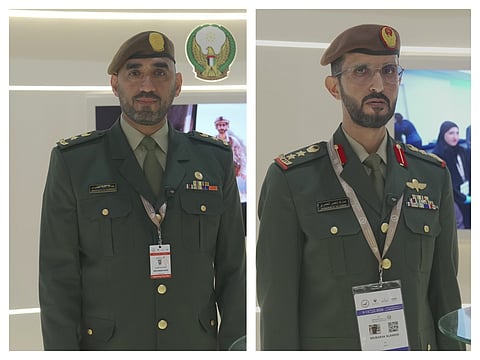
“The reliance here is on the human element and how to train and develop it to reach the desired goals,” Staff Colonel Dr. Mubarak Nasser Al Ameri, official spokesperson for the Ministry of Defence, told Gulf News at the exhibition.
Military medicine in the UAE develops as its personnel develop, he said, through planning, training and qualification, including drills for both expected and unexpected scenarios.
Faster decisions, better diagnosis
Al Ameri said the UAE is a leader in AI and that medical staff are now being equipped with it through modern data and the skills to use it. “Today, the human cadre has been developed and equipped with AI,” he said, helping them make decisions “faster and more accurately”.
In military medicine, he said, that means “faster treatment and better diagnosis”, and ultimately the goal of “treating people and caring for people”.
Speakers from Mohamed bin Zayed University of Artificial Intelligence are giving lectures at the congress on integrating AI and digital transformation into military medicine.
Why it matters now
With conflicts growing more complex, the congress is built around the theme of anticipating the future, Al Ameri said, and that starts with the past. “Forecasting the future today comes through the lessons of the past,” he said, explaining that experts and attendees study the dilemmas countries have faced and work on smart solutions.
Lieutenant Colonel Dr. Abdullah Al Hamoodi, also an official spokesperson for the Ministry of Defence, said the pace of change in warfare leaves no choice. “Technologies develop alongside the weapons being used,” he told Gulf News, adding that the congress is focused on AI and modern technologies for delivering care and protection “from the field all the way to the hospital”.
Al Hamoodi said the workshops held before the opening reflect that reality. They covered chemical, biological, radiological and nuclear injuries, mass-casualty incidents, battlefield pain management with X-ray and ultrasound, and severe bleeding and burn injuries.
“A person, doctor, or medical staff member needs to be able to deal with injuries outside the hospital,” he said, pointing to burns, accidents and what he called unconventional injuries from chemical and radiological materials.
Civilian and military medics
Both officials stressed that the effort does not stop at the barracks. Al Hamoodi said readiness is needed “not only of military personnel but also of our colleagues in the civilian cadre, because their readiness is part of national readiness”.
Al Ameri said civilian medical staff take part in joint exercises and joint medical readiness at UAE level, and that the congress is discussing how to integrate military and civilian medicine “in order to better advance and treat people”.
“Military medicine is an integral part of national readiness,” Al Hamoodi said, adding that sharing experience, knowledge and the latest technologies “will make us ready and resilient”.
What success looks like
Asked how the congress should be judged, Al Ameri pointed first to engagement. The event, he said, “has proven its success in this period through the attendance we see, through the interest shown, through the recommendations and lectures, and through workshops presented for the first time at this Congress”.
He said the congress has drawn more than 120 countries and over 2,000 participants to its lectures, with more than 60 exhibition platforms on show. “I tour them every day and discover something new,” he said. The programme features more than 300 speakers and more than 700 medical abstracts.
Al Ameri said the lasting measure lies in what other countries take from it. “We hope that in future conferences in other countries, they will build on what we gained from hosting the conference in the UAE,” he said, citing qualified national cadres, strategic partners and the UAE’s experience in AI and digital transformation. Discussions are expected to produce recommendations through the General Assembly of Military Medicine at the close of the event, which runs until November 13.
Al Hamoodi put the numbers first. Visitors had exceeded 12,000 by the latest count, along with a large turnout of participants and research papers. “The numbers are very large, honestly beyond expectations,” he said.
He said the UAE’s position as a global hub made it easier to bring together East and West, and so easier to share knowledge.
A humanitarian message
For Al Ameri, the purpose goes beyond logistics. Asked what message the UAE wants to send, he called it “purely humanitarian”, describing military medicine as “a necessity for advancing humanity” and for preserving lives.
The UAE, he said, has a long record of supporting countries affected by disasters and crises, and sees itself as “a partner to the world” in that work.


