Indian startup patents rare-earth-free electric motor for EVs, challenging China’s supply chain dominance
$5M Bengaluru team patents EV motor that needs zero expensive magnets
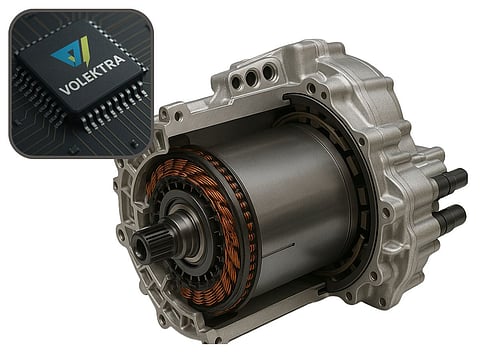
A Bengaluru-based startup has secured an Indian patent for a software-defined electric motor that eliminates the need for rare-earth permanent magnets.
The technology builds on existing synchronous motor principles but innovates in “excitation” and control to maintain a brushless, slip-ring-free design.
Get — updated faster and for FREE: Download the Gulf News app now - simply click here
Vimag Labs’ Virtual Magnet Synchronous Motor (VMSM) uses power electronics and proprietary control algorithms to generate and manage magnetic fields in real time, replacing traditional permanent magnets embedded in the rotor.
The result: a motor that replaces rare-earth permanent magnets in the rotor with real-time, software-controlled magnetic fields generated via power electronics and control algorithms.
Vimag Labs' fifth patent in India for “A Robust Rotating Transformer Excited Synchronous Motor and Its Control,” covers the core architecture of its proprietary Virtual Magnet Synchronous Motor (VMSM) platform.
Vimag Labs now holds 5 𝐠𝐫𝐚𝐧𝐭𝐞𝐝 𝐩𝐚𝐭𝐞𝐧𝐭𝐬, supported by 10 𝐩𝐚𝐭𝐞𝐧𝐭 𝐚𝐩𝐩𝐥𝐢𝐜𝐚𝐭𝐢𝐨𝐧𝐬 and 15 𝐭𝐫𝐚𝐝𝐞𝐦𝐚𝐫𝐤𝐬 spanning motor design, software controls, and power electronics.
Groundbreaking move
It's a groundbreaking move towards electrification.
Vimag Labs developed the patented VMSM architecture, and the company operates under the Volektra brand to commercialise its magnet-free electric motor technology globally.
Last year, Volektra Inc. entered into a strategic Memorandum of Understanding (MoU) with Jendamark India Pvt. Ltd. , a global leader in advanced manufacturing and automation solutions.
This collaboration designates Jendamark as the partner for industrialising and deploying production lines based on Volektra's patented Virtual Magnet Motor (VMM) platform.
This breakthrough could revolutionise EV manufacturing, reducing the industry’s heavy reliance on China-controlled supply chains.
Rare-earth magnets (typically neodymium-based) must be precisely cut, magnetised, inserted into rotor laminations (often in buried “spoke” or surface-mounted configurations), and secured against high centrifugal forces at high rotations per minute (RPMs).
This involves specialised adhesives, retainers, or “sleeves”.
Disruption
This shift could disrupt rotor manufacturing.
The company claims the design matches the performance of conventional permanent magnet synchronous motors while potentially reducing battery consumption and enabling over-the-air software upgrades.
Founded in 2025 by automotive veteran Manish Seth, the five-person startup has raised about $5 million in Series A funding led by Accel, with participation from Chakra Growth Fund and Thinkuvate.
It is conducting pilot tests with Indian two- and three-wheeler makers, a passenger vehicle manufacturer, and a European firm, with plans for limited production later this year.
Motor India reported that Vimag Labs has secured its fifth patent in India for “A Robust Rotating Transformer Excited Synchronous Motor and Its Control,” covering the core architecture of its proprietary Virtual Magnet Synchronous Motor (VMSM) platform.
In 2025, Volektra Inc. entered into a strategic Memorandum of Understanding (MoU) with Jendamark India Pvt. Ltd. , a leader in advanced manufacturing and automation solutions. It designates Jendamark as the partner for industrialising and deploying production lines based on Volektra's patented Virtual Magnet Motor (VMM) platform. It sets the foundation for a scalable and efficient manufacturing model that supports the global adoption of Volektra's rare-earth-free motors designed for micro-mobility and electric vehicle applications.
Invention
Rare-earth magnets, essential for high-performance EV motors, are currently dominated by China, which controls roughly 90% of global processing and has used export restrictions as leverage.
This creates supply vulnerabilities, price volatility, and geopolitical risks for automakers worldwide.
Vimag’s approach: a potential “software-defined” alternative.
In a nutshell, it works by simulating magnet performance through electronics and algorithms rather than physical rare-earth materials.
If proven to work reliably, it could revolutionise EV motors, lower costs, enhance supply chain resilience, and support India’s push for self-reliance in EVs.
If scaled, it could address a long-standing industry challenge that major players like Tesla and GM have pursued without full commercial success at this level.
'Promising'
The technology is promising, according to IEEE Spectrum.
However, they emphasise that real-world validation at scale — efficiency, durability, cost-competitiveness, and thermal management under mass production — will determine impact.
Success could accelerate affordable electrification in price-sensitive markets like India while offering an exportable solution.
How VMSM could revolutionise rotor production
By eliminating permanent magnets entirely, Vimag’s design shifts the rotor toward a more conventional synchronous or wound-field-like architecture (likely using ferromagnetic materials, copper windings or excitation systems, and a robust core), with the “virtual magnet” effect handled externally through electronics and software.
Potentially, it could lead to simplified structure and fewer parts.
Rotors become primarily laminated steel cores with possible excitation windings or salient poles, without embedded magnets.
This reduces assembly steps: no magnet insertion, gluing, balancing for magnet placement, or specialised retainers.
Manufacturing resembles established induction motor or wound-rotor processes, which are already mature and scalable.
While VMSM cuts direct material costs and exposure to price swings, it could also lead to easier and faster assembly, reduced risk of defects during handling, faster production lines and lowers scrap rates.
Automation becomes simpler without dealing with strong magnetic forces that can interfere with robotic assembly.
It could also lower material costs and easier sourcing: reliance shifts to abundant steel, copper, and standard electrical steels instead of rare-earth alloys.
Improved thermal, mechanical flexibility
Without demagnetisation risks, designers can optimise for higher operating temperatures or simpler cooling systems.
Rotors may also be lighter or more compact in some configurations, improving overall power density and manufacturing tolerances.
Perhaps the biggest upside: It could also enhance scalability and supply chain resilience — localised production in India or elsewhere becomes viable without rare-earth dependencies, supporting rapid scaling for India’s EV market (two- and three-wheelers especially) and exports.
This could also make end-of-life rotors easier to recycle using standard scrap processes, with no hazardous rare-earth separation needed. This aligns with circular economy goals and regulatory pressures.
Software-driven iteration
Performance tuning (torque, efficiency, field weakening) moves largely to algorithms and over-the-air (OTA) updates rather than hardware redesigns. This accelerates development cycles and allows rotor variants without full retooling.
Currently, around 90% of the world's processed rare earth elements come from China, making the EV industry highly vulnerable to supply chain disruptions as demand for rare earth materials grows.
Reducing dependence on China
To reduce this dependence, governments, universities, national laboratories, and automakers worldwide are developing electric vehicle (EV) motors that use little or no rare earth elements.
In the United States, organisations such as Oak Ridge National Laboratory, the US Department of Energy, General Motors, Stellantis, Tesla, and Niron Magnetics are leading these efforts.
Similar initiatives are also underway in Europe through collaborations like the Passenger consortium.
Two approaches
Researchers are exploring two main approaches: developing rare earth–free permanent magnets and designing motors that eliminate permanent magnets altogether.
While replacing rare earth magnets currently reduces motor performance, advances in materials, manufacturing, and motor design are narrowing this gap.
Recent experimental motors have demonstrated performance comparable to today's high-performance permanent-magnet synchronous motors, suggesting that rare earth–free EV motors may soon become a practical alternative.
Vimag’s approach could shift rotor manufacturing mirring a broader industry trends toward “software-defined” vehicles and could lower barriers to entry, reduce costs in the motor assembly, and enable faster global EV adoption — particularly benefiting cost-sensitive markets.
Success at scale would represent a significant step toward “decoupling” advanced manufacturing from critical mineral vulnerabilities.
Major automakers
Several major automakers, suppliers, and startups are actively developing or producing EV motors that eliminate or significantly reduce reliance on rare earth elements (like neodymium and dysprosium), which are used in traditional permanent magnet synchronous motors (PMSMs).
Here's what we know about this push, driven by supply chain risks, cost volatility, and sustainability goals, and the following companies:
BMW: One of the leaders. Uses externally excited synchronous motors (EESM) without rare earth permanent magnets in models like the iX. Plans to expand this across next-generation vehicles. Achieves high efficiency (over 95%) and good highway performance.
Tesla: Historically used induction motors (rare-earth-free). Aims for rare-earth-free next-generation motors (announced in 2023, with production timelines still pending).
Renault: Has used rare-earth-free motors since 2012 and continues development (e.g., E7A project).
Others: Nissan, Volkswagen, and Mercedes-Benz are reducing or targeting elimination of heavy rare earths.
Suppliers and tech developers
Valeo + Mahle (iBEE motor): Jointly developing high-power magnet-free externally excited synchronous motors (up to 350 kW) for upper-segment EVs. Targets series production around 2028.
ZF Friedrichshafen: Developed the compact I²SM (In-Rotor Inductive Excited Synchronous Motor), a highly efficient magnet-free design.
Advanced Electric Machines (AEM, UK): Specializes in magnet-free motors (e.g., SSRD). Has major development contracts with Tier 1 suppliers and Asian automakers; targeting series production by end of the decade.
Niron Magnetics (US): Developing iron-nitride ("Clean Earth") permanent magnets that are rare-earth-free. Backed by GM, Stellantis, and others; building commercial production facility.
Notable startups
Vimag Labs (Bengaluru, India): Recently secured patents for its Virtual Magnet Synchronous Motor (VMSM) — a software-defined, magnet-free design using power electronics and algorithms. Raised $5M Series A in 2026; in pilots with two- and four-wheeler makers.
Ola Electric (India): Received government approval for in-house ferrite (rare-earth-free) motors for scooters/motorcycles.
Conifer (US): Developing axial-flux motors optimized for ferrite magnets (abundant and cheap).
Others: Chara Technologies, Numeros Motors (India), Enedym (switched reluctance motors, backed by Honda), Emil Motors, and C-Motive (electrostatic motors).


