Chinese EVs are forcing the world’s car giants to rethink the race
China’s EV makers are winning on price, technology and factory speed
Dubai: If you’ve been wondering why Chinese EVs are suddenly everywhere on UAE roads, the answer goes back more than a decade.
For the past 10 to 15 years, China has been building the capacity, supply chains, battery ecosystem and manufacturing scale needed to challenge the carmakers that once defined the global industry, such as Germany's BMW and Mercedes-Benz, Italy's Ferrari and the US' Tesla. For a long time, Chinese automakers were seen as fast followers, strong on price but weak on product, design and brand power.
That view now feels badly outdated.
Get updated faster and for FREE: Download the Gulf News app now - simply click here.
More than a decade ago, Elon Musk laughed when he was asked whether BYD could become a serious competitor to Tesla. During a 2011 Bloomberg interview, he responded with the now-famous line: “Have you seen their car?” He went on to say, “I don’t think they have a great product. I don’t think it’s particularly attractive. The technology is not very strong.”
At the time, his reaction did not seem completely unreasonable. Tesla was building itself into the face of high-end electric mobility, while BYD was still known largely for affordable cars, plug-in hybrids and batteries. One company looked like the future. The other looked like a domestic Chinese player trying to survive in a difficult market.
Fast forward to 2026, and the tone of that interview did not age well.
BYD has now moved past Tesla in global EV sales and market presence, while Tesla has had to deal with weaker deliveries and a more competitive market than it faced even a few years ago. The bigger point, however, is not only that BYD beat Tesla in a sales race. The bigger point is that China has changed the terms of the race itself.
The race is now about who can build a car with better technology, faster production, stronger battery control, wider model choice and a price point that makes sense for ordinary buyers. That last part matters more than ever.
In a world where almost everything feels more expensive, buyers are no longer looking at electric vehicles only as a technology statement. They are looking at price, range, features, software, after-sales support and long-term value. The badge still matters, but it does not matter in the same way it used to. A growing number of consumers are asking: Why should I pay three times more for a legacy brand if a Chinese EV gives me more technology for less money?
BYD is only one part of that story. By early 2026, there were around 129 active Chinese EV brands, all fighting for visibility, scale and market share. Many of them are clearly playing the long game. Margins may matter later, but right now the priority is to get the cars on the road, win trust, build brand familiarity and prove that Chinese automakers can do more than compete on price, which is already showing results.
Electric car sales rose by more than 20% in 2025 to around 21 million units, with one in four cars sold globally being electric, according to the IEA. In China, the shift is even more compelling, with electric cars accounting for more than half of all annual car sales for the first time.
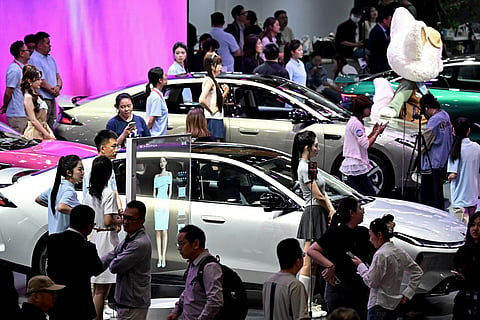
I saw this shift up close at the Beijing Auto Show, one of the most anticipated car events in the world. It is the kind of event where automakers come to flex, and this year, Chinese brands did exactly that.
My honest takeaway was that in terms of innovation, some of these cars feel like they belong in 2050.
That may sound exaggerated, but it is hard to walk through a 380,000 square-metre exhibition space filled with 1,451 vehicles from 21 countries and regions, including 181 global premieres and 71 concept cars, and not feel that something significant is happening. The density of new models was overwhelming. The level of technology packed into the vehicles was even more striking.
Some of the Chinese EVs on display did not feel like cars in the traditional sense. They felt like moving digital devices, built around screens, sensors, AI systems, voice assistants, advanced driver assistance, smart cabins and design details that clearly target a younger, more tech-aware customer.
I also visited a couple of factories during the trip. Full disclosure, this was my first time inside a car factory, so I was seeing the process with fresh eyes. But even with that caveat, the scale and efficiency were hard to miss.
The level of automation was something else. AI systems and robots were central to the production process. Some manufacturers claimed that one car rolls off the assembly line every 58 seconds. Walking through the facility, I could see why that claim did not feel impossible. A large part of the heavy work, from fitting seats to placing window panes and handling other repetitive tasks, was being done by robots in seconds. The human teams were focused more on inspections, testing, technical adjustments and quality checks.
That matters because the EV race is also happening on factory floors. The companies that can design faster, build faster, and correct mistakes faster will have a serious advantage, especially in a market where consumer preferences can change almost overnight.
This does not mean European and American brands are finished. That would be too simplistic. Legacy carmakers still have engineering depth, brand heritage, motorsport history, design credibility and loyal customers. But they are no longer competing in a market where their names alone can carry them.
China’s EV makers are moving fast, pricing aggressively and building cars that make many older assumptions about quality and innovation look lazy.
The West once dismissed China’s EV ambitions as a volume game, which was a mistake. The next phase will be about technology, manufacturing speed and consumer trust. On all three fronts, China is already much further ahead than many people realise.