Paula Badosa and Ons Jabeur open up on pressure, identity, and mental strength in sport
Tennis stars share candid insights at World Sports Summit in Dubai
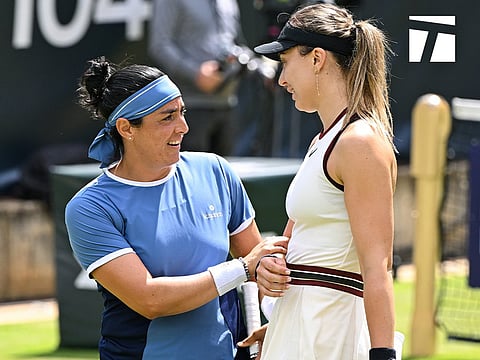
Dubai: Sport at the highest level can make or break an athlete. On one hand, victory brings limelight, trophies, glamour, wealth, and global admiration; on the other, defeat can weigh heavily, taking a serious psychological and emotional toll.
In a candid discussion at the World Sports Summit in Dubai, two tennis stars, Paula Badosa and Ons Jabeur, reflected on the weight of labels, the responsibility of representation, and the importance of normalising mental health struggles in sport.
For former World No 2 Badosa, success came quickly — and with it, a label that proved difficult to carry. Early in her career, she was dubbed “the next Maria Sharapova,” a comparison that, while flattering on the surface, became a heavy burden.
“Yeah, all that weight of expectations, all that pressure. Also, I had the media expecting me, at a very young age, to be a legend because they were comparing me to a legend. I think even my maturity at that moment wasn’t ready. So having that label on my back at such a young age was very difficult to manage. Because of that, I went through very difficult — or let’s say, dark — moments at that age,” Badosa said.
The transition from a highly successful junior career — where she won a Grand Slam — to the harsh realities of the professional tour only intensified the pressure. She said: “It took years. I had to build my own name. It was a couple of years of working on myself, of being very clear and saying that I want to be the next Paula; I don’t want to be the next Sharapova.
“So it was tough to handle, but then I made my way, I made my career, and in a way, I made my wins and experienced my highs and lows. But I just wanted to be myself, and I wanted people to know me and respect me for my own career, my own journey — and that’s what I’ve tried to do until today,” she added.
High expectations
If Badosa struggled with comparison, Tunisian superstar Jabeur has faced a different kind of weight: representation. As a trailblazer for Tunisia, the Arab world, and Africa, Jabeur has played not only for herself but for millions who see their hopes reflected in her success.
“It depends on how you take it. It was always a proud moment. It was like a good kind of pressure. But at a certain time, it became too much. I wasn’t expecting to make such a huge impact everywhere.
“We take expectations in the wrong, negative way. We should take them on the positive side and see that from them, we can build something bigger. And I discovered that even if I don’t have pressure, I don’t play as well as when I have pressure on my shoulders.
“A lot of fans say, ‘Just play for yourself, don’t play for anyone else,’ and I’m like, I can’t. It doesn’t feel the same. So for me, it is a great responsibility and a great honour to represent my country, the Arab world, and Africa.
“I truly want to inspire more and more players. I see that we have a lot of talent, but sometimes they’re a bit lost. They don’t know how to make it to a professional career, and we’re missing more role models from our region. To show that, okay, I’m a woman, I also got married very young, and I can still go very far. So nothing is really impossible. It doesn’t matter where you come from — you can make it,” Jabeur added.
Strong minds
Both players emphasised how often the human side of athletes is overlooked. Fans see trophies lifted on sunny days, but rarely the anxiety, pain, and emotional exhaustion behind them. The constant travel, isolation, and relentless competition can wear down even the strongest minds.
“Tennis takes you to the limit,” Badosa said. “People only see the trophy — but behind that is suffering.”
Jabeur echoed the sentiment, noting how young players are often unprepared for the psychological demands placed on them. Labels, media attention, and public scrutiny arrive long before athletes are emotionally equipped to handle them. Many begin playing simply out of love for the game, unaware of everything that will eventually come with it.
When it comes to managing pressure, both players stressed the importance of self-investment. Badosa highlighted the value of understanding why certain things affect you, not just masking symptoms with surface-level tools. Meditation, breathing exercises, and yoga can help — but deeper self-reflection and healing are just as crucial.
Honest conversations
Equally important is community. Honest conversations with trusted people, especially fellow athletes, can make all the difference. Despite being competitors, Badosa and Jabeur share a bond rooted in mutual understanding. “Nobody understands you better than another athlete,” Badosa noted.
Social media, however, remains one of the sport’s greatest challenges. Both acknowledged its power to inspire — and to harm. Hateful comments and even threats extend beyond players to their families. Jabeur now avoids social media after matches, choosing instead to stay within her team’s protective bubble. Her greatest concern is for younger generations, who may struggle to separate online negativity from their self-worth.
For Badosa, openness has never felt like a weakness. Being vulnerable, she insists, doesn’t give rivals an edge — it reflects strength. On court, her competitive fire remains intact. Off court, honesty has helped her survive moments when pressure nearly pushed her away from the sport altogether.
What ultimately kept her going was passion — and a dream that still burns. The dream of being one of the best in the world continues to give meaning to the daily grind.


