World Cup curse: Can Spain avoid the fate of past champions at FIFA World Cup 2030?
Winning the World Cup is hard. Retaining it, even more so.
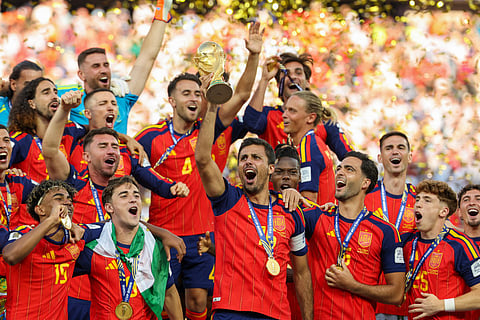
Spain may have just hoisted the 2026 World Cup trophy, but if history is any indication, they might want to start sweating 2030 right about now.
Winning the World Cup is hard. Retaining it, even more so.
There’s a ghost that haunts defending champions, a cosmic tax on greatness often whispered about as the "Champion’s Curse." Out of 22 completed tournaments, six reigning champions haven't just stumbled—they’ve completely imploded in the group stage, trading expected dominance for an early flight home. Just ask Argentina, who spent the 2026 group stage dodging that exact same shadow after their 2022 triumph in Qatar.
If La Roja wants a preview of the trap waiting for them in four years, they only need to look at the legendary squads who took the exact same victory lap right off a cliff.
Italy: The double-dip (1954 and 2010)
Italy is the only team on this list to experience the defending champions’ curse twice.
1954: The reigning champions were drawn alongside England, Switzerland and Belgium. They finished third in their group and failed to reach the quarter-finals.
2010: More than five decades later, Italy arrived in South Africa as the holders once again. But the campaign quickly unravelled. They drew with Paraguay and New Zealand and lost to Slovakia, finishing bottom of the group without a win.
For captain Fabio Cannavaro and several of Italy’s 2006 heroes, it was a far cry from their triumphant campaign four years earlier.
Brazil: When the favourites fall (1966)
Brazil arrived at the 1966 World Cup with Pelé and Garrincha in the squad and back-to-back titles from 1958 and 1962.
But the defending champions did not make it out of the group stage.
Brazil beat Bulgaria in their opening match but then lost to Hungary and Portugal, ending their campaign early. It was a sharp reminder that even the most decorated teams can struggle when a new tournament begins.
France: A title defence without a goal (2002)
France went into the 2002 World Cup as both the reigning world champions and European champions, having won Euro 2000.
The tournament, however, quickly turned into a nightmare.
France lost 1-0 to Senegal, drew 0-0 with Uruguay and then fell 2-0 to Denmark. They finished bottom of their group and left the tournament without scoring a single goal.
It remains one of the most dramatic collapses by a defending champion.
Spain: From champions to an early exit (2014)
Spain had dominated international football between 2008 and 2012, winning two European Championships and the 2010 World Cup.
Their title defence in Brazil, however, began in disastrous fashion.
The Netherlands defeated Spain 5-1 in their opening match, followed by a 2-0 loss to Chile. A 3-0 win over Australia in their final group game could not change the outcome: Spain were already out.
The defeat marked the end of one of the most successful eras in modern international football.
Germany: A shock group-stage exit (2018)
Germany arrived in Russia as the reigning world champions after their memorable 2014 campaign.
Their defence began with a 1-0 defeat to Mexico. A late Toni Kroos free-kick against Sweden then appeared to put the team back on track, but Germany suffered another setback in their final group game.
South Korea won 2-0, sending Germany out at the group stage for the first time in their World Cup history. The four-time champions finished bottom of Group F.
The lesson for Spain
Spain will hope history does not repeat itself after their 2026 triumph.
The past offers plenty of cautionary examples: defending a World Cup title is one challenge, but doing it again four years later can be far more difficult. The champions' celebrations may last long into the summer — but the next tournament always brings a fresh test.


