A World Cup red card can cost up to $20,000: Who has paid the biggest FIFA fines?
Every card at the World Cup has a financial penalty, with red cards costing up to $20,000
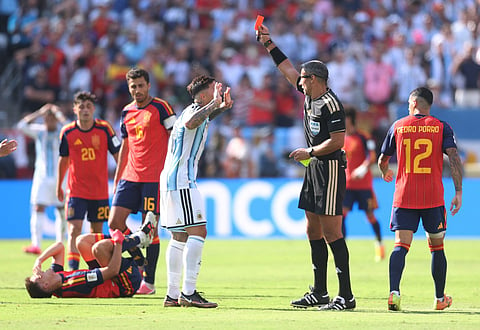
Dubai: Have you ever wondered why the players get so agitated when given a red card? What is the price of a red mist: how much a card actually costs at the World Cup.
Every red card at the World Cup comes with a story on the pitch. What's less known is that it also comes with an actual invoice.
Under FIFA's Disciplinary Code, every single booking at this tournament carries a financial penalty, on top of any suspension. Here's exactly how much, who's paid the most, and whether there's any way out of it.
The price list
FIFA's fine structure for the 2026 World Cup breaks down clearly. A yellow card costs $10,000. A second yellow in the same match, resulting in a red, costs $15,000. A straight red card carries the steepest individual penalty at $20,000.
There's also a team-wide penalty built in: if five or more players from the same side pick up disciplinary sanctions in a single match, FIFA can add an extra $15,000 fine on top, aimed squarely at teams whose discipline breaks down as a whole rather than through one bad moment.
Yesterday's red card, priced
Given yesterday's final, this one's topical. Enzo Fernandez's second yellow card in stoppage time, the one that sent him off and left Argentina to play extra time with ten men, comes with a $15,000 price tag under FIFA's own fine schedule, on top of the suspension consequences that would have followed had Argentina needed him for another match.
Who's actually paid the most so far
The clearest example from this tournament belongs to USMNT striker Folarin Balogun. He was sent off during the United States' Round of 32 match against Bosnia and Herzegovina after a VAR review found he'd stepped on an opponent's ankle.
FIFA's Disciplinary Committee fined him $40,000, twice the standard straight-red penalty, reflecting the severity FIFA assigned to the specific incident rather than the flat-rate figure. Balogun avoided a suspension on top of it, but the fine stood regardless.
Who actually pays the bill
Here's the twist that surprises most fans: players rarely pay these fines out of their own pocket. In Balogun's case, FIFA explicitly ruled that the U.S. Soccer Federation was jointly liable for the payment, and that's the norm rather than the exception. National federations typically cover these fines on behalf of their players as a standard part of representing the country, treating them as an operational cost of the tournament rather than a personal penalty.
That said, it's not entirely without personal consequence. Players on modest contracts, without the earning power of someone like Balogun, whose club deal alone is reportedly worth close to $3.7 million a season, could plausibly find themselves covering part of a fine or facing internal deductions depending on how their federation structures things. It varies enormously by country and is rarely made public.
Is there any way to waive it?
Not really, at least not by appeal on the money itself. FIFA's fines are handed down through its Disciplinary Committee alongside the card itself, and while players and federations can appeal the underlying decision, red card, suspension length, and so on, there's no real precedent for successfully appealing just the financial penalty while accepting the card stands.
If the card gets overturned entirely, which does happen on review, the fine typically goes with it. Short of that, the fine is simply part of the package.
A few fun wrinkles in the rules
FIFA's disciplinary system has some quirks worth knowing. Yellow cards get wiped clean twice during this expanded 48-team tournament, once after the group stage and again after the quarter-finals, specifically so bookings picked up early don't end up costing a player a place in a later, bigger match.
There's also a newly introduced rule this tournament allowing a red card for covering your mouth while talking to an opponent, brought in after a high-profile incident in European club football last season.
It's already been used twice: first on June 19, when Paraguay's Miguel Almiron was sent off against Turkiye, becoming the first player in World Cup history to receive the card for this offence, and again on June 30, when Ecuador's Piero Hincapie was shown a straight red for the same thing during a stoppage-time exchange with Mexico's Santiago Gimenez.