Small nations, big dreams: Why cricket’s Associate teams deserve more
Appreciation shouldn’t end with the T20 World Cup; it should be backed by continuity
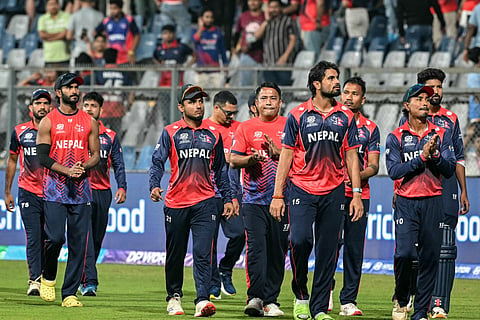
Dubai: The Wankhede Stadium in Mumbai felt momentarily displaced. A sea of Nepal flags, chants, and colours flooded the venue for Nepal’s T20 World Cup opener against England, prompting a genuine question among onlookers: was this Mumbai or Kathmandu? The scale of support was staggering, a reminder that cricket’s emotional geography now stretches far beyond its traditional strongholds.
Nepal’s players matched the occasion. What unfolded on the field looked less like a mismatch and more like a contest between established cricketing nations. England were pushed hard, the match going down to the final moments before Nepal fell agonisingly short by four runs. It was heartbreak.
Perhaps the most telling image of the night came after the result. Nepal’s players completed a lap of honour, applauding the fans who had turned a neutral venue into a home ground. For a team representing a nation that, barely a decade ago, wasn’t even in the global cricketing conversation, this was a moment of arrival. The result mattered, but the journey mattered more.
Create memories
This is the enduring charm of elite tournaments like the T20 World Cup. They don’t just crown champions; they create memories that redefine what is possible for smaller cricketing nations.
Italy’s presence at the tournament reinforces that idea. Playing their first-ever World Cup match, they lost to Scotland — who themselves entered the competition at the last minute after Bangladesh’s withdrawal due to hosting and security concerns. Yet Italy’s performance was met with admiration. For a country synonymous with football rather than cricket, their gritty display stood out.
Italy’s qualification was unexpected, and that surprise is precisely the point. It sparked hope that cricket’s footprint can widen, that more nations can carry the sport into new cultural spaces. The same can be said of the United States, whose historic performances on home soil in the 2024 tournament reshaped perceptions. Their famous victory over Pakistan and progression into the Super 8s wasn’t just an upset — it was a statement.
Add to that the UAE, who periodically spring surprises against major teams, and Namibia, whose repeated World Cup appearances have built experience and credibility. Collectively, these stories suggest that the gap between full-member nations and associates is narrowing — at least during global events.
'Token participation'
But the real question begins once the tournament ends. What happens next for these teams?
Former India batter Aakash Chopra recently voiced a concern that resonates deeply within the cricketing ecosystem. Speaking on his YouTube channel, Chopra questioned the seriousness of cricket’s commitment to associate nations, calling it “token participation” and “lip service.”
His analogy was pointed: associate teams are invited to the wedding, celebrated briefly, and then forgotten for the next two years. Performances are praised, stories are shared, but once the World Cup curtain falls, the cricketing calendar reverts to bilateral series among the same established nations. The momentum disappears.
Chopra’s criticism cuts to the core of the issue. Growth cannot be sustained on applause alone. If associate teams only receive exposure once every World Cup cycle, progress will remain sporadic and fragile.
Structural commitment
The solution lies in structural commitment. Leading cricketing nations must move beyond symbolic praise and actively integrate associate teams into the global schedule. Regular bilateral series, tri-nation tournaments, and consistent competitive exposure are essential — not optional.
Afghanistan’s rise offers a compelling blueprint. Once viewed as plucky underdogs, they are now a formidable force, capable of defeating top teams on a regular basis. Their ascent wasn’t accidental; it was built on sustained opportunities, quality opposition, and a clear development pathway. That should be the benchmark.
If cricket genuinely aspires to be a global sport, the focus must extend beyond marquee events. For associate nations, the talent is evident. What they need now is continuity. And for cricket, providing that pathway isn’t just generosity — it’s an investment in the game’s future.


