Are hydration breaks hurting FIFA World Cup 2026 momentum? Why fans and coaches are divided over safety rule
The pauses have also sparked debate about rhythm and broadcasting
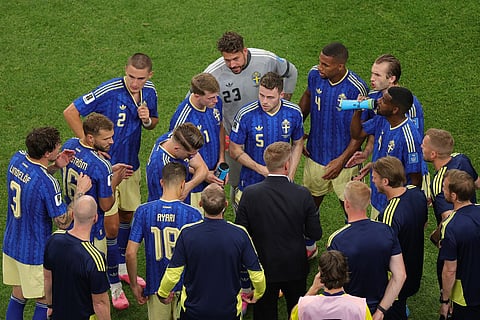
If you’ve noticed matches at this World Cup pausing at almost predictable moments, often just as momentum is building, you’re seeing one of the tournament’s newest features in action: mandatory hydration breaks.
Designed primarily as a player welfare measure, the pauses have also sparked debate about rhythm, broadcasting and the evolving shape of modern football. The result is a rule that sits right at the intersection of health and entertainment.
A new universal rule: Breaks in every match, everywhere
Unlike previous tournaments where hydration breaks were used selectively in extreme heat, FIFA has introduced a standardised system this World Cup.
Now, referees pause play twice per match, typically around the 22nd minute of each half, regardless of weather conditions, stadium type, or temperature.
That means even games played in cooler climates or in air-conditioned arenas are subject to the same structured stoppages.
FIFA’s stated intention is consistency: Ensuring all teams benefit from the same recovery window while reducing the risk of heat-related fatigue across a packed international schedule.
Tuchel’s view: Useful in theory, disruptive in rhythm
England head coach Thomas Tuchel has offered one of the more nuanced takes on the change.
Speaking ahead of England’s Group L match against Ghana, as quoted by the BBC, he acknowledged that hydration breaks can be helpful, particularly in hotter conditions where players genuinely need recovery time. However, he also said the universal application has altered how matches flow. "I think that it interrupts and changes the identity of a football match much more than I thought. I had hydration breaks before when it was really, really hot and needed, but they were shorter."
Tuchel noted that in the past, such breaks were shorter and used only when conditions demanded it. In this format, he suggested, every match is effectively segmented into repeated phases, which can make it harder for teams to build sustained momentum.
"It's hard to build momentum, and it's hard to keep the momentum, when there are breaks. If you do not have a break, then it's just like the battle on the field between the players and the teams. It plays out in a longer period of time. It just adds to the character of the beautiful game," he said.
At the same time, he admitted there is a coaching advantage: The breaks give managers a rare opportunity to communicate clearly with players during live matches, something that is usually difficult amid the intensity of play.
The science behind the breaks
According to NPR transcripts, (National Public Radio), medical expert Dr Gregory Waryasz had explained, that while dehydration-related cramping is common, the bigger concern is preventing serious conditions like heat exhaustion and heat stroke, which can be dangerous or even life-threatening. "What you really want is to make sure no players are having heat stroke and heat exhaustion and different things that can be really deadly," he says.
From this perspective, he suggests standardised breaks make sense because players already take informal water breaks during stoppages, so formalising them ensures consistency across all matches.
NPR had also brought forth the criticism emerging around the rule. Fans and commentators quoted in the report argue that the breaks disrupt match flow, particularly when momentum is building, and in some cases feel unnecessary in cooler conditions.
At the same time, the transcript also included a counterpoint from coach Mauricio Pochettino, who says the breaks can be helpful in demanding conditions, describing them as useful during hot afternoon matches, on some days.
Overall, the breaks are presented as a rule introduced for safety, but one that has quickly become controversial because it alters match rhythm and coincides with new commercial opportunities in broadcast coverage.
The broadcasting factor: A new window in the game
Hydration breaks have also introduced a new element for broadcasters.
Networks now have predictable mid-half windows to air content, which has led to experimentation in how matches are presented. Some broadcasters have used full-screen advertisements, while others have shifted to split-screen formats that keep live stadium footage visible alongside commercials.
According to LA Times, these windows have also become commercially significant, with major tournaments drawing high-value advertising slots during stoppages. Soccer fans were upset that they were missing on-field action, and the discussion grew more intense.
However, by the Mexico–South Korea match last week, Fox had shifted its approach for the first time, introducing split-screen advertising that placed live stadium coverage alongside commercials in a side-by-side format. However, the strategy remained inconsistent, by the U.S.–Australia fixture on Friday, the network had reverted to running full-screen advertisements during the breaks.
A rule shaped by modern football’s demands
Despite the debate, there is widespread agreement that hydration breaks are rooted in player welfare. With matches taking place across different climates and conditions, many in the sport see standardised recovery time as a practical safeguard that helps protect players in a demanding tournament schedule.
At the same time, the way the breaks are being implemented and adjusted in both stadiums and broadcast coverage, shows that football is still finding its balance, refining how such pauses fit into the rhythm of the game.


