All about Shawk the Hawk, Gulf News' World Cup prediction expert
You've seen Shawk's famous World Cup predictions, now get to know more about him
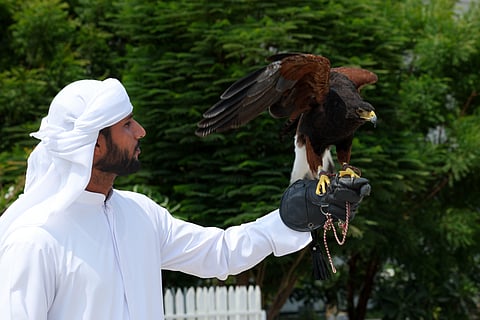
Dubai: We've all seen Shawk the Hawk on social media. The hawk has been soaring with his FIFA World Cup predictions – even outpredicting a famous German economist. The feathered football oracle boasts a flawless World Cup knockout record, and has even been called the "prediction king." Not bad for a hawk who just enjoys playing ball in a pool in his free time.
Get to know more about Shawk and what he gets up to when he's not predicting FIFA World Cup 2026 winners. Shawk sat down for an exclusive interview with Gulf News, along with his colleague, Falconer Sikander Ali.
Tell us a bit about Shawk.
Shawk is six years old, and Shawk is a Harris Hawk from Spain. You can find the species in Mexico, Argentina, Chile, and the UK as well.
Besides predictions, what does Shawk do?
Shawk does shows, and he also does pest control. He scares the birds from resorts and airports as well. He’s very good at this.
How long have you known Shawk?
Shawk is now six years old, and he has been with me for more than 3.5 years.
I’ve worked in the UAE for the last 3.5 years. Shawk was my first bird. I trained him and I spend time with him.
Shawk is with me in my room. We spend time together almost all day, and in the night, Shawk sleeps with me in the same room and he watches TV with me as well.
What is Shawk’s favourite food?
Chicken, baby chicks, pigeon, quail, and sometimes rabbits.
What’s an interesting thing people don’t know about Shawk?
Shawk is always calm and friendly, even with the kids.
How big is Shawk and Harris hawks?
The wingspan of the Harris hawk is around 18 to 23 centimetres. Their weight is around 850 grams, up to 1.6 kg, depending on the size of the bird. Now, Shawk is 1.3 kg.
Does Shawk have any hobbies?
At the end of the day, in the evening time, I put a big bowl of water in front of Shawk. Shawk goes inside, takes a shower, and then plays with the ball.
Does Shawk like Bollywood or Hollywood?
Shawk is from Europe side, so I think he likes Hollywood.
What sports does Shawk like?
I think he likes to play with the ball, so football. Cricket is okay.
All about Hawks
What is the lifespan of a hawk?
15-20 years in captivity. In the wild, they can live seven to nine years.
Do hawks have teeth?
They don’t have teeth. They only have the beak. They just tear off one big piece of meat and swallow it whole. After 16 to 18 hours, they throw up feathers and bones.
How do hawks sleep?
They take one foot up, and they turn their head under the feathers, and then they go to sleep. They just need a quiet place to sleep.
How far can they turn their heads?
They can turn their heads more than 270 [degrees].


