Empowered to lead: How Emirati women are shaping the UAE’s future
Decades of investment are opening pathways to expertise, leadership and innovation
Emirati Women’s Day has never only been about individual achievement. It reflects something larger: a national belief that women are essential partners in building the UAE, strengthening its economy and shaping its future.
That idea carries particular significance in 2026. Under the theme “We Emerge Stronger and Better,” this year’s celebration extends across an entire month, creating space not only to recognise what Emirati women have achieved, but also to reflect on what has enabled that progress.
The answer lies in an ecosystem built over decades: families that encourage ambition, policies that expand opportunity, education that develops capability, and institutions willing to invest in women throughout their lives and careers.
The progress of Emirati women did not happen by chance, nor did it happen in isolation.
Decades of investment
It is the result of decades of investment in education, legislation, professional development, family stability, and leadership opportunities. The UAE has moved beyond seeing women’s empowerment simply as participation. The ambition today is broader: enabling women to lead, shape decisions, develop deep expertise and contribute to the sectors that will define the nation’s future.
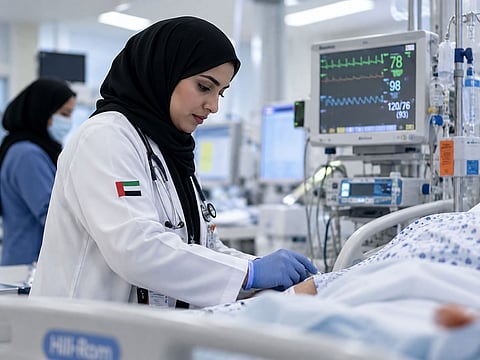
I see the results of that evolution every day in healthcare. Emirati women are no longer simply entering the profession in greater numbers. They are building specialist expertise, leading teams, contributing to research and helping shape how healthcare will evolve in the UAE.
The National Policy for Empowerment of Emirati Women 2023-2031 reflects this ambition. It provides a national framework to improve the quality of life of Emirati women, strengthen their leadership and expand their participation across society and the economy.
Importantly, the policy recognises that a woman’s professional journey cannot be separated from the wider realities of her life. Career development is closely connected to family stability, economic security, access to education and the availability of meaningful opportunities.
This is what makes the UAE’s approach so effective: empowerment is treated as a complete ecosystem.
When women receive support at different stages of their lives and careers, they are better able to remain in the workforce, develop their skills and pursue long-term ambitions. In turn, families become stronger, workplaces benefit from a wider range of talent, and the national economy becomes more resilient.
Supporting families
We can see this thinking in the recent enhancements to the Nafis programme, announced in 2026 in line with the Year of Family.
The amendments to the Child Allowance Scheme removed the previous limit on the number of eligible children for Emiratis working in the private sector. Support through the Salary Support Scheme was also expanded to include children of female nationals and wives of male nationals working in the private sector.
These measures acknowledge a simple but important truth: supporting national talent also means supporting the families behind that talent. When people feel secure at home, they are better able to build stable, sustainable and rewarding careers.
This is particularly important as more Emirati women pursue opportunities beyond the traditional government sector. Today, Emirati women account for more than 70% of UAE nationals working in the private sector, reflecting the scale of their contribution to the country’s changing economy.
This level of representation is encouraging, but numbers should never be the only measure of progress.
What happens after women enter the workforce?
The more meaningful question is what happens after women enter the workforce. Are they progressing into specialised professions? Are they leading teams and organisations? Are they influencing policy, conducting research, building businesses and creating opportunities for the next generation?
Across the UAE, we are increasingly seeing that they are.
Emirati women are making an impact in aviation, finance, technology, government, diplomacy, entrepreneurship, science, education, advanced industry, energy and healthcare. They are not only present in these sectors; they are helping to shape them as leaders, specialists, and decision-makers.
Healthcare is one of the clearest examples of this progress.
Throughout my career, I have had the privilege of seeing the role of Emirati women in healthcare evolve in remarkable ways. What has changed is not simply who enters the profession, but the ambition with which women now enter it. Increasingly, Emirati women are pursuing specialist practice, advanced education, research and leadership as interconnected parts of the same career.
Careers across specialised areas of medicine
Today, Emirati women are building careers across highly specialised areas of medicine, from surgery and emergency medicine to genetics, haematology and oncology, and advanced transplantation services.
These are demanding fields. They require years of study, specialist training, continuous learning, and the confidence to make critical decisions in complex clinical environments.
The growing presence of Emirati women in these specialties reflects their determination and ability. It also reflects the strength of the education and healthcare systems that have been built to support national talent.
Their impact now extends far beyond direct patient care.
Emirati women are contributing research, genomics, precision medicine and other emerging areas that will shape how healthcare is delivered in the future. Their work is strengthening scientific capability, supporting more personalised approaches to treatment and building expertise within the UAE.
They are also taking on greater responsibilities in healthcare management, policymaking, education, research, innovation, and the oversight of national medical programmes.
This shift is important. True empowerment is not simply about increasing the number of women working in a sector. It is about giving women the opportunity to influence how that sector develops, how decisions are made and which priorities are pursued.
At Sheikh Shakhbout Medical City (SSMC), we see this progress within our own workforce. Emirati talent is central to SSMC’s recruitment and workforce development strategy as we continue to develop the capabilities needed for the future of specialised and complex care in the UAE.
Today, more than 415 Emirati women are part of SSMC’s workforce. They hold 30 leadership positions and contribute their expertise in over 200 specialised roles across clinical, nursing, and healthcare professions.
Each of these figures represents a person with her own journey, ambitions and contribution. They are professionals caring for patients, building expertise, leading teams, supporting innovation, and showing what can be achieved when personal determination is matched by institutional opportunity.
Investment in the healthcare system
Healthcare reminds us every day that strong systems depend on strong people. Supporting Emirati women to pursue advanced education, develop specialist expertise, take part in research and move into leadership is not simply an investment in representation. It is an investment in the quality, resilience and future readiness of the entire healthcare system.
The same is true in every industry.
The UAE’s experience shows that empowerment is most effective when all parts of society work together. Policy creates opportunity; families provide stability, and education builds capability, while institutions open pathways. Women then turn those opportunities into achievement.
This month-long celebration in 2026 gives us time to recognise how much has been achieved. But it should also remind us of the national vision and collective effort behind that progress.
The success of Emirati women is not a collection of isolated stories. It reflects a broader model in which leadership, policy, education, family support and institutional commitment come together to create lasting change.
As we look ahead, our ambitions should continue to grow. We should see more Emirati women entering future-focused industries, progressing into highly specialised professions, contributing to research and innovation, and taking their place at the highest levels of leadership and decision-making.
The achievements we celebrate today show how far Emirati women have come. The opportunities being created today show how much further they can go.

Dr Mariam Al Suwaidi is Consultant and Chair of the Dermatology Division, Sheikh Shakhbout Medical City

