You’re the story now: How gaming trains your brain and makes every choice count
Narratives expose players to emotional language and social situations
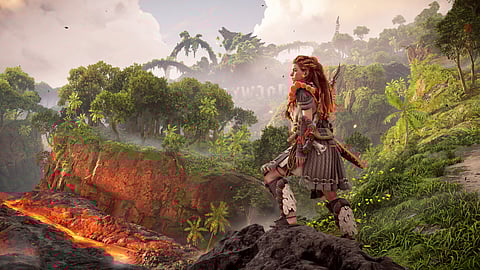
There’s a game called Horizon Forbidden West.
It’s the end of the world, and our protagonist Aloy is the only hope we have. She will say this quite often, just in case you didn’t get it the first time. As she embarks on her series of quests, she meets friends, old and new, treating them with a rather sneering icy indifference. But that’s only to protect them. As you walk with Aloy through this dystopian world, you don’t quite feel as if you’re in a video game: It feels oddly like virtual reality, owing to the characters micro-expressions, animation, and brilliant voice acting.
If you’re a beginner, you finally understand what people mean by ‘immersive’, a word that’s used a little too easily these days. You’re drawn into the backstories of different tribes and cultures, where every face could be hiding a lie
That’s the joy of gaming. You are the story. And you tell the story, too.
Perhaps, that’s just one of the reasons why people are drawn to it. As Dubai’s 22-year-old Osaja Abbas had once listed her favourite games to us, mentioning Sea of Thieves. “There’s something exciting about the pirate theme, sailing out on adventures, hunting for treasure, dealing with ship damage, making repairs, fending off attacks. It’s all about surviving and adapting, which is just so much fun.” If you’re interested in the details, in this particular game, the ships have a detailed damage system, where holes in the hull begin to fill the ship with water.
Water can be bailed with a bucket and holes repaired with boards, provided you don’t sink first.
Agency: Why control changes everything
When you play the game, you feel that your decisions matter. Unlike books or films, games don’t just ask you to observe. They demand participation.
According to Dr Olivia Pounds, a clinical psychologist from Hummingbird Clinic, immersive storytelling allows players to often act as protagonists in the story, with their decisions directly leading to outcomes within the game. “This helps players feel a greater sense of agency in the gaming world, where they can influence the narratives in a fictional world.”
This sense of control taps into something deeply human: The desire to feel effective in our environment. In games, actions have visible consequences. Success feels earned. Failure feels instructive. It’s also what makes gaming feel so personal. When you choose the path forward, the story feels personal.
Stepping into another person's mind
Agency invites perspective. Dr Pounds explains that with such storytelling, you can place yourself in another’s shoes and understand the world from their point of view.
This ability usually begins developing in early childhood, around the age of four or five, when children start to recognise that others have independent thoughts and feelings. But development isn’t always linear. “Sometimes differences in development, such as in autism, can make this skill more difficult for the child to acquire,” explains Dr Pounds.
Although direct research linking video games and theory of mind is still limited, she notes that it is plausible that games support this skill. Here, players are given opportunities the experience the world through a character, other than themselves and act in line with their goals and experiences.
In practice, that means learning to think as someone else, to anticipate reactions, weigh motivations, and understand emotional context. Over time, this can reinforce empathy. So, it’s not surprising when people become emotionally invested in their characters, and are more likely to consider how this character feels and why.
The psychology of losing, learning and trying again
There’s no straightforward story. Everyone has one, some more harrowing than others, and each evokes emotion. Dr Pounds explains that emotional intelligence can arguably be gained from complex game narratives, which expose users to situations that trigger an emotional response.
Games repeatedly place players in emotionally charged scenarios, offering chances to recognise emotions as they arise, regulate responses and recover from setbacks. “People frequently learn to cope with failure, offering opportunities to develop frustration tolerance skills,” she says.
This is especially relevant in a world that often discourages failure. Games, by contrast, normalise it. You fail, you learn, you try again. If you lose in a combat, you have the chance to fight again (one hopes, otherwise you have to start from the beginning).
Narratives also expose players to emotional language and social situations, helping them interpret how characters feel in different environments. Emotional intelligence, Dr Pounds explains, involves understanding, using, and managing one’s own emotions, as well as to recognise how one can influence the emotions of others.
However, she cautions that gaming isn’t automatically beneficial. If players lack emotional regulation tools, or are already dealing with high levels of stress, gaming can intensify unhelpful patterns. Experiencing frustration repeatedly without coping strategies “can have the opposite effect and lead to development or maintenance of unhelpful strategies or beliefs about emotions.”
Video games often involve clear goals, targets, immediate feedback, and gradual increases in challenge, which can help build persistence and resilience. Increasing challenges and presenting new scenarios supports learning, creativity and critical thinking...

Morality in a safe, fictional sandbox
Many modern games place players in ethically complex situations, quietly training moral reasoning. “Moral reasoning, the process of deciding on what is right or wrong, and acting in the way one ought to, is an important prosocial skill,” Dr Pounds explains.
Games can simulate ethical dilemmas, allowing players to see how their choices affect others and the wider virtual world. Whether these lessons translate into real life depends on factors like personality, emotional maturity and developmental stage. But the sandbox itself matters.
In games, moral exploration is low-risk, but emotionally real.
Trying on new lives
On some days, you’re Sam Porter, who has to connect to the Chiral Network, which is an online system bringing civilisation together after the world almost ends. On other days, you’re Geralt from The Witcher 3, on a country-wide hunt pining for Yennifer, a long-lost love. Sometimes, the stakes are too high, and sometimes, you’re really on just a wild goose chase.
But it all adds up. As Dr Pounds explains, role-playing games allow players to step into entirely different lives. “Video games allow players to try out and explore different identities in safe and controlled environments,” Olivia says.
This experimentation can prompt reflection: What feels natural? What feels uncomfortable? How does power, vulnerability or responsibility sit with you? These questions can quietly inform real-world identity development and self-understanding.
When gaming becomes a cognitive workout
The best and most frustrating part about open worlds gaming: The answers are there, but you need to hunt for it. You need to keep panning the camera, scouring through rocks, boulders, trees, or walking to nearby rivers and finding the next clue. In some games, you need to piece the puzzle together. And fighting doesn’t mean just mashing all buttons: You need to know what you’re pressing.
Problem-solving is baked into nearly every game genre. People track objectives, process information quickly and adapt strategies under pressure. These demands support skills like attention, working memory, processing speed and visuospatial awareness. “Gaming can help build important executive functioning skills,” Dr Pounds explains, including metacognition—the ability to monitor one’s own thoughts and actions. You learn from mistakes and planning ahead, skills that extend beyond the screen.
Moreover, challenging games offer cognitive benefits, especially those requiring flexibility and planning. The fun matters. “If a game becomes overly taxing or feels too academic, it may no longer feel intrinsically motivating,” Dr Pounds adds. Balance remains essential, particularly for developing brains that need varied stimulation.
Do you need a cafe by the river?
While challenging games have their virtues, there are several calming, cheerful ones such as Animal Crossing and Stardew Valley. Really, sometimes, you just need to live in a hotel by the river and decorate the room for guests, as I'm told by my sister.
Call it a good day. Maybe that's all you need.
For many, gaming offers genuine relief from stress. It can create a sense of control in a world that often feels overwhelming. A little escape from your thoughts. “The sense of achievement gained through completing tasks or overcoming challenges can also contribute to improved mood and self-efficacy,” Dr Pounds explains.
But moderation matters. When gaming becomes avoidance rather than engagement, it can increase emotional distress. Used as part of a balanced lifestyle, however, it can be restorative rather than harmful.
Why these worlds stay with us
Back in Aloy’s world, the machines still roam, and survival remains uncertain. But as you guide her forward, choosing when to fight, when to listen, when to trust, you’re doing more than playing.
And perhaps that’s why gaming endures.
Sometimes, saving a fictional world helps us better understand our own.


