From non-verbal to flipping off walls: How obstacle-course training is reaching neurodiverse kids
How an obstacle-training programme is helping neurodiverse children build confidence
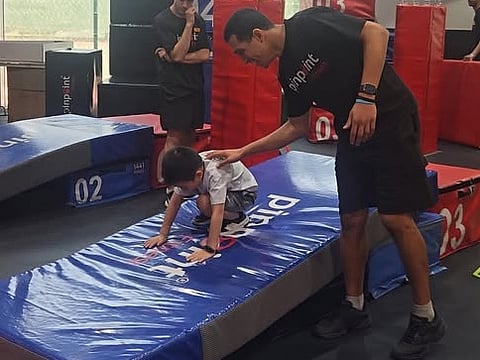
Dubai: Most kids' sport runs on the same template: line up, follow along, keep up. For a neurodiverse child, that template often doesn't fit, and being unable to keep up becomes one more place they're quietly left behind.
Samer Hijazi, founder of Pinpoint Fitness, a centre dedicated to obstacle-course training and parkour for children and teenagers, has built his programme around the opposite idea, that a child's abilities should shape the training, not the other way around. He's firm that kids aren't sorted by labels. "We don't segregate kids based on certain labels about whether they're special needs or so," he said. Instead, every child is assessed first, physical ability, comprehension, how they process and respond, and the training is built to fit them from there.
That thinking is what led to a dedicated neurodiversity and autism programme. "We believe that all kids need to have access to this kind of training and need to have access to unlock their full potential," Hijazi said, describing the goal as making sure there's no "ceiling on the possibility of their progress."
Starting with communication, not exercise
For the coaches, the first challenge often isn't physical at all. It's finding a way in.
Coach Mahdi, head coach at the Al Furjan branch, described working with a child who is non-verbal and not yet walking, where the entire starting point was communication through what the child could see rather than hear. His method was patient and visual, showing the same action repeatedly and trusting the child to absorb it over time. "If I keep repeating one thing for him as many times as possible, eventually he will pick up," Mahdi explained. Only once that understanding lands does the physical teaching really begin.
It's slow, deliberate work, and it reframes what progress even means. Before a single flip or climb, the win is simply being understood.
Ambrosh, and turning energy into progress
I asked the coach for a story that stuck with him, and one name comes up.
A boy named Ambrosh arrived with significant anger issues, hitting himself, throwing himself around, difficult to settle. Rather than trying to suppress that intensity, Mahdi described using it. "He was giving me a lot of energy, so I had to use that energy to help him," he said. What followed took dedication and patience from everyone involved, but the payoff was real. "Eventually he managed to reach a certain level that we didn't even know he could go to. He surprised us."
That element of surprise runs through a lot of these accounts, kids moving past ceilings nobody was sure existed, precisely because nobody had assumed a ceiling in the first place.
What the parents are seeing
For the families, the changes often show up first in temperament and confidence rather than physical skill.
Aneesa Islam, from the UK, described her five-year-old son Osman as introverted and not especially active, particularly next to his older brother, who takes to sport easily. Osman is shy and reserved, and she'd been specifically looking for something to help him break out of his shell. Coming along, she said, has started to make a real difference in drawing him out.
Nishprabh Singh saw a similar shift in her nine-year-old daughter Irisha, though for her it was about resilience. She described a child who wanted to be adventurous but had started becoming overly delicate, making a fuss over the smallest scratch.
What she valued was how the coaching pushed her rather than letting her give up. "I like the fact that the coaches are making the mentors stronger," she said. Rather than telling kids they can't do something and should take a break, she felt the coaches did the opposite. "They motivate them that they feel that they are strong," she said.
Nearly two years in, she credits the sessions with broad change. "We've seen a lot of changes, overall growth," she said. Irisha has since been picked for both the netball and basketball teams at school, and Singh feels her daughter now handles pressure and competition in a way she didn't before.
For Rosanna Perez, mother of four-year-old Rose, the appeal was simpler but no less important, keeping her child genuinely active rather than on a screen. With her kids studying all day at school, she prefers their downtime to be spent moving, not in front of a device, exactly the kind of purposeful, engaged activity these sessions are built around. But it also builds confidence and character which is the main reason why she chose this for her daughter.
The training
The training itself is built around obstacle courses at its core, with specialty classes that each isolate one skill, strength work drawn from CrossFit-style lifting, pushing and pulling; grip and swing through climbing, monkey bars and ropes; speed through kid-versus-kid races; and flip classes teaching rolls, front flips and back flips.
That breakdown matters more than it might seem. For a neurodiverse child, a single clear focus per session, one skill, one target, no random play, can be far easier to engage with than an open, unstructured environment. Hijazi is firm that even the youngest and newest kids follow a purposeful class structure rather than just being handed free play, describing a clear pathway of skills to move through every time. The name Pinpoint itself, he noted, comes from accuracy, from doing something specific with purpose.
When the results are beyond expectations
The most striking outcomes, by Hijazi's own account, are the ones that started from the smallest hopes.
Several parents of neurodiverse children, he said, first came through the doors hoping only for a very simple level of engagement, any activity at all. What some of those kids went on to achieve outstripped that completely. With persistence from the parents, the child and the coaches together, he described kids learning skills impressive even next to their peers, going from struggling to walk in a straight line to running along walls and pulling off flips. Some of those before-and-after transformations have since drawn millions of views online, precisely because of how far the child travelled.
Underneath the viral clips, though, Hijazi's framing stays grounded. The skill itself is almost beside the point. "If you put effort, then there will be return," he said, describing the real lesson as the understanding that working hard and overcoming challenges leads to good things, something he believes reaches well past the gym floor.