When is Navratri 2026 and what colour to wear each day
Sharad Navratri runs October 11 to 19, with Dussehra on October 20. Here is what to know
Dubai: Navratri is almost here, and across India and the UAE, people are planning outfits, fasting menus and garba nights.
The name comes from Sanskrit and means "nine nights". Over nine days, devotees worship the Hindu goddess Durga in nine forms, known together as Navadurga. The festival marks Durga's victory over the demon Mahishasura, a story of good winning over evil.
It is one of the biggest festivals on the Hindu calendar. It is also one of the most colourful, as many people wear a different colour on each of the nine days.
Here is what to know about Navratri 2026.
When is Navratri 2026?
Navratri actually takes place twice a year. Chaitra Navratri falls in spring and ends with Ram Navami. In 2026, it ran from March 19 to 27.
The autumn festival, Sharad Navratri, is the more widely celebrated of the two. This year it begins on Sunday, October 11 with Ghatasthapana, a ritual in which a sacred pot, or kalash, is set up. It ends with Maha Navami on Monday, October 19.
Vijayadashami, also known as Dussehra, follows on Tuesday, October 20.
Dates follow the Hindu lunar calendar, so exact prayer timings can vary slightly by city. Many families check a local panchang, or Hindu almanac, before starting their rituals.
The nine colours of Navratri 2026
Wearing a set colour each day is a popular modern tradition rather than a religious requirement. The sequence changes every year because it depends on which weekday the festival begins. Since Navratri starts on a Sunday this year, the list opens with orange.
Day 1, Sunday, October 11: Orange. The first day honours Maa Shailaputri. Orange is associated with warmth, enthusiasm and positive energy.
Day 2, Monday, October 12: White. Devotees worship Maa Brahmacharini. White represents purity, peace and simplicity.
Day 3, Tuesday, October 13: Red. This day is for Maa Chandraghanta. Red is linked to strength and passion.
Day 4, Wednesday, October 14: Royal blue. Maa Kushmanda is worshipped on the fourth day, with royal blue associated with calm and depth.
Day 5, Thursday, October 15: Yellow. The day of Maa Skandamata. Yellow stands for happiness and optimism.
Day 6, Friday, October 16: Green. Maa Katyayani is honoured, and green is tied to growth and new beginnings.
Day 7, Saturday, October 17: Grey. The seventh day belongs to Maa Kalaratri. Grey is associated with balance.
Day 8, Sunday, October 18: Purple. Devotees pray to Maa Mahagauri. Purple is linked to ambition and grandeur.
Day 9, Monday, October 19: Peacock green. The festival closes with Maa Siddhidatri. Peacock green is associated with compassion and individuality.
Colour lists can differ between regions, communities and families, so some households follow their own sequence.
How Navratri is celebrated
Prayer sits at the centre of the festival. Many families set up a small altar at home, light a lamp and offer prayers to the goddess of the day each morning and evening.
Fasting is common too. Some devotees fast for all nine days, while others fast on the first and last days. Regular rice and wheat are usually avoided, along with onion and garlic in many homes. Instead, dishes are made with ingredients such as sabudana (tapioca pearls), kuttu (buckwheat) flour and singhara (water chestnut) flour.
On the eighth or ninth day, many families perform Kanya Puja. Young girls, seen as forms of the goddess, are invited home, have their feet washed and are served a meal, often puri, black chana and halwa.
How it looks across India
Navratri is marked in very different ways depending on where you are.
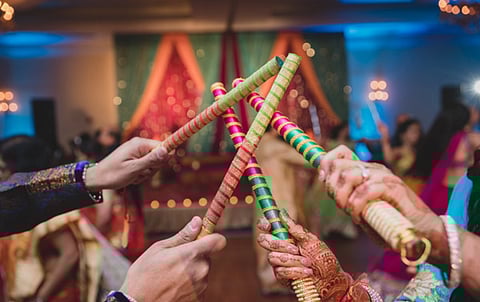
In Gujarat, the nights belong to garba. Dancers move in circles around a lit clay pot or an image of the goddess, using claps and flowing steps. Dandiya raas is danced in pairs with decorated sticks, and the striking sticks represent the battle between Durga and Mahishasura.
In West Bengal, the festival takes the form of Durga Puja. Huge clay idols of the goddess are placed in elaborately themed pandals, or temporary structures, and visited by crowds over the final days. On Vijayadashami, the idols are immersed in rivers and other bodies of water.
Southern India has its own traditions. In Tamil Nadu, families arrange Golu, a display of dolls and figurines on stepped shelves, and invite friends and neighbours to see it. A similar custom in Karnataka is known as Bombe Habba.
In northern India, Ramlila performances retell the story of Lord Rama through the nine nights. On Dussehra, giant effigies of the demon king Ravana are burned with fireworks.
Navratri in the UAE
In the UAE, garba and dandiya nights have become a fixture of the autumn calendar, with families turning up in chaniya cholis and kurtas to dance late into the night.
Organisers of the annual garba weekend at Zabeel and Mamzar parks have told Gulf News that the event typically draws 12,000 to 15,000 people. Last year's Navratri Utsav Dandiya Nights at Zabeel Park Amphitheatre drew thousands of residents and visitors over two evenings.
New events are also arriving. Mumbai's Rangilo Re garba celebration makes its Dubai debut at Sound Stage, Dubai Studio City on October 3, led by Indian singer Parthiv Gohil with a live band and orchestra priced at Dh49 at Platinumlist.
For first-timers, the usual advice is to wear comfortable flat shoes, join the outer circle of dancers and follow the steps of those around you.


