Stories off-script: Author Samit Basu’s journey across sci-fi, Bollywood, Netflix and literary mischief
Author Samit Basu shares a peek into the wild, chaotic world of writing
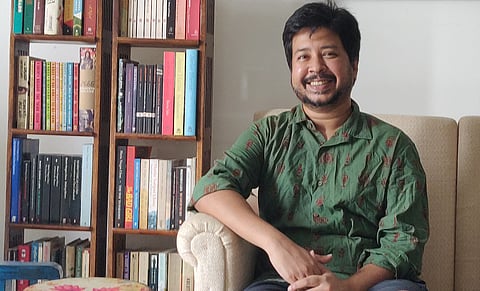
Writing, arguably, is like chasing Lewis Carroll’s rabbit and tumbling down the rabbit hole. It’s wonderful, weird, and occasionally bewildering — the kind of journey where you find yourself asking a leering Cheshire Cat which way to go next.
Sometimes, you don’t know where you’re going and, as the Cat reminds you, then it doesn’t really matter, does it?
It’s a wonderland, and it can also be a Kafka-esque nightmare, especially for an aspiring, fresh-eyed writer. So it’s reassuring when a seasoned author like Samit Basu—whose career spans fantasy epics, superhero fiction, contemporary novels, satire, and screenwriting—looks out for writers wandering into the rabbit hole.
In our conversation, infused with Basu’s wry humour, he shares the story of how he became a writer — a journey he describes as a ‘trail of confusion and enthusiasm,’ full of lessons and un-lessons picked up along the way.
Sipping coffee from a raccoon mug, he begins with a sense of raw, refreshing realism.
Where it all began
It’s a truth universally acknowledged that growing up with a home library almost guarantees you will try picking up a pen yourself.
Referring to an early period he calls ‘prehistoric’, Basu, who splits his time between Delhi and Kolkata, recalls where his itch to write began. “I think it was just reading a lot, as a child. And it was family circumstances too,” he says, explaining that because of a difficult environment, he spent most of his time indoors — and in books. “We had a library at home, and so the die was cast there. If you read a lot, you admire the writers that you read, and you want to be one,” he says.
Basu began writing in his college days. Referring to it as his ‘quarter life rebellion’, he says that he just wanted to write books and be creative. “These feelings let me choose the most impractical career possible. As you can see, I have mixed feelings,” he says with a laugh.
To genre or not to genre
Basu’s relationship with genres has always been fluid, instinctive, and occasionally conflicted.
The author of the fantasy Gameworld Trilogy, he says that he never really cared about genre. Referring again to the ‘prehistoric era’, he says, “Growing up, you didn’t read by genre. Bookstores didn’t have genre divisions, and I had no knowledge of writing or publishing in the first place. I didn’t know fantasy and sci-fi were different spaces. I discovered, only after publishing,” recalls Basu.
So he had two options: Pretend to be a sci-fi fantasy expert that he emphasises he isn't , or write whatever he felt like. As his body of work shows, he took the second path. While his new novel is a reimagining of Oscar Wilde’s Dorian Gray with a Bollywood twist, he has tried a variety of genres. “There’s sci-fi, superhero…it's all over the place. It’s a trail of confusion and enthusiasm, if I look back," he says rather modestly. He may call it that, but as any writer would admit, writing across genres and platforms for years, adapting to different voices, requires a steely mix of courage, determination, and creativity.
Nevertheless, as his career evolved, so did his awareness of how the publishing world categorises writers—and how narrow those lanes can be. “Ever since I became aware of genres, I’ve certainly thought about what genre a book belongs to,” he says.
Yet for Basu, the bigger concern is how the global distribution system works. When you start writing, you do it because you want to live an interesting life and not do boring things, he notes. But that’s an idealnworld; checklists follow you and you find yourself in the boxes. “Every kind of identity marker externally shapes the book you write,” he notes.
Fantasy and sci-fi, he explains, were dominated by the US and UK for decades, leaving little space for writers from elsewhere. Even as things have shifted slightly over twenty years, he remains acutely conscious of the gap between what he wants to write and what he’s expected to produce. For him, tension between what sells and what satisfies has shaped the arc of his writing life—not as a limitation, but as a map for negotiating artistic freedom.
Writing, satire, and the perils of calling something ‘funny’
Basu’s humour is quiet and razor-sharp, never leaning on punchlines or slapstick. He simply notes something, lets the wit shimmer for a moment, and moves on — the same clean precision that runs through his novels. While his books are known to readers as ‘satirical’ social commentary, Basu resists the label.
“The Jinn-bot of Shantiport wasn’t particularly satire,” he explains, before adding, “Satire is quite like comedy, the moment you call something satire as the writer, it ruins the effect. For instance, when you often hear a writer say ‘my book is so funny’, they’ve just lost their readers right there. Everyone will just turn around and say, ‘Oh is it?’”
Humour, for him, is instinctive—shaped by time, practice, and teaching. And so, when asked about how he balances humour with the serious elements in his novels, he answers with a laugh, “Oh, I have lots of free time. I have all the time in the world to sit and balance my elements.”
In short, the rhythm of humour, the layering of ideas, the instinctive choices is what molds tone. Teaching writing has shown him how much of a writer’s voice emerges from practice rather than intention. He is candid about the creative process: Writers must get comfortable with the fact that much of their early work will feel like ‘garbage.’
He explains: “And when you keep writing, you get better or you get more conscious of what you’re bringing to the table." His worry for writers struggling with themselves and their work, resurfaces as he says:" And a lot of the really good writers don’t get ahead, as they believe their work is nonsense.” They give up, halfway. It is too much to bear.
It’s a sentiment that Basu is too familiar with. “I felt that. I’ve felt that I produced garbage, but it’s okay to believe that. It means that you want to make it better. And when you reach the point, where you say, ‘I don’t know how to make it better, it is what it is’, and you send it out, then you are pleasantly surprised when others like your work."
Rarely will anyone produce a first draft on par with the world’s classics. That’s impossible, he says flatly — and believing otherwise often clouds your ability to tell whether your voice works for anyone else. But the opposite problem exists too: when a writer is so completely pleased with themselves that they can’t recognise when something is off in their work.
With time, he explains, you begin to understand how readers might receive what you’ve written. You gain more control, more pleasure in the work itself, and a wider range of choices in how to shape a scene. But that only comes from getting comfortable with your own instincts — no small task if you’re naturally self-critical.
Distance helps: Revisiting older writing, you may find parts that impress you and parts you now know you could do better. After decades of this, he simply writes and hopes for the best. “I have a reasonable amount of faith,” he says, “that if strangers liked my work before, they might like it again.”
The writer’s voice: Switching gears without losing yourself
Despite moving across genres that range from sci-fi to superhero comics and X-Men and Lucifer writer Mike Carey and zombie comedies, Basu doesn’t find the shifts particularly difficult. Different projects require different voices, children’s fiction is not the same as a grim social novel—but he likens this adaptability to the way people behave at different weddings and at home with friends, the same person, subtly altered for the setting.
Understanding one’s voice, he says, comes from two ingredients: Practice and clarity of intention. Writers must know what kind of experience they want readers to have.
His own confidence, he hints, comes partly from his background on stage—he was shy offstage but unusually free while performing. Writing taps into that side of him: the part that focuses on doing the work, enjoying the process, and trusting that strangers will connect with it.
How do you get through a Writer’s Block?
“I don’t manage Writer’s Block. I just suffer,” he says, laughing. Basu doesn't delve into the usual advice that you normally hear that include 'doesn't matter, keep writing something'. He doesn't insist that you plough through. Basu explains his viewpoint: "It helps, when you’re doing this for a living; you have to get the work done. I’ve burnt out several times. In this space, when you burn out, just don’t tell anyone else that you’re planning to quit or you're done. When you eventually get your energy back, you can return."
Nevertheless, he plans outlines for the ‘worst case’ scenarios. As Basu says, the writer’s block is something you carry throughout your life: Everyone has a different one, owing to their own psychological makeup. Over time, you slowly figure out the pattern of where you get lost, and the way forward from there.
Looking out for new authors
Basu is concerned for the new and aspiring writers. He worries for the advice, feedback and criticism they receive. It does send one reeling, as they wrestle with themselves The conflicting opinions drown out their inner voice. "When someone is starting out and wants to write, they’re so open and vulnerable. They’re ready to receive the worst advice. It’s tragic, and there are people who would give them unhelpful advice that would make their writing even worse.”
He notes emphatically: There’s no ‘correct’ approach to writing. It’s about what works for you and really, how you are as a person. Of course, he also brings it back to the earlier point: It’s also about deciding what you’re writing, and what you can sell.
From books to films, and back again
Basu, whose Netflix production House Arrest, released in 2019, relates that his detour into screenwriting was both accidental and inevitable. Mentioning how privileged he felt to co-direct a film, he answers why and how he got into screenwriting in the first place. “I was approached many times, for my books to be adapted into movies. I didn’t think it was a good idea; these books are around 500 pages and would require a certain level of Game of Thrones production. It can’t be compressed into one script, " he says.
To protect his stories, he started writing scripts himself. “I wrote a bunch of screenplays, and after years of failing, my first day on a film set was for a story where instead of the Marvel-esque epic that I planned, was a love story set in a flat.”
Following the pandemic, Basu returned to books after writing over 100 screenplays. The learning curve here: Greenlighting those scripts was another ballgame altogether.
That return to books has now brought him to one of his most ambitious experiments: A double-edition retelling of Dorian Gray.
What’s next: Dorian Grey, but Bollywood
Basu’s upcoming project is a retelling of The Picture of Dorian Gray, transplanted into Bollywood’s glittering, image-obsessed ecosystem. Eternal youth, vanity, and the unchanging public persona of movie stars form the thematic backbone. It’s also, he admits, a way of venting—after years spent observing the industry up close and watching aspects of it decline. "I’m doing a new thing; I’m switching genres when I’m approaching the West with it. “In the West, it’s a literary fantasy crossover,” he explains.
Two editions, two markets, two modes of storytelling—and one writer who resides in the in-between spaces where stories reinvent themselves.
And so, like Alice, as an author you keep walking—because in Basu’s telling, every writer eventually finds their way, even if the Cheshire cat keeps grinning.


