From Qurbani to community: How UAE residents celebrate Eid
From Qurbani to shared meals, UAE residents reflect on celebrating Eid abroad
Dubai: Eid Al-Adha is one of Islam's most significant occasions. Known as the Festival of Sacrifice, it commemorates Prophet Ibrahim's willingness to sacrifice his son in obedience to God, and sits at the heart of the Hajj season. For Muslims across the UAE, many of them far from their home countries, the day is a careful balance of faith, tradition, and community built over years of life abroad.
What Eid Al-Adha is about
Unlike Eid Al-Fitr, which marks the end of Ramadan, Eid Al-Adha is tied to the season of Hajj and the act of Qurbani, the ritual sacrifice of an animal in remembrance of Ibrahim's devotion. The meat is divided into three equal portions: one for the family, one for friends and neighbours, and one for those in need. It is a structure that places generosity at the very centre of the celebration.
Teacher Juhi Danish Zariwala, based at Sharjah Indian School, describes the wider spirit of the day. "The focus is on forgiveness, mending relationships, and community," she says. "Giving to charity is emphasised in both Eids, but it is built into the structure of the day."
How the day begins
The morning of Eid Al-Adha opens with the Takbir, the recitation of "Allahu Akbar, Allahu Akbar, La ilaha illa Allah," which is sounded through the days surrounding Eid. Families dress in their best clothes, with new outfits common where possible, before heading to the mosque or an open prayer ground for the special two-unit congregation prayer held in the morning.
After prayer, the visits begin. Houses open up, greetings of "Eid Mubarak" are exchanged, and the day takes on a warmth that is hard to replicate at any other time of year. For expat families in the UAE, this part of the day often looks a little different from back home, but the feeling is the same.
Choosing the Qurbani animal
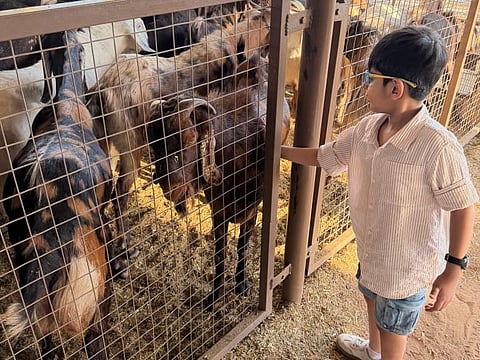
For some families, the Eid Al-Adha preparations begin well before the day itself. Muhammad Asad and his son Orhan Uddin make a tradition of going together to choose their Udhiya, the sacrificial animal. Goat prices this season are running between Dh1,500 and Dh1,800. For young Orhan, the trip is a highlight in itself. He enjoys feeding and playing with the goats before the sacrifice, turning what could be a routine errand into a meaningful moment of connection with the ritual.
It is the kind of experience that plants the tradition early, giving children a tangible sense of what the occasion is really about.
Arranging Qurbani from abroad
For those who prefer to arrange Qurbani through an organisation, the Sharjah Cooperative Society has built a strong reputation among residents. Mohammad Khalid, originally from India, has been using their service for several years and speaks highly of it. "The process is smooth, well organised, and handled with great care and professionalism," he says.
He has since recommended it to several friends, and describes every experience as hassle-free and deeply satisfying. "It has always made us feel as comfortable and connected as we do back in our home countries," he says. For expats who want the Qurbani carried out properly but cannot do it themselves, services like this offer both convenience and peace of mind.
Open doors and full tables
Tahseen, who has lived in Sharjah for over 15 years, has her Qurbani arranged back in India each year. But that does not make her Eid here any quieter. She starts the day by hosting friends for breakfast at home, her door open to whoever wants to come. It is a tradition she has kept up over the years, and one that sets the tone for the rest of the day.
Later, she heads out for dinner with her husband's work friends and her own circle, a community she has built steadily over a decade and a half in Sharjah. The table is big, the conversation is easy, and the evening stretches as long as it needs to.
It is a version of Eid that many UAE residents will recognise. The extended family may be thousands of kilometres away, but the people gathered around the table are family in every way that counts. Away from home, you build a new one, and on Eid, you celebrate with them.