Zeenat Aman recalls 'cracks' in marriage with Mazhar Khan: 'Rosy picture of domestic bliss was fading'
She framed the experience as part of a long series of returns and reinventions
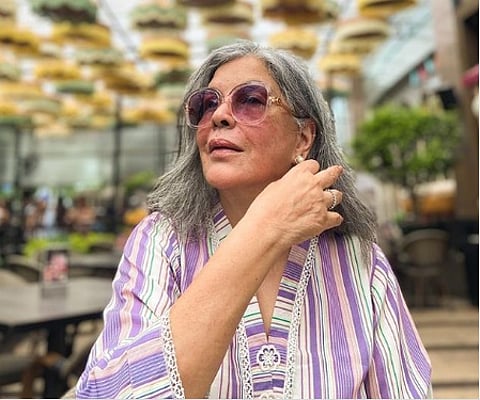
Zeenat Aman has long made her social media space feel like a living scrapbook, filled with honesty, a touch of glam and several reflections. In her latest post, she revisits a chapter from her life that blurred the boundaries between reel and real: the making of her 1980s film Gawaahi and the personal turbulence unfolding alongside it.
This time, the veteran actor opened up about her second marriage to late actor-director Mazhar Khan and the emotional strain she was navigating during that period. The shoot of Gawaahi became, in her words, a backdrop to a life in transition, one where domestic ideals were beginning to fracture, and she found herself questioning identity beyond the roles of wife and mother.
Sharing a behind-the-scenes clip from the sets of Anant Balani’s courtroom drama Gawaahi (shot in 1988), she paired the video with a deeply personal caption that traces both her professional return and private upheaval:
Get updated faster and for FREE: Download the Gulf News app now - simply click here.
She wrote, “How many comebacks can a gal have? When it comes to me, apparently the answer is unlimited! Gawaahi was shot in 1988, two years after the birth of my first son Azaan and just before the conception of my second born Zahaan. At this point in my life, the rosy picture of domestic bliss that I had conjured up while at the peak of my career was beginning to fade. Marriage and motherhood had both arrived, but the former was starting to show cracks. I was back living with my own mother (with little Azaan in tow) in her flat in south Bombay when an unexpected script arrived at my doorstep. It was a low budget courtroom drama based on Ayn Rand’s play The Night of January 16th, and it was terrifically pitched to me by producer Vivek Vaswani and debut director Anant Balani.”
The project itself brought her back into a creative rhythm at a time when she was, by her own admission, seeking an escape, not from fame, but from the weight of personal roles that had begun to feel consuming. With support from her mother, she stepped into the character of Janhvi Kaul, a woman entangled in a murder accusation, in a story adapted from The Night of January 16th. The film also featured performances from Shekhar Kapur and Ashutosh Gowariker, and was entirely shot in Mumbai.
Zeenat described a shift in how she saw herself, saying she didn't want to disappear into domestic expectations, but to reclaim a sense of individuality through work.
“Having once wanted to escape my professional life, I now wanted to escape my personal life and remember my identity as something outside of daughter, mother and wife! My amazing Amma stepped in to help out with Azaan and that allowed me to accept the role of murder-accused Janhvi Kaul in Gawaahi. We shot entirely in Mumbai, and the cast included the highly decorated Shekhar Kapur and the talented Ashutosh Gowarikar. I rewatched the film last night, and was reminded that it’s quite a bold and unconventional whodunnit! Kaul is the “other woman” and secretary to business tycoon Ranjeet Chaudhary, whose mysterious death is the pivot on which the plot turns. If slow burn legal dramas, with a dose of passion and perhaps a plot twist are your thing, this one may be worth a watch,” she wrote.
Closing her note with characteristic wit, she framed the experience as part of a long series of returns and reinventions—both onscreen and off.
“This interview clip is from the film set of Gawaahi, and for me personally it is madly nostalgia-provoking. The role marked my return to films after giving birth, and so of course it was also hailed as a comeback. One of many I’ve apparently had since! I guess you can call me a comeback queen.”
What happened in her previous marriage
In an earlier interview with Simi Garewal, Zeenat Aman explained why she left her husband. She said, “What had happened with Mazhar is that he had stopped helping himself. Whatever he was doing, he was inflicting further damage on himself and I couldn’t stay there and watch him do that.”
She explained, “What really happened is that he became addicted to prescription drugs, painkillers. He was at a point taking seven a day and the doctor had said that there was a good possibility that his kidneys would pack up. The children would request him, I would request him, we would tell him don’t do it but he didn’t.”
She added, “Eventually, his kidneys did pack up and this was after I had opted out. It took me a very long time to do that because when I left, I still cared. I had fought so many of his battles so hard for him. It was very difficult for me to leave even though it was a question of self-preservation.”
Zeenat revealed that after she walked out of her marriage, she was severely punished for taking a stand. She shared her children were turned against her and Mazhar’s sister and mother didn’t let them inherit any of her husband’s properties after his death. She said, “Every penny he possibly had has been taken by his mother and sister. There is nothing.”
In the same interview, Zeenat said that she was not allowed to pay her last respects to her husband after his death by his mother and sister. “They wanted to punish me for leaving Mazhar”, said Zeenat.
Also In This Package


