'I am a Pathaan, shoot me if you want': Sanjay Gupta on how Shah Rukh Khan faced down the mafia
The filmmaker says gangsters signed top stars onto films and turned up on set to watch
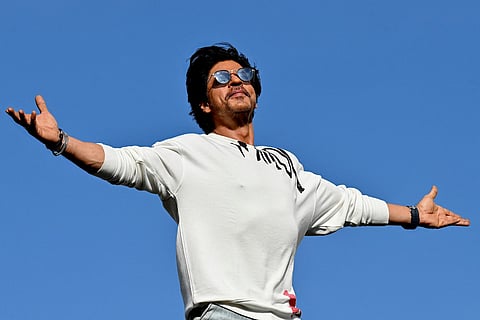
Dubai: There is a period of Hindi film history that everyone in the industry lived through and almost nobody discusses on the record. Between roughly 1995 and 2002, Mumbai's organised crime networks had a working relationship with Bollywood built on extortion, forced casting and, when that failed, bullets.
Filmmaker Sanjay Gupta has now given an account of it, and the anecdote at the centre involves Shah Rukh Khan refusing an offer nobody else was refusing.
What Gupta said
Speaking to Hussain Zaidi Files on YouTube, Gupta described watching the underworld operate at full strength in Mumbai. He listed the casualties: a Punjabi actor found dead at Film City, later said to have been an informant. Manisha Koirala's secretary, shot dead in his own office. Rakesh Roshan, fired on in the street.
The point Gupta returns to is that the film industry had no protection. He described its people as soft targets, and drew a distinction between routine extortion calls and what was actually happening, which was gangsters signing top actors and actresses onto films that were then made, with the financiers turning up on set to watch the shoot.
Then there was Shah Rukh Khan.
According to Gupta, when the threats came, Khan's answer was flat. "Pathaan hoon, goli maarni hai maar do," he said, which translates as: I am a Pathaan, shoot me if you want. He would not do the film. He would not do the shows. Gupta says the refusal earned Khan a kind of respect from the people threatening him, who seemed to register that at least one person in the industry would not move.
He has told this before
Worth noting for context: Gupta made a shorter version of this claim publicly three years ago.
In September 2023, days after Jawan released, he posted on X about having just seen the film and recounted the same exchange, using the same phrase. The Zaidi interview is a longer, more detailed telling rather than a new disclosure.
Hussain Zaidi wrote Dongri to Dubai, the definitive account of the Mumbai mafia, and Gupta adapted it into Shootout at Wadala in 2013. The two have worked together on precisely this subject before.
The incidents Gupta lists are on the record
Rakesh Roshan was shot on 21 January 2000 outside his office in Santacruz, a week after Kaho Naa Pyaar Hai released and turned his son Hrithik into a star overnight. Two of Abu Salem's men fired on him. One bullet hit his left arm, another grazed his chest. Roshan later described two men appearing in front of him with revolvers and opening fire, and said he had ducked repeatedly before one round found him. Hrithik came close to leaving the industry afterwards. Investigators suspected the attack was pressure to push him into a mob-financed film.
Ajit Dewani, Manisha Koirala's personal secretary, was shot dead outside his Oshiwara office on 30 June 2001. Police attributed the killing to Salem's gang. The stated reason was that Dewani had failed to deliver on what had been promised.
Before both came Gulshan Kumar, the T-Series founder killed in broad daylight in 1997, a case in which Salem's involvement was suspected but never proven to the standard required.
Court records and police statements from the period list Salem's extortion targets across the industry. Shah Rukh Khan's name is on that list, alongside Salman Khan, Amrish Puri, Preity Zinta and J.P. Dutta. The singer Daler Mehndi was also fired on, on Salem's instructions.
So the threat Gupta describes Khan receiving is corroborated by the record. What is not independently documented is the response.
Farah Khan has said something similar
Gupta is not the only person from that era to have discussed it publicly, though most stop short of naming who received what.
On Ranveer Allahbadia's podcast, Farah Khan confirmed that pressure on the three Khans did exist. Asked specifically whether Shah Rukh had received a call, she said she did not know, but recalled a threat made to Karan Johar around the time of either Duplicate or the Kuch Kuch Hota Hai premiere. She described it as frightening, and said there was a serious discussion about whether the premiere should go ahead at all.
The line has an afterlife
Khan returned to cinemas in January 2023 in Pathaan, after a four-year absence and a difficult stretch that included the failure of Zero in 2018. The film was his biggest opening.
Gupta's account is a filmmaker's recollection of conversations he was not party to, given more than two decades after the fact, on a channel run by a writer he has collaborated with. Khan has never discussed the episode publicly and has not responded to this telling.
The surrounding history is solid. The specific exchange rests on Gupta's word.


