From Greece to Iceland: Inside the locations that brought Christopher Nolan's The Odyssey to life
From Greece to Iceland, Christopher Nolan used real locations instead of digital worlds
Dubai: Christopher Nolan built The Odyssey around a simple rule: no green screens, no digital environments, wherever it could be avoided.
That meant sending his cast and crew to six countries over roughly six months, hunting down real coastlines, castles, volcanoes and glaciers that could stand in for Homer's ancient world without a single frame of CGI trickery.
Here is what each location actually became on screen, and why Nolan picked it.
Greece: the return itself
Greece got the most obvious job, since it is the country Odysseus is actually trying to get back to. Filming took place across Messinia, in the Peloponnese, in March and April 2025. Voidokilia Beach, with its near perfect horseshoe shaped cove, was used alongside Nestor's Cave nearby, reportedly the setting for the film's Cyclops sequence with Polyphemus.
The Methoni Castle, a Venetian fortress built in the 13th century that sits partly in shallow water, and the Acrocorinth, a fortress site above the city of Corinth dating back nearly 2,500 years, both feature too. Using real, ancient Greek ground for a story about the pull of home was less a filming choice than an inevitability.
Morocco: the fall of Troy
Troy itself was recreated at Aït Benhaddou, a UNESCO listed ksar, or fortified village, near Ouarzazate. Its earthen, mud brick buildings and defensive walls have made it a go-to filming location since the 1960s, previously standing in for the ancient world in Lawrence of Arabia, Gladiator and The Mummy, which makes it an almost natural choice for Nolan's own ancient epic.
Additional scenes were shot around Marrakech, Essaouira and Tahanaoute, with the production also travelling further south to the Atlantic coast near Dakhla for extra coastal footage. The undulating dunes and centuries old architecture gave the film an atmosphere no set built from scratch could easily match.
Italy: the island of the winds
Sicily and its surrounding islands did some of the heaviest lifting. Favignana, part of the Aegadian Islands and known locally as Goat Island, is widely believed to be the real island Homer described as the place where Odysseus and his crew rested and restocked supplies before their encounter with the Cyclops. Its jagged coves and turquoise water were used for naval manoeuvres, a shipwreck sequence and tense beach landings.
Above it all sits Castello di Santa Caterina, a ruined castle on the island's highest point, used for the film's clifftop sentry scenes. Matt Damon has described hiking up to it every day for two weeks during the shoot, a roughly 900 foot climb, with helicopters used to move equipment up and down instead.
Further north, the volcanic Aeolian Islands of Lipari, Vulcano and Basiluzzo stood in for Aeolia, the floating island home of Aeolus, keeper of the winds. Their black sand beaches and, in Stromboli's case, an active smoking volcanic cone, gave Nolan a genuinely elemental landscape to work with rather than one built digitally.
Iceland: the underworld
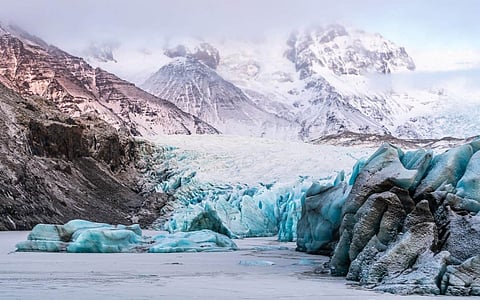
In Book 11 of Homer's poem, Odysseus sails to the underworld to consult the blind prophet Tiresias, and Nolan turned to Iceland to bring that sequence to life. The black sand and caves of Hjörleifshöfði, the Snæfellsnes peninsula, the river Markarfljót and the harbour at Landeyjahöfn all feature.
It is not the director's first time using the country this way: he shot parts of both Batman Begins and Interstellar at the Svínafellsjökull glacier in the country's southeast. Iceland's steaming geothermal vents and stark, glacial terrain gave the underworld sequence a genuinely otherworldly quality without needing a single digital environment.
Scotland: the shape of Ithaca
The Moray Firth coast, a roughly 500 mile inlet across northern Scotland known for its sea stacks and resident bottlenose dolphins, became the film's version of Ithaca. Findlater Castle, perched on a cliff above the water, and the nearby Culbin Forest both appear on screen.
During filming, a full scale wooden Viking longship, the real life Draken Harald Hårfagre, was spotted docked in Buckie Harbour, standing in as Odysseus's own ship. The wild, windswept coastline gives Ithaca the feeling of a home that has been waiting a long time for its king to return.
Malta: Calypso's captive
Malta's contribution is smaller but pointed. Calypso's Cave, near the town of Xagħra on the island of Gozo, was used for the sequence in which the nymph Calypso holds Odysseus captive for years, delaying his journey home.
Local legend has long associated the cave with exactly this part of the myth, making it less a stand-in location than the closest thing to the real setting the production could find. Malta has its own long history in ancient world filmmaking too, having previously hosted Troy, Gladiator and Alexander.