Narendra Modi-inspired film to release this week
‘Modi Kaka Ka Gaon’ in loosely inspired by Indian Prime Minister’s development agenda
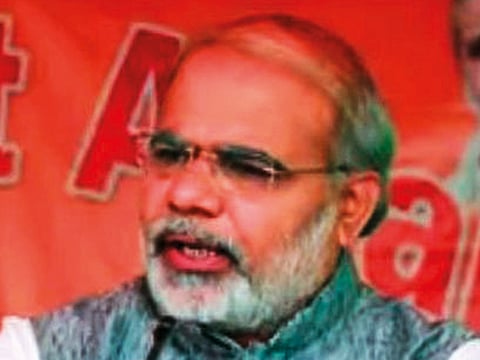
Nearly 11 months after it was denied a censor certificate on various grounds, Hindi feature film Modi Ka Gaon — now renamed as Modi Kaka Ka Gaon — will finally release in India on Friday, filmmakers said.
The movie in loosely inspired by Indian Prime Minister Narendra Modi’s development agenda.
“In the first phase, the Hindi film will be released for around 600 screens in Maharashtra, Gujarat, Delhi, Uttar Pradesh, east Punjab and Uttarakhand. The rest of the country will be covered soon thereafter,” producer Suresh K. Jha said.
Posters and banners went up on roads and several cinemas and multiplexes in Mumbai city and suburbs, besides other cities in the country this week, heralding Modi Kaka Ka Gaon.
The development comes close on the heels of the Central Board of Film Certification (CBFC) giving the censor certificate to the movie in late November. It had been refused for eight months.
Jha reiterated that the film is “not a biopic on Modi”, but the story has been inspired by the Prime Minister’s vision for the country’s progress.
“I am keen that the work of the great leader should be highlighted since some people are making false propaganda and harming the country’s interests,” Jha said.
In February, then CBFC Chairman Pahlaj Nihalani declined to certify the film on various grounds and set a precondition of a No-Objection Certificate from the Prime Minister’s Office (PMO) and Election Commission of India (ECI) for clearing it.
Jha wrote to the PMO and ECI, but they did not respond, after which he moved the Film Certification Appellate Tribunal (FCAT) and won the case there in October.
In its October 12 order, the FCAT said that there are no statutory basis or justifiable requirements for getting NOC from PMO and ECI.
“The requirement to obtain NOC from the PMO, since either references are made to the PM or a character is portrayed as the PM, have no legal basis or foundation,” the FCAT ruled.
“The statutory responsibility for certification of films is cast upon the CBFC Board under the Cinematograph Act. [It] cannot be delegated to different statutory authorities, departments or individuals,” the order added.
It noted Jha’s contentions that though the film has been inspired by Modi’s development plans and strategies, the scenes in the film are imaginary and not reproductions of any actual events.
“This was a major victory for us. All the objectionable points raised by the CBFC were crushed by the FCAT and we decided to finally release the film this month-end,” Jha said.
Nihalani’s reluctance stemmed from the ongoing assembly elections in some states at that time (early 2017), the resemblance of the main protagonist to Modi, references to the Uri attacks, news speeches related to the PM and a character named ‘Pappu’ Bihari featuring in the film.
The FCAT also considered Jha’s plea that ‘Pappu’ is a child’s pet name in many parts of India and later it supersedes the child’s given name. Also, in the past, there have been instances like Bollywood song Pappu Can’t Dance Saala and an advertisement with the slogan Pappu Pass Ho Gaya.
“Although it is not a biopic on Modi, throughout our film, we represent the working of our PM, his dream of Swachh Bharat Abhiyan [Clean India Movement], Smart India and Digital India,” Jha explained.
About the Modi look-alike, he said when the film is about Modi’s development agenda and vision of transforming India, how can it be portrayed with somebody else who does not resemble him?
However, in the changed avatar, Modi Kaka Ka Gaon, he has deleted controversial references like ‘Pappu’ and direct references to the Uri attack and the PM in sync with the CBFC’s requirements.
Mumbai businessman Vikas Mahante enacts the main character of Modi. Television actors Chandramani M. and Zeba A. portray the other important roles in the 135-minute-long film, directed by Tushar A. Goel.
It was shot last year extensively on locales in Mumbai, Patna and Darbhanga, detailing the Prime Minister’s aim of transforming all rural and urban centres into Smart Villages and Smart Cities.
With seven songs featuring, the music for the film is directed by Manojanand Choudhary.


