Working on blueprint for Rolls-Royce’s revival
Current CEO has to strip away the legacy problems to make profits fly again
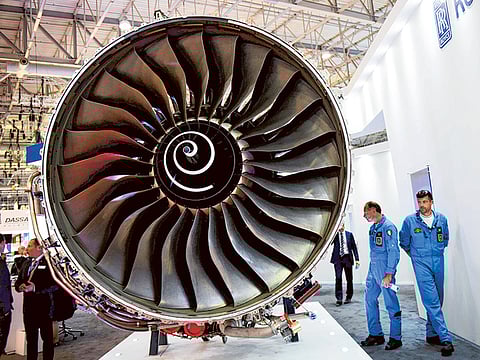
Warren East is blunt about the challenge he faces in reviving Rolls-Royce, Britain’s premier engineering company, which is reeling from five profit warnings in 20 months.
There was a lot of “mud” clogging up the group’s information systems, said the new chief executive, as he unveiled the first findings of the operational review he launched on arrival in July. By that, he means the bureaucracy and cost that has built up over decades as the 109-year-old company has expanded to become one of the world’s leading manufacturers of passenger jet engines.
In a long awaited investor briefing, East set out his assessment of Rolls-Royce’s strengths and weaknesses. He identified areas where the group proposed to invest for the future, and indicated that Rolls-Royce would have to face up to some hard truths about its product range — even in the core aerospace business.
He admitted that the group’s failure to win a place for its engines on the most popular regional jets now entering service could signal an eventual withdrawal from this market.
He also told investors that Rolls-Royce would stop “wasting time” debating when and how it should re-enter the booming market for narrow-body jet engines. Instead, it should focus on the investment challenges for the next generation of wide-body jet engines.
Finally he attempted to clarify the “accounting fog” that had left investors confused about how Rolls-Royce treated the long-term revenues that make up the bulk of aerospace earnings and are derived from servicing jet engines.
If investors were expecting to walk away with a blueprint for a new Rolls-Royce, they were disappointed. East remains committed to a strategy that sees the group’s technology applied across areas beyond aerospace. This strategy has been challenged by some investors, not least the group’s biggest shareholder, the US-based activist ValueAct.
East signalled that, while some product lines might be rationalised across the group — in power systems, the struggling marine business and aerospace — there was no question of significant disposals. “Don’t expect wholesale change,” he told reporters.
About 60 per cent of the group’s land and sea division — which some investors think should be disposed of — was positioned in attractive markets with growth potential, he added.
Moreover, he said there would be no medium-term earnings guidance for 12 to 18 months, partly because the group’s unsatisfactory accounting processes meant it was difficult to give targets.
But Rolls-Royce’s chief executive was clear that this was not a bleak story. “This is fundamentally a good business with arguably some of the best engineers in the world,” he said.
East’s ability to convince investors that he can cut costs and get a grip on the day-to-day performance of the business will be crucial to restoring confidence shaken by the profit warnings.
The task is made all the more urgent by the fact that Rolls-Royce’s core aerospace engine business, which accounts for more than 60 per cent of sales, is facing its most significant production challenge since the Second World War. The number of engines it has to deliver will double from 1,600 over the last decade to more than 4,000 over the next.
East’s admission that there could be yet another profit warning as he attempts to change Rolls-Royce’s “operational software”, as he describes it, is a sign of how mammoth the task is.
Despite the absence of hard numbers in the briefing, East attempted to paint a picture of the opportunities for improvement and for streamlining management.
He used the example of how the company — renowned for its groundbreaking Trent engine for wide-body jets — manages the advances that will shape its future.
“We have identified 27 key technologies,” he said. “We manage them ... with multiple management meetings, multiple committees, all times 27. But if you think of them as eight key technology themes ... you can reduce the overall numbers of meetings and management you have to have.”
But shaking up a company that for decades has wrapped itself in a glow of engineering excellence will not be done overnight.
East will have to change Rolls-Royce’s slow-moving, bureaucratic processes even as it contends with a costly transition from older, highly profitable jet engine programmes to new generation turbines whose margins will be significantly lower for some years to come.
Amid the downturn in the oil and gas industry, there is also weak demand for the group’s marine engines.
The challenge for East is to free up the resources to invest in the next generation of aircraft, while also delivering returns to shareholders.
To do so, Rolls-Royce will have to change the way it works, and perhaps even more controversially for a flagship of British engineering, where it works. The shift of manufacturing to low-cost countries will have to accelerate.
John Rishton, Warren East’s predecessor who presided over three profit warnings even as the civil aerospace order book grew to record highs, expressed frustration before he left at the inability to bring down costs sufficiently to ensure the group would have the resources to compete when the time comes.
It was hard to cut costs he once told investors, without a “burning platform” to create a sense of crisis. East is now the man standing on that platform — the question is whether he has the equipment needed to prevent the fire’s spread.
Financial Times


