Syria battles crippling drought
Urban areas face growing pressure as people migrate in search of jobs
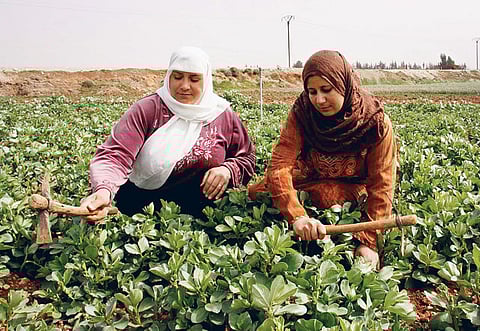
Damascus : A farmer balances skilfully on a plank of wood that a horse is drawing across a small patch of earth to cover freshly planted garlic, and as he works other men stand nearby chatting animatedly about the weather.
It is a scene that has been replicated for centuries in Syria's semi-arid hills and valleys, where farmers harvest crops, tend fruit trees, and herd sheep and goats.
However, the conversation of late, punctuated by glances and gestures towards the heavens, has taken on additional urgency as the nation grapples with a three-year drought that experts describe as the worst in four decades.
"It's getting harder and harder every year," says Turki Hussain Yezbak, one of the farmers.
The impact has been felt across the country, with 1.3 million people from the rural east and north-east "drastically affected" and 40,000 to 60,000 families forced to migrate in search of alternative employment, putting extra pressures on urban areas, according to a UN report in September.
In some areas, rainfall has been about 50 per cent below the long-term average.
Government officials seek to play down the drought, citing recent rains to suggest that the problem has diminished.
Climate change
However, "references to climate change have entered the [government's] narrative" for the first time, says a western diplomat.
Lack of water is a problem that blights the entire the Middle East, where most countries are unable to meet demand for water.
By 2050, per capita water availability is expected to fall by half, according to the World Bank, as populations and economies expand, while rainfall patterns are predicted to shift because of climate change.
In Syria, which lacks the financial resources of many of its oil-rich neighbours, water supplies to urban households are cut off each evening. About 90 per cent of its water is consumed by agriculture, which accounts for about 20 per cent of gross domestic product, and the sector is mainly dependent on rain-fed irrigation.
"When you have a good season, the economy grows; when you have a drought, it slows down," says Nabeel Shuka, a Syrian economist.
"A lot of people have been displaced so it creates pressure on Damascus and this is a problem — it's a social problem."
The outskirts of Yabroud, a small town about 90km north of the capital, is where the farmers are chatting. Yezbak mulls over the causes of the drought.
"It's because of the factories — they are bringing pollution. Also the nature, it has changed," he says.
For him and his colleagues, it is a problem that has become noticeably worse during the past decade. To make a point about the changing climate, Yezbak holds his hand out flat above the road.
"We used to have too much snow, almost half a metre of snow, but this generation does not know snow."
A nearby reservoir that used to irrigate the plots dried up some 10 years ago, the farmers say, its cracked bed collecting rubbish.
A water mark on the rock face that forms a wall provides lasting evidence of the amount it once held.
As a consequence of the diminishing water, walnut trees have wilted and vegetables such as potatoes, beans and marrows are no longer grown in the area, the farmers say, pointing to a sandy, barren patch of land they say would have been cultivated years ago.
Sewage irrigation
Apricot trees still dot the area, although some are using extreme measures to keep them in fruit — local sewage is the irrigator.
"In the past people were against sewage water when it was pumped, but now they are fighting to get the sewage," says Safar Saibeha.
As he walks through clusters of apricot trees, the stench of the sewage flowing along irrigation channels is unmistakable. Saibeha is uncertain what impact the sewage has on the fruit, but says he has no choice.
Farther to the north and east, in areas such as Al Hassakeh, Deir Ezzor and Ar Raqqa, the situation is far worse.
In some districts, livestock farmers have lost up to 70 per cent of their herds, while others have endured failed crops for a third successive year, according to Abdullah Taher Bin Yahya, who represents the UN Food and Agriculture Organisation in Damascus.
The lack of rain has sucked farmers into a vicious circle. Because of the drought they have to buy fodder to feed their livestock, but the failure of crops has driven up cereal prices. And because so many farmers are being forced to sell their sheep and goats, livestock prices have plummeted.
"It's always the same people who are suffering," Bin Yahya says. Mohammad Darwish is among those. Leaning on a stick, his head wrapped in a kaffiya to protect it from a biting cold wind that blows through the valley where he is minding a herd of sheep, he explains that he had to abandon his farm in Al Hassakeh after his crops failed for three years.
Once the owner of 50 sheep, he says he now owns just five goats and was forced to take the job as a shepherd in Nabek, a short distance from Yabroud.
"For three successive years, I never saw a single stem come out of the land," he says.
"I'm almost 60 years old and I have to do this difficult job."
He says most of his neighbours in Al Hassakeh were also forced to leave.
Bin Yehia says the government is helping farmers, with measures such as food assistance and the rescheduling of loans, but the size of the problem is "beyond the capacity of the country."
UN appeal
To assist, the United Nations has appealed for $53 million (Dh194.6 million) and Bin Yehia says farmers need assistance to improve machinery and modernise their practices.
Shuka, the economist, says a critical issue is the fragmentation of land.
The government put a ceiling on land ownership in the 1950s, and this was lowered further when the Baath party took power in the 1960s.
Indeed periods of drought have played a part in Syria's wider, political woes. Sukkar recalls that there was a drought in the late 1950s, when Arab nationalism was flourishing and Syria joined Egypt to form the United Arab Republic. The union lasted only from 1958 to 1961, and Syria entered a period of instability. Drought and the economic woes it wrought may have been a factor in the union's demise, says Shuka.
"So now we have drought, I hope it will not create political problems."
— Financial Times


