Steel is big in modern art and design
From minimalistic furniture and shining works of art to slides to travel from one floor to another, steel is fast emerging as the design element of choice among artists, designers and buyers alike
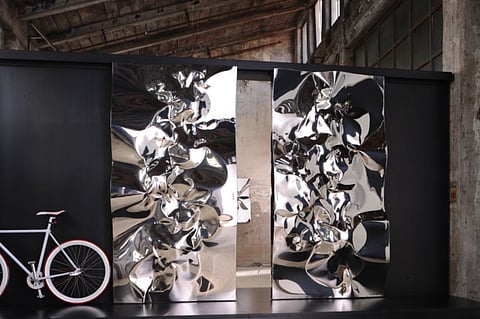
Avant-garde designers who work with steel to create art are pushing the limits of technology to make the material translate their artistic visions. Steel becomes a sparkling kitchen sink or shiny rods to show off Japanese designer Issey Miyake’s merchandise with ease and is preferred to achieve that futuristic look in fitted interiors.
Home chic
Maria Pergay’s Ring Chair and Flying Carpet Daybed, exhibited in 1968, remain the best examples of how steel can be used to create impressive interiors. Last December, she collaborated with fashion house Fendi to create signature furniture combining fur and leather with stainless steel for the international design show Design Miami 2013. Steel flower petals and surreal cabinets came together with leopard print chairs, marrying minimalism with a material traditionally reserved for pressure cookers.
Linus R. Adolfsson of the Los Angeles-based Gallery Seomi says, “Steel is not commonly used in furniture design since it is heavy, lacks flexibility and appears uninviting and cold. Pergay was the first artist to really dig deep into steel. Her impact and touch on steel is beyond real to me and she will forever remain a role model and pioneer for the use of steel in furniture design.” One of the artists that the gallery represents, Kim Sang Hoon, is making an armchair and a sofa using steel to be shown at Design Miami/Basel this June.
Known for its strength, steel is used in interiors and exteriors to create structural frames that can carry weight. With the metallic look back in style, steel tiles are being used in kitchens, bathrooms and even living rooms. The alloy also lends itself to futuristic design by morphing into curving sofas, chairs and tables while customised kitchen islands made of high-grade stainless steel are becoming visible in Dubai and other parts of the world. In New York, intrepid homeowners are installing stainless steel tubes or slides as a fun way to travel from a top floor to a lower floor. >
At the 24 Issey Miyake store in Tokyo, Japanese firm Nendo came up with a steel solution to solve an interior design problem. The brief was to create interiors similar to a Japanese convenience store to accommodate price, variety of colour and form of the products (such as the formless Bilbao bag) and frequent changes in the line-up.
According to the Nendo website, “To match the bag, we abandoned the standard flat and smooth fixtures and created a set of variable height fixtures made of thin steel rods similarly undefined in shape. Supported by points instead of surfaces or lines, the bags seem to waft in the air like flowers in a light breeze.”
Alloy art
Artists who use steel describe an enduring preoccupation with the material. Emirati artist Mattar Bin Lahej, who has used steel to create calligraphic sculptures, is currently working on a series that will be shown at the Sharjah Islamic Museum. “The sculpture consists of signs and symbols in a balanced vision and presents the history of Arabic calligraphy through the years to its contemporary form as 3D artwork,” he tells GN Focus.
Steel is Albanian designer Helidon Xhixha’s favourite material as well. His sculptures are found all over Dubai, including in Meliá Dubai. Xhixha once used steel to create a portal to a house of the future at an exhibition in Italy. “It’s a large, gleaming sliding door combining sculpture and design and leading to new conceptions of the world’s most beautiful homes,” he says.
In fact, the alloy often attracts designers looking for a challenge. Adolfsson says, “Its attraction lies in the possibility of overcoming its limitations and creating something unique.” Consequently, designers are using technology to make it come alive.
“My technique of cold-working steel by folding it, turning it inside out and marking it became my signature style,” says Xhixha, who uses 316 marine grade stainless steel, known for its resistance to corrosion. To make the most of the reflective qualities of steel, which add light and colour to any surrounding, is a craft in itself too. “I don’t sculpt steel; I use it to sculpt light. To me the form of a sculpture becomes secondary and its capacity to reflect and illuminate takes prime place,” he says.
For French enameller Anne-Marie Naboulet, steel is challenging because she can make it do unexpected things. “Steel is generally considered austere, cold and hard, but I want to show that it can be very expressive and warm. Adding colourful and shiny enamel smoothens its roughness,” she says. For lighting, Naboulet uses very thin stainless steel sheets, bent and folded in spirals and reaching a delicate balance before breaking point.
Adolfsson says that the single-largest contributor to New Age steel art and design is laser-cutting technology. “It pushes the boundaries of what is possible to achieve with steel as well as other materials.”


