European charm set to captivate The World
Kleindienst Group sees strong demand for holiday homes on landmark Dubai development.
The island cluster — titled ‘Heart of Europe' — is in transit from sand to characterise in some form the European states they take their name from.
"The islands are a celebration of each country's unique architecture and culture," enthuses Josef Kleindienst, chief executive of the Kleindienst Group. Thus, Switzerland will offer romance and tranquillity, the Netherlands will be home to chic clubs and lounges, and Germany — true to its national identity — brings innovation. And Russia somehow is to represent wonder.
To maximise the development's attractions, six more destinations are integrated into the islands — Belgium, Geneva, Luxembourg, Monte Carlo, Poland and Sochi. Kleindienst, of course, knows he cannot recreate Europe in its entirety at The World. The intention is to hand pick certain attributes of each country and city and try to translate them into the environment here. For example, Austria, will be elevated onto a hill, while Sweden gets a climate-controlled road, and Germany will get a tree-lined avenue.
"Germany is the first to break ground in the first quarter of this year, in Phase One we're building 20 villas Sült and in Phase Two the five-star hotel Sült," Kleindienst adds.
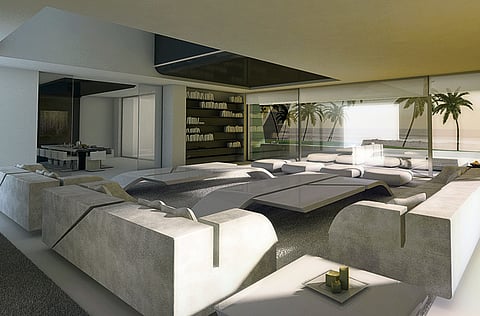
Sült is a rather fitting name for the minimalist looking villas. It is a popular holiday island in northern Germany, and it's easy to see how the developer sought to make a link with the project emerging off the Dubai waters.
This project though is not a development for permanent residents, but a holiday home destination, and Kleindienst sees this distinction as The World's future. Around 70 per cent of the 300 islands have been sold and over 30 handed over to date.
"There are no permanent residences or offices, which would disturb the holiday feel," he says. "We know there is strong appetite for this in Europe, Dubai is closer to them than other destinations. I also expect to attract GCC residents and expatriates." Some of the villas, or rather their seafront plots of 6,000 to 40,000 square feet, ranging from Dh1.8 to Dh12 million, have already been sold.
Kleindienst wants to instil confidence by handing over the land title as soon as the sale is closed and then have the investor pay for construction. More importantly the instalments will be deposited directly into an escrow account.
The three- to five-bedroom villas are selling at Dh500 a square foot for the entry level pre-designed core and shell. Then, buyers can choose individual designs and finishing for the interiors, which means prices will rise accordingly.
This means a villa could set one back anything between Dh4 and Dh15 million. The Spanish architectural firm A-cero has provided the sleek designs.
Kleindienst rationalises his extreme confidence in the development, and backs it up by trotting out relevant numbers. Germans own over 200,000 holiday homes and are expected to buy a further 60,000 this year alone, and this at a time when investor confidence in global realty is shaky.
"We have a property ownership model which follows European guarantees and international property law standards," the chief executive lets on. "So there is no risk to buyers that the project will not get completed."
This means the developer will not start constructing until an island is fully paid off and he holds the title deed from the Land Department. The island of Germany has already met these requirements, and Kleindienst expects to pay off the other five islands by 2012, with the Netherlands and Switzerland up next.
"We did have to change our pre-crisis plans slightly, we had planned to reshape the islands," Kleindienst attests. "But it is healthy that prices have come down, Dubai shouldn't be too expensive. In Europe they say a person shouldn't spend more than 30 per cent of his income on housing; here it is more."
Sustainability gets a strong look-in on the design front, with the Fraunhofer Institute roped in to take care of that important aspect. The developer's local partner, Sharjah-based Al Amiri Group, will offer its expertise in managing environmental services.
Water conservation methods should reduce the need by around 50 per cent and power savings of 80 per cent are envisaged.
The solar power system and the sewage system cost Dh300,000 and Dh50,000, respectively for each villa.
But there is a huge payback for the owners, whatever power they do not use feeds back into the islands' grid. Service charges will be decided in a transparent manner by actively involving all the concerned homeowners.
"When we bought the islands in 2006 it was clear that we as the owners had to take care of our infrastructure," Kleindienst explains.
"DEWA may connect these islands when 10 per cent is under construction, but we may have to tank in fresh water from Port Rashid."
It was in December 2006 that Nakheel duly informed The World developers they were to assume responsibility for connecting their own islands to the secondary and main utility services hubs, including waste water. Water and electricity was to be connected to the mainland grid via under-water pipes and cables.
Similarly, a sophisticated marine transport system with the RTA was in the planning. One would assume that by the time sub-developers are closer to completion, this will materialise.
According to The World's website, the infrastructure network will be introduced in phases depending on the need of the master-development.
To finance the venture, Kleindienst says he has made enough to see them through until 2012, when the developer expects banks to start lending at decent rates again. He is looking forward to getting the other 70 per cent to complete the project by 2015.
"I sold Dh1.1 billion worth of properties between January and June 2008 to secure financing for this project. The villas should take no longer than a year to complete."
Since arriving in Dubai in 2003, Kleindienst has been involved in an array of real estate related ventures. These include brokerage activities, buying properties in developments throughout Dubai and developing the European Business Centre offices. However, his Jumeirah Village South Crystal development is currently stalled.
"There is a delay in infrastructure," he elaborates. "We're also discussing with Nakheel what to do regarding the Dubai Waterfront, there is only one investor in my development."
A peep into the heart of Europe
The ‘Heart of Europe' will house 75 private holiday homes, six apartment buildings, six lighthouses and six floating palaces as well as six hotels. One of them is Austria's Empress Sissi.
"We're looking for traditional, small family hotel owners with a proven track record willing to invest 30 per cent into the hotels, rather than large operators to make these hotels unique," says Josef Kleindienst, chief executive of the Kleindienst Group. Other features will include a climate-controlled shopping boulevard, entertainment venues, including an underwater aquarium and an Amsterdam nightlife district. Underwater villas, marinas as well as museums and fine arts from each country are also on the menu.
Does all this remind you of Dubai's realty talk circa 2007 up to the fourth quarter of 2008? It sure seems so.
Whatever the final shape of the Heart of Europe will be, it does seem that Dubai's developers, at least some of them, are starting to think of a life beyond recession.


