Online threat: Bookshops rewrite plans
More readers prefer e-books to paper, bringing hard times to book stores
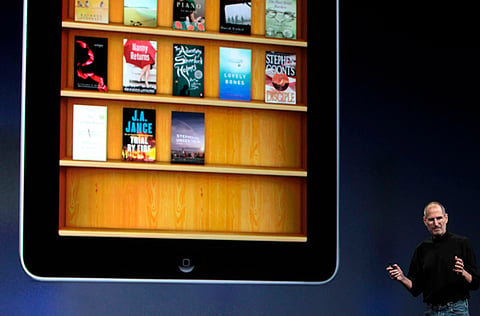
For some people, going to a bookstore is a chance to catch up with the latest authors and get the titles. But to a growing number of people, bookshops are becoming dinosaurs from another age.
Online sales of books in many western countries have been threatening brick-and-mortar bookstores such as Borders and Barnes and Nobel, for almost 15 years, forcing them to close down some stores. Physical books, too, are being replaced by a growing number of readers who prefer e-books.
However, the difficult situation exists in maturing markets — as opposed to "emerging markets" where the illiteracy rate is still increasing, say managers of bookstores in the UAE. Yet even here some bookshops have closed down in the past few months as "part of a revision in their strategic plans in response to changes in the market."
"At the moment, there is a huge difference between the UAE and the rest of the world," Dubai-based Mathew Cowdery, book range manager at Magrudy's bookstores, told Gulf News. "We are definitely behind the cap. America is leading the way.
Future concerns
Magrudy's, which has presently five stores across the UAE, has closed down some branches in the past few months as a result of a "revised portfolio of retail shops" in response to market changes, Cowdery added. New locations will open in the coming months, including one in Abu Dhabi at Zayed University. The closure has raised concerns of the future of physical bookstores, and fears of a similar transformation to the changes in the American market.
Borders Group has been going through difficult times that resulted in its filing for protection from creditors in the US bankruptcy court. The company has faced more than $50 million (Dh183.6 million) in losses since then. The chain, which started with one store in 1971, is planning to close 228 of its 642 stores by the end of May. Recent reports said the troubled company is discussing selling more than half of its remaining stores.
Borders' situation was so bleak that it was unable to find a buyer when the entire chain of stores was up for sale.
Last Thursday, the bookstore chain asked a bankruptcy court judge to extend the time during which it has exclusive rights to propose a reorganization plan to its creditors.
The extension sought was for 120 days, and the judge is scheduled to consider the request on June 2, nearly four months after Borders initially filed for bankruptcy protection with liabilities of about $2.6 billion and assets of $1.6 billion.
Barnes and Nobel is also facing financial trouble, and has already announced it will be closing some stores across the US.
The main factor pushing these stores to ruin is the flourishing of online book sales and the introduction of electronic books.
Sales of e-books in the US reached $966 million in 2010, according to a report by Forrester Research, an American technology and market research company. It predicts sales will hit $3 billion in 2015.
"Bloomsbury Publishing Group is confident that this year (2011) is the year the e-book takes hold," a press report said recently, quoting the British independent publisher.
The publisher's expectations are based on the 4 per cent increase in revenues last year, peaking at £90.7 million.
Western publishing houses are also publishing and selling increasing numbers of books. Over 8 million Kindles, Amazon's electronic book read, were sold in 2010, and Bloomsbury published close to 1,800 e-books in 2010.
The growing demand for iPads in developing countries is also encouraging readers to buy e-books. Apple sold over 7 million iPads in the last quarter of 2010, according to press reports.
"What online offers that stores don't offer is a huge, huge selection. That is the single biggest advantage they have," said Narain Jashanmal, general manager of Jashanmal bookstores, said, but he added that physical bookshops still offer "immediacy."
However, the demand for e-books in the region is far less than that in the western countries. The online sources for e-books is "still relatively limited," as many companies require the usage of American credit cards for transactions.
Demand in region
The percentage of those who demand e-books, according to a report written by the Arab Thought Forum, reached 5 per cent in Egypt, the most populous Arab country with nearly 80 million population. The percentage reaches 6 per cent in Lebanon, 3 per cent in Syria, 4.1 per cent in Jordan, 5.6 per cent in Morocco, and 4.5 per cent in Algeria.
As for the Gulf states, the report continued, the percentage reaches 11 per cent in the UAE, 9.5 per cent in Saudi Arabia, 7.6 per cent in Qatar, 7.5 per cent in Kuwait, 6 per cent in Bahrain and 5.5 per cent in Oman.
The prospects for growth in the Arab region are enormous for both online sales and e-books, managers noted.
Being described as a "young" region because more than half of its population is under 25 years of age, the Arab region is witnessing a boom in "interaction with technology."
"The younger generation is more familiar with technology, and the technology is more available," said Cowdery. "People have smart phones, tablets and other devices that are capable of hosting more books, or some type of the written word," he added.
Yet, the picture is not totally gloomy for the bookstores for several reasons, Jashanmal said.
"Sales of physical books globally are still going up," he said. Jashanmal added that in the emerging markets of India, China and Africa, literacy is still going up, and there "you don't have 100 per cent literacy, and as a consequence print media sales are actually still going up, being newspapers, magazines and books."
In "mature" markets like Western Europe, United States and Australia "print media sales are stagnant or decreasing, but the source of people buying their books [from] is changing."
Comparing the status of book sales with that of music sales in the past decades and at present, Jashanmal seems convinced that physical bookstores will continue to exist.
Their share in selling books will be around 50 per cent while online sales will take the other 50 per cent, similar to music.
Despite the fact that people shifted from buying albums to individual tracks, and there was a huge legitimate downloads of music from the different websites, "still globally speaking, 50 per cent of music sales happen on physical media."
Forecasting the situation ten years from now, people will continue buying printed books from both physical bookshops and online, managers said.
Parties involved in selling physical books at present need to start looking for a digital channel to start filling in the future, Jashanmal noted.


