RBI intervention lifts rupee from record lows against dollar, dirham. What does this mean for your remittances?
Currency swings add uncertainty for UAE expats sending money home
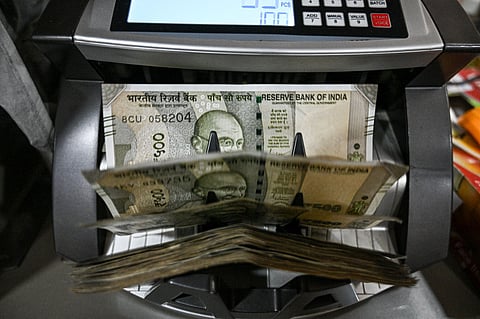
Dubai: India's Reserve Bank launched aggressive dollar sales to arrest the rupee's plunge, delivering its biggest one-day gain in seven months. The currency climbed as much as 1% to 90.0963 per dollar on Wednesday after closing at a record low of 91.0837 the previous day. By 8 am Dubai time Thursday, it traded at 24.49 per dirham, pulling back sharply from Tuesday's all-time low of 24.7.
The intervention followed a $5 billion forex swap on Tuesday to inject liquidity, quelling speculation after weeks of record lows that fueled debate over the RBI's restraint. Traders recall similar October actions that lifted the rupee 1% each time. The rupee settled 0.7% higher at 90.37 on Wednesday, though analysts see limited upside until a US trade deal eases $18 billion in yearly foreign outflows and 50% tariff threats squeezing exporters.
Dirham rate volatility over the past month
The rupee held steady against the dirham in late November, around 24.21 to 24.26, before easing to 24.04-24.05 early that month, then rising to 24.39-24.47 by early December. Mid-month stability near 24.39-24.51 gave way to acceleration, hitting 24.62 on December 15 and peaking at 24.7 on the 16th amid record dollar weakness. Wednesday's rebound to 24.53, then today's 24.49, highlight RBI action countering a near-2% monthly slide driven by equity withdrawals, firm imports, and tariff uncertainty.
Expats debate remittance timing amid volatility
Hasan Fardan Al Fardan, CEO of Al Fardan Exchange, flagged INR 25 per dirham, equivalent to USD/INR near 92, as a realistic near-term risk if foreign portfolio outflows persist. "At current levels, INR 25 per dirham is no longer a theoretical number. Whether the rupee reaches 25 per dirham is less about a single date and more about global conditions. Continued foreign portfolio outflows from India, driven by prolonged uncertainty surrounding US tariff negotiations, which currently stand at 50%, have resulted in an outflow exceeding $18 billion in 2025."
He highlighted the RBI's stabilising role without rate targets. "The Reserve Bank of India remains an important stabilising force. While the RBI does not target a specific exchange rate, it has at times intervened to support orderly market functioning and help limit sharp, speculative-driven moves." Volatility, he added, unfolds in bursts rather than steadily.
Tips for Indian expats in the UAE
For UAE expats, Fardan urged practicality over speculation. "Staggering remittances over time helps average out exchange rate movements and reduces exposure to sudden reversals. Behaviourally, periods of rupee weakness do tend to accelerate decision-making, especially around month-end salary cycles, as people act on favourable levels instead of waiting indefinitely." India's FY2025 remittances reached a record $135.46 billion, with 2026 forecasts remaining resilient amid stable employment in the UAE.
Ali Al Najjar, CEO of Al Ansari Exchange, supported a needs-driven strategy. "Exchange rates move for many global and domestic reasons, so it’s not possible to predict when the rupee might reach INR 25 per dirham. Such levels, if they happen, would depend on long-term market trends rather than short-term movements." He advised phasing transfers: "The best approach is usually to consider personal financial needs rather than trying to time the market. For individuals with ongoing commitments back home, remitting in a phased or planned manner often helps balance out volatility. It’s ultimately about what aligns with their financial priorities."
With US trade delays fueling $18 billion outflows and tariff pressures on exporters, expats balance locking today's recovery against potential retests of weaker levels.
- With inputs from agencies.