India, EU seal long-awaited free trade pact: What changes, why it's ‘mother of all deals’
From tariffs to tech access, the deal redraws trade rules between two economic giants
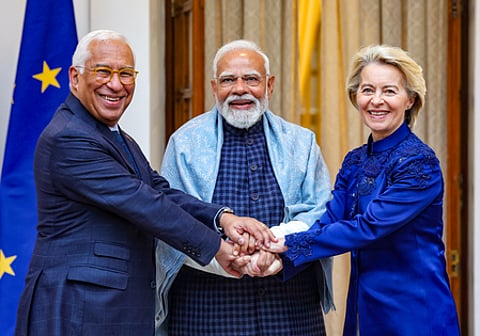
Dubai: After nearly two decades of negotiations, India and the European Union have concluded a free trade agreement, linking two of the world’s largest economies in a pact that leaders on both sides described as a strategic and commercial turning point.
Announced at the historic India-EU Summit, the agreement brings together the world’s fourth- and second-largest economies. India and the EU together account for about 25% of global GDP and roughly one-third of world trade.
“This agreement will bring major opportunities for the people of India and Europe,” Prime Minister Narendra Modi said in a virtual address. “It represents 25% of the global GDP and one-third of global trade.”
European Commission President Ursula von der Leyen called it “the mother of all deals,” describing the pact as a decision by “two giants” to deepen cooperation at a time of global disruption.
The agreement extends beyond trade. India and the EU also announced a framework for deeper defence and security cooperation, along with a separate arrangement to ease mobility for skilled workers and students, signalling a partnership that reaches beyond commerce.
Why a deal now
The timing reflects a shifting global trade landscape.
Both India and the EU face rising tariff pressure from the United States, disrupting established trade flows and pushing major economies to seek alternative markets and partners.
Speaking alongside von der Leyen and European Council President António Costa in New Delhi, Modi said closer ties with Europe would “strengthen stability in the international system” during a period of “turmoil in the global order.”
Negotiations gained momentum after renewed U.S. tariff actions and a broader push in Europe to reduce exposure to unpredictable trade relationships.
“Europe and India are making history today,” von der Leyen said in a post on X. In later remarks, she said the agreement sends “a strong message that cooperation is the best answer to global challenges.”
For Brussels, the deal fits into a wider strategy to expand trade alliances across Asia and Latin America as the bloc recalibrates its economic dependencies.
What it covers
The FTA spans trade in goods and services, investment, digital trade, small businesses and professional mobility.
Indian officials said more than 99% of Indian exports will receive preferential access to the EU. India is expected to reduce or eliminate tariffs on 96.6% of EU exports in a phased manner.
The European Commission estimates the agreement will eventually cut up to 4 billion euros ($4.7 billion) a year in duties paid by exporters and support millions of jobs across both regions.
Indian sectors expected to benefit include textiles, apparel, engineering goods, leather, handicrafts, footwear and marine products. EU exporters are set to gain in automobiles, wine and spirits, chemicals, pharmaceuticals and industrial machinery.
A formal legal review of the text is still required. Officials expect the agreement to be formally signed later this year and to enter into force in early 2027.
Also Read: EU, India agree ‘mother of all’ trade deals
What will change
At the core of the pact is a sweeping reset of tariff barriers.
India will gradually lower duties on European automobiles from peaks of 110% to as low as 10% under a quota system. Tariffs on car parts will be eliminated after five to ten years, according to the European Commission.
Duties of up to 44% on machinery, 22% on chemicals and 11% on pharmaceuticals will also be mostly phased out.
On wine, tariffs in India will drop from 150% to 20% for premium categories.
Quotas will apply to sensitive products such as automobiles, wine and whisky, allowing controlled liberalisation while protecting domestic industries.
New Delhi excluded dairy products and cereals from the agreement, citing domestic sensitivities. The EU will not grant concessional access to Indian sugar, meat, poultry or beef.
More than trade
Trade is only part of the equation.
India is moving to diversify its export destinations as it absorbs the impact of higher U.S. tariffs, including an additional 25% levy linked to its purchases of discounted Russian oil. That brings combined U.S. duties on Indian goods to as much as 50% in some categories.
For the EU, India offers scale, growth and long-term demand at a time when parts of the global economy face stagnation and heightened geopolitical strain.
Bilateral trade between India and the EU stood at $136.5 billion in 2024-25. Officials aim to raise that to about $200 billion by 2030.
“Ultimately, the agreement is about creating a stable commercial corridor between two major markets at a time the global trading system is fragmenting,” said Indian trade analyst Ajay Srivastava.
Europe’s outreach has accelerated over the past year. Von der Leyen has signed or advanced trade deals with Japan, Indonesia, Mexico and South American partners as Brussels pushes what it calls “strategic autonomy,” reflecting a shift away from heavy dependence on a U.S. trade relationship many European leaders now view as politically volatile.
What changes now
For companies, the deal redraws cost structures, sourcing strategies and long-term investment planning.
European automakers gain a clearer path into the world’s third-largest car market, while Indian exporters secure deeper and more predictable access to a high-income consumer base.
For consumers, the impact will come through pricing, availability and competition, with lower tariffs feeding into imported goods across automobiles, machinery, chemicals and lifestyle products.
For governments, the agreement locks in a trade and strategic partnership between two economic blocs whose combined weight shapes global growth.
After twenty years of talks, the pact marks not only a trade opening, but a recalibration of where India and Europe are placing their economic bets.
- With inputs from Agencies