Europe looks East as old alliances strain
From India to China, diversification replaces dependence in a changing global order
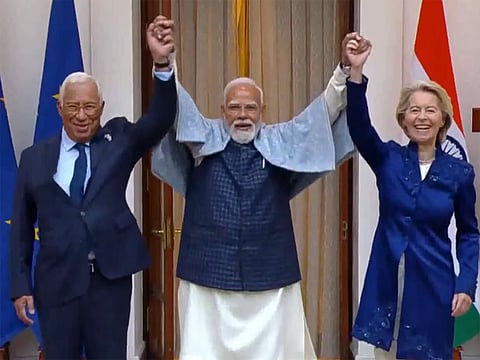
European leaders are increasingly turning toward the East amid shifting global alliances, fluctuations in US-European relations, and external pressures marked by rising protectionism. The East is also not immune to tariff disputes and geopolitical tensions. It is as if the global landscape is being strategically and economically reshaped, leaving Europe with little choice but to reduce its dependence on the American market, diversify its partnerships, or bear new burdens to remain aligned with the United States.
As part of this diversification, the European Union and India concluded a Free Trade Agreement aimed at opening new markets and offsetting the impact of tariff policies. The agreement includes reducing or eliminating tariffs on most industrial goods, with the EU set to remove or lower duties on 99.5% of imports from India within seven years.
Impact of global transformation
The success of negotiations after two decades of stagnation reflects the impact of global transformations. The EU now finds it necessary to reduce economic dependence on the United States, while India seeks to ease the burden of protectionism — especially as it faces US tariffs reaching 50% — while maintaining a balance in its economic relations with Russia and avoiding export losses by seeking cost-effective alternatives that do not compromise political decision-making. In essence, India and Europe have aligned in confronting protectionism.
India currently imposes tariffs of up to 150% in some sectors, restricting European exporters’ access to large segments of the Indian economy. Under the agreement, many of these barriers will be removed, and the EU will gain better market access for financial services companies, paving the way for deeper economic integration and business openness.
The agreement is expected to give India a competitive advantage in exporting labour-intensive goods affected by tariffs, such as garments, gemstones, jewelry, and handicrafts — revitalising employment in a country of 1.4 billion people. Beyond tariff concessions, the deal extends to investment and the creation of a free trade zone encompassing nearly two billion people (India and Europe). India’s rapid growth rates complement Europe’s capital resources and advanced manufacturing capabilities, while the agreement strengthens both manufacturing and services in India and enhances investor confidence in Asia’s third-largest economy.
Legal review
The agreement will require months of legal review and ratification by the European Parliament, amid concerns about delays similar to those faced by the EU-Mercosur agreement due to French objections. Should the Mercosur deal stall, the agreement with India could significantly boost European trade. Trade between India and the EU reached $136.5 billion in the fiscal year ending March 2025, compared to $132 billion between India and the United States.
The EU is thus moving to expand its alliances — even if initially sector-specific rather than comprehensive — opening the door to broader future cooperation, particularly in defence industrial collaboration and maritime security, as stipulated in the agreement with India. India is following a similar path, having signed trade agreements with New Zealand and the Sultanate of Oman. The announcement of a security and defense partnership between India and the EU, including joint development and production of defense platforms, maritime and space cooperation, and counterterrorism, signals an intention to build deeper ties amid rising geopolitical tensions.
Desire for autonomy
Europe’s new policy is driven by a desire for autonomy and diversified partnerships following the unpredictability of its American ally. It is therefore unsurprising that European leaders have visited China — the world’s second-largest economy — including leaders from France, Australia, and the United Kingdom, seeking new engines for economic growth and ways to mitigate escalating global trade disputes.
In another eastern pivot, British Prime Minister Keir Starmer visited China after an eight-year hiatus to mend ties with the world’s second-largest economy. This comes amid tensions with the US ally, disputes over Greenland, tariff issues, disagreements over resolving the Ukraine crisis, and Britain’s readiness to diversify relations in response to political and economic uncertainty in a volatile international environment.
Europeans appear to have downplayed certain security and human rights concerns in pursuit of these moves, as trade disputes intensify. This shift aims to recalibrate relationships around economic interests, recognising that surviving high tariffs is no longer feasible under old patterns of alliances. Fluctuating relations with China have not served either side, and the current international climate may encourage the development of a long-term partnership.
Focus on mutual interests
In China, understandings with Britain have focused on mutual interests, including potential visa exemptions for British citizens, British export contracts worth approximately $3 billion over five years in the Chinese market, pledges of Chinese investment in the UK, and tariff reductions on certain British goods. Facilitating travel and business is expected to create new opportunities for British investment in China and expand cooperation in healthcare, financial and professional services, legal services, and education. Both sides are also considering negotiations for a bilateral services agreement.
Should relations extend beyond economics, China and the UK — both permanent members of the UN Security Council — could engage in dialogue and coordination on international security issues, although expectations in this regard remain limited in the near term. The primary goal of the visit is to normalise relations between London and Beijing, which have deteriorated in recent years over security and human rights issues. Nevertheless, expansion into broader areas cannot be ruled out.
The transatlantic alliance between Europe and the United States is facing one of its most difficult tests in decades, amid European security risks, weakening strategic alignments, and efforts to build a unified European capability to withstand external challenges, particularly amid divisions within NATO. Meanwhile, China offers substantial investment opportunities in vital sectors. Europe’s desired balance rests on diversifying relations, adapting to international shifts, and building resilience through economic and strategic autonomy.
Europe’s long reliance on the American ally now appears to have delayed its search for alternatives. Today, it seems compelled to seek new partners—including some once considered adversaries. Amid geopolitical turbulence and uncertainty, Eastern powers, particularly China and India, have become preferred destinations for European states seeking economic partners. The time may come when these eastern partnerships evolve from economic ties into full strategic partnerships.
Shama Ahmed AlQutbah is a Research Assistant at Trends Research and Advisory


