European and Asian shares fall
Euro dips after rally this week
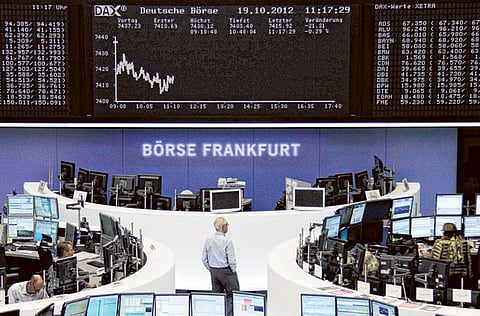
London: Spanish and Italian bond yields hit their lowest levels in over half a year on Friday after Eurozone leaders firmed up plans for a common bank watchdog, while world shares and the euro remained on course for strong weekly gains despite a dip.
European stocks declined and Asian technology shares fell after worse-than-expected earnings for Microsoft Corp and Google Inc. Metals and rubber dropped.
The Stoxx Europe 600 Index slid 0.2 per cent as of 8:09am in London as Samsung Electronics Co. fell 2.6 per cent in Asia. Futures on the Standard & Poor’s 500 Index were little changed. The MSCI Asia Pacific Index lost 0.2 per cent even as Japan’s Nikkei 225 Stock Average and Hong Kong’s Hang Seng Index rose. Copper dropped 1 per cent in London and rubber fell 3.8 per cent in Tokyo. The Hong Kong dollar touched the strong end of its peg to the dollar for the first time since December 2009.
Google slumped as much as 10.5 per cent yesterday after reporting third-quarter profit excluding some items of $9.03 a share versus an average analyst estimate of $10.65. Microsoft’s net income fell to 53 cents a share in the three months through September 30, missing the 56-cent average forecast. European leaders set a goal to establish a euro-area bank supervisor by year-end. Foreign direct investment in China fell for the 10th time in 11 months, according to a government report today.
“You end up in a standoff in the share market between focus on economic data, which is more forward-looking, and focus on earnings, which are not as good,” said Shane Oliver, Sydney- based head of investment strategy at AMP Capital Investors Ltd, which has almost $100 billion under management. “Earnings reflect the economic weakness we saw a few months ago, and therefore you could argue it’s somewhat outdated.”
Wall Street is expected open mixed when trading resumes, after solid results from manufacturing bellwether GE Electric helped offset Thursday’s surprisingly weak earnings from tech giants Google and Microsoft.
Spanish 10-year yields fell to their lowest in 6-1/2 months as markets digested news from the EU summit. Italian yields also fell to levels not seen in over seven months, helped by a jumbo sale of 4-year bonds on Thursday.
“There is more of a general understanding that the ECB backstop is actually effective,” UniCredit chief Eurozone economist Marco Valli said of the central bank pledge to buy sovereign bonds on the secondary market.
“The market has brought yields in Italy and Spain down to levels which, for the time being, seem to be much more consistent with debt sustainability,” he added.
“The big question now remains will Spain go for support? And if so, when?”
Global economic data in recent days and signs of progress in defusing the Eurozone debt crisis has left the MSCI index of world shares up almost 3 per cent for the week, near a 15-month high, and the euro up about 1.5 per cent against the dollar.
With equity investors in a mood to book profits after four sessions of gains, world shares were down 0.3 per cent on Friday ahead of the start of US trading.
Stock futures also pointed to falls for the S&P 500 and the Dow Jones after General Electric met forecasts with a 8.3 per cent rise in quarterly profits.
The pan-European Euro STOXX 50 was down almost 1 per cent at 1150 GMT but was still on course for one of its best weeks of 2012, up over 3 per cent since Monday.
“It is possible that the highs for the year are in,” said Lex van Dam, hedge fund manager at Hampstead Capital. “Company earnings remain under pressure.
“Today feels very much like a risk-off environment.”
In currency markets, the euro, at $1.3056, hovered below its one-month high against the dollar as the EU summit reconvened on Friday, while the yen was near a two-month low against the dollar as speculation mounted over the possibility that the Bank of Japan will take fresh stimulus measures.
The Australian dollar was steady at $1.0365, off a three-week high of $1.0415 hit on Thursday. Gold, which has been slowly slipping this month as the dollar has strengthened, fell to $1,733.90, heading for its second successive weekly decline.
The Eurozone’s troubles, the upcoming US election and growth in China are the three principle factors dominating global financial markets.
Over the weekend, Spain’s Basque and Galicia regions hold elections in what is been seen as an effective referendum on the country’s spending-cut programme.
Investors had speculated that Spain might check itself in to a fiscal rehabilitation programme once these votes were out the way, but the recent fall in its borrowing costs have left many struggling to put a timeframe on any such move.
“If the market is open, as it is at the moment, signing your name on a MOU signs away some sovereignty over economic policy and that is politically costly,” said Deutsche Bank economist Mark Wall. “So we need some kind of event to push us into the end-game.”
Copper and other metals attuned to the economic cycle fell on Friday but remained on track for weekly gains, boosted by signs that world powerhouse economies China and the United States are stabilising.
Oil prices held above $112 a barrel, but were set for their third weekly fall in five weeks, as the restart of Britain’s largest oilfield is imminent.
“We have enough supply,” said Jeremy Friesen, a commodities strategist at Societe Generale, adding that Brent prices would probably trade between $110 and $115 a barrel this quarter.
“Short of any geopolitical or economic shocks,” he said, “The market will probably grind lower this month.”


