India trims deficit, revises tax slabs to benefit consumers
New budget trims deficit, begins to rollback tax cuts while maintaining spending on social programmes and infrastructure
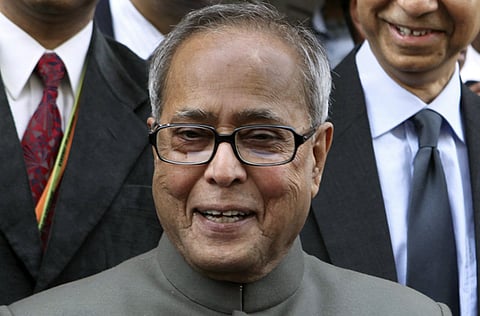
New Delhi: India began to rollback tax cuts Friday as the government’s new budget pledged to trim the swollen fiscal deficit while maintaining spending on social programmes and infrastructure.
Presenting the budget for the fiscal year ending March 2011 to a belligerent Parliament, Finance Minister Pranab Mukherjee said India's fiscal deficit, now 6.5 percent of gross domestic product, would shrink to 5.5 percent of GDP, before falling to 4.1 percent of GDP by 2013.
As expected, he also hiked excise taxes by an average of 2 percentage points. The government had cut those taxes by 6 percentage points in the wake of the financial crisis to stimulate spending.
His pledge to reinstate duties on petroleum products and raise exise taxes on petroleum and diesel to 1 rupee a litre brought angry parliamentarians to their feet, shouting and raising their arms in protest. “Give me attention,” Mukherjee shouted back. “Please do not prevent the presentation of the budget.”
However, Mukherjee also revised the personal tax slabs for individuals, and raised the highest tax slab from Rs 5 lakh to Rs 8 lakh, potentially allowing tax savings for the middle-income bracket. The minister also increased the limit of deduction available under Section 80C on tax benefits, allowing an additional investment of Rs 20,000 for infrastructure bonds taking the total of the limit under section 80C from the current Rs 1 lakh to Rs 1.2 lakh.
Higher taxes threaten to hit consumers as inflation is rising. Policy makers worry that double-digit food inflation is beginning to spill over into nonfood sectors. Mukherjee said the government's top priority is to "quickly revert to high growth of 9 per cent, and then find the means to cross the double digit growth barrier."
India's economy has bounced back from the global downturn faster than many expected, helped by thundering growth in manufacturing.
The government said Friday that India's economic growth slowed to 6 percent in the October-December quarter, compared to 7.9 per cent in the previous quarter, largely due to a decline in farm output and some service sectors. The slowdown was largely expected, as a drought hit agricultural output and rural spending.
Mukherjee said India is on track to grow 7.2 percent for the fiscal year ending March 2010. He expects Asia's third-largest economy to grow 8.5 per cent next fiscal year, before hitting 9 per cent growth in 2011-12. "We have weathered this crisis well. Our economy is in a far better position than it was a year ago," he told Parliament.
Investors seemed pleased, sending the benchmark Sensex index up 1.9 per cent, to 16,564.98 points in midday trade.
Highlights of Budget 2010
- Plan to introduce a nationwide goods and services tax by April 1, 2011
- Government to sell stakes in state-owned companies
- Plan to complete auctions of bandwidth for high-speed 3G mobile phone networks
- Final FY10 GDP figure maybe higher than estimate of 7.2 per cent
- Roadmap within six months to cut public debt
- Government to simplify FDI policy
- Clean energy cess of Rs.50 per tonne on coal produced in India
- Concessional customs duty of 5 per cent for cable TV operators for importing equipment
- Toys fully exempt from central excise duty
- Service sector tax retained at 10 per cent to aid the introduction of GST; more services to be taxed
- Net revenue gain Rs.22,500 crore
- Taxes on large cars and SUVs increased 2 per cent to 22 per cent
- Basic duty of 5 per cent on crude oil restored
- Tax on cigarettes, cigars and chewing tobacco increased
- Income up to Rs.1.6 lakh per year exempt from income tax; up to Rs.5 lakh to be taxed at 10 percent; income of Rs.5-8 lakh to be taxed at 20 per cent and income above Rs.8 lakh to be taxed at 30 per cent
- IT returns forms for individual tax payers to be further simplified
- Expenditure in 2010-11 estimated at 11,l8,749 crore
- Fiscal deficit estimated at 5.5 per cent in 2010-11; an improvement of 1 per cent over 2009-10
- Two more centralised tax processing centres to be set up in addition to the one at Bangalore
- National Social Security Fund created for workers in unorganised sector with allocation of Rs.1,000 crore
- Government to give Rs.1,000 for each National Pension Scheme account opened by workers in the unorganised sector
- Exclusive skill development programme for the textile sector
- Fifty percent hike in allocation for schemes for women and child development
- Rs.1,900 crore for Unique Identification Authority of India
- Rs.147,344 crore (approximately $31 billion) allocated for defence sector
- Draft Food Security Bill prepared and will be put in the public domain
- Allocation on primary education raised from Rs.26,800 crore to Rs.31,300 crore
- Banking facilities to be provided to all habitations with a population of 2,000 and more
- Forty-six per cent of plan allocations in 2010-11 will be for infrastructure development
- Allocation for new and renewable energy sector increased 61 per cent from Rs.620 crore to Rs.1,000 crore in 2010-11
- National Clean Energy Fund to be established
- Rs 200 crore allocated as special package for Goa to prevent erosion and increase green cover
- FDI policy to be made more user-friendly with one comprehensive document
- Apex level financial stability council to be set up for banking sector
- Indian Banking Association to give additional licences to private players
- Government sets in motion steps to bring down food inflation
What do you think of the new Indian budget? Are there enough provisions to safeguard the interest of the NRIs in the new budget? What is your opinion about the new tax proposals? Send us your comments.


