Trump hails ‘nuclear renaissance’ as advanced reactors achieve early milestones
US president signals shift in US energy policy
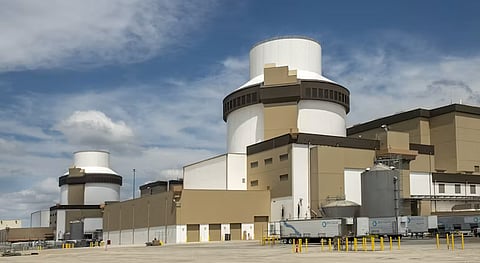
In a White House event on Friday, US President Donald J. Trump celebrated what he described as a "pivotal victory" for American energy dominance: multiple cutting-edge civilian nuclear reactors reaching operational “criticality” well ahead of an ambitious target set by his administration.
The announcement, which featured executives from pioneering nuclear firms, underscores the president’s aggressive push to revive and expand the nation’s nuclear industry — a sector long hampered by regulatory delays, cost overruns, and political opposition.
Get updated faster and for FREE: Download the Gulf News app now - simply click here.
Trump framed the development as both an engineering triumph and a rebuke to reliance on intermittent renewables.
“In the past, it took six years or more to approve a reactor!” Trump said, according to footage from the event.
“Now, America is building again... we’re leading the world in pioneering the next generation of nuclear power. There’s nobody even close.”
Streamlined approvals, private innovation
Approvals are sclerotic in the US: mining permits for critical minerals on US mainland could take as long as 30 years, even as China and other nations tie permitting to national industrial policy.
It's the same for new nuclear reactors.
The Trump administration has increasingly found a work-around, rolling out what amounts to a policy shift.
The milestone stems from executive orders Trump signed in May 2025 directing the Department of Energy to fast-track advanced reactor demonstrations.
A pilot programme challenged private companies to achieve criticality for at least three advanced reactors by July 4, 2026 — the nation’s 250th anniversary.
Four companies — including Antares Nuclear, Valar Atomics, and others — beat that deadline, delivering what officials called the first privately funded advanced reactors in the US in over 40 years.
Cultural shift
Energy Secretary Chris Wright and Interior Secretary Doug Burgum joined Trump and industry leaders for the Oval Office announcement.
Executives highlighted a cultural shift from bureaucratic “PowerPoints” to actual power plants. One CEO praised the administration’s focus on results over process.
Nuclear power currently provides roughly 100 gigawatts of US electricity capacity, primarily from traditional large-scale reactors.
The new advanced designs, often smaller and modular, promise greater flexibility, enhanced safety features, and faster deployment to meet surging demand — particularly from data centers powering artificial intelligence.
New dawn for reliable energy
Nuclear energy has enjoyed rare bipartisan interest in recent years amid concerns over grid reliability, energy costs, and decarbonisation goals.
Proponents argue it offers dense, reliable, low-carbon baseload power without the land-use intensity or weather dependence of solar and wind.
Critics, including some environmental groups, have historically raised issues of waste disposal, proliferation risks, and high upfront costs.
Trump’s approach has been unabashedly pro-nuclear expansion, tying it to national security, economic competitiveness, and reducing dependence on foreign supply chains (notably contrasting it with wind technology he has called out for reliance on Chinese components).
The administration has also explored offshore nuclear projects and military applications.
Reactions reflect enthusiasm in conservative circles for what some dubbed a “huge blow” to overly restrictive policies of the past.
Supporters see an American "nuclear renaissance" -- skeptics question whether regulatory streamlining can fully overcome longstanding industry challenges like financing and public acceptance.
Friday’s event arrives as the US grapples with exploding electricity needs.
Analysts project significant growth in power demand through mid-century. Trump has set a goal of quadrupling nuclear capacity by 2050.
Whether these early small-scale successes scale into dozens of new plants will depend on sustained private investment, further regulatory evolution, and political continuity.
For now, the administration is touting concrete progress where previous efforts stalled for decades.


