Oil prices up sharply as traders weighed ongoing supply disruptions, benchmark crude contracts further above the $100/barrel mark
Global fuel inventories tighten as tensions in the Middle East continue
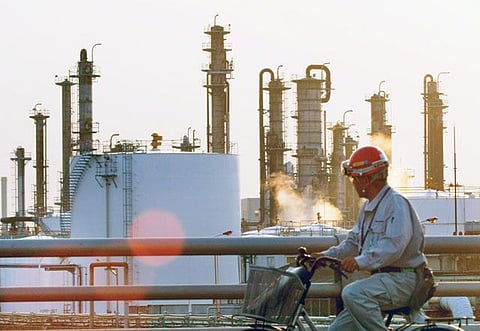
Oil prices rose sharply on Monday (May 18) as traders weighed ongoing supply disruptions tied to tensions in the Middle East and tightening global inventories, pushing benchmark crude contracts further above the $100-per-barrel mark.
US benchmark West Texas Intermediate (WTI) crude climbed $1.22 to $106.64 a barrel in early trading as of 9:24 am Tokyo time. Brent crude, the international standard, gained $1.03 to $110.29 a barrel.
Get updated faster and for FREE: Download the Gulf News app now - simply click here.
Murban crude surged 3.15% to $108.00, while the OPEC basket advanced nearly 7% to $115.09.
Natural gas futures also moved higher, rising 2.06% to $3.021 per million British thermal units.
Volatility
Energy markets remained volatile amid continued uncertainty surrounding shipping flows through the Strait of Hormuz, a critical artery for global oil exports.
Moody’s Ratings, in its latest energy industry report, said the disruption to one of the world’s most important energy shipping routes is increasingly looking less like a short-term shock and more like a structural risk that could reshape global trade, energy markets and economic planning well beyond 2026.
Analysts said fears of prolonged disruptions have kept a geopolitical risk premium embedded in crude prices.
Supply losses
The International Energy Agency (IEA) said last week that global oil inventories are falling at a record pace as supply losses mount across Gulf producers.
The agency estimated that more than 14 million barrels per day remain shut in because of restricted tanker traffic and infrastructure disruptions linked to the regional conflict.
OPEC last week lowered its forecast for global oil demand growth in 2026, citing elevated prices and weaker economic activity stemming from the conflict.
Still, traders largely focused on near-term supply risks rather than softer demand projections.
Among regional crude benchmarks, Western Canadian Select rose 4.78% to $93.07 a barrel, while Louisiana Light advanced 1.42% to $104.52. Russia’s Urals crude slipped 0.81% to $96.72.
Retail gasoline prices have also climbed in recent weeks, adding pressure to inflation readings globally and complicating the outlook for central banks already grappling with persistent price growth.


