Brent crude down 5%, Murban slides 3.8%, WTI below $100
Supertankers resume risky Hormuz transits after two-month Gulf delay
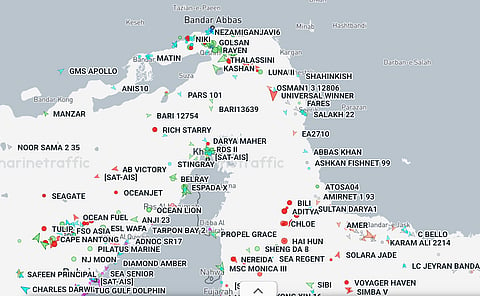
Brent crude oil prices tumbled more than 5% on Thursday as diplomatic progress toward ending the Iran conflict eased market fears over blocked energy supplies.
The drop followed reports that supertankers managed to safely exit the Strait of Hormuz, unlocking millions of barrels of crude for Asian markets.
The significant price decline reflects a cooling of the "war premium" that previously pushed energy costs higher.
However, energy traders remain cautious. Industry guidance still highlights high risks with every crossing as uncertainty persists over conditions in the Gulf.
The recent tanker movements underscore this tension:
The logjam: Three supertankers successfully crossed the Strait of Hormuz carrying oil bound for Asian markets, according to shipping data tracked by LSEG and Kpler.
The delay: These vessels had been bottlenecked in the Gulf for more than two months, hoarding 6 million barrels of Middle East crude on board.
The chokepoint: These ships are among a rare group of supertankers permitted to exit the region via a specific transit route mandated by Iran.
While the resumption of tanker flow signals some de-escalation, it doesn't change the energy industry given that roughly one-fifth of the world’s global oil supply relies on this narrow corridor.
Because of ongoing regional risk, shipping companies are navigating heightened operational dangers, leading to global energy markets remaining highly sensitive to any shift in the Gulf.


On Wednesday, three East Asia-bound crude oil supertankers were reportedly attempting to transit the Strait of Hormuz, signaling a possible easing of tensions along one of the world’s most critical and dangerous energy chokepoints.
A South Korean-flagged very large crude carrier (VLCC) reportedly transited the strait — the first successful crossing by a South Korean supertanker since the escalation of the US-Israeli conflict with Iran, as per Bloomberg.
At the same time, Reuters, citing LSEG and Kpler shipping data, reported that two Chinese crude tankers carrying about 4 million barrels of oil had already exited the Strait of Hormuz and were heading toward China.
The tanker movements are being closely monitored by traders and governments because many Asian refineries are heavily dependent on Gulf crude supplies.


