UAE-Sri Lanka trade deal could be finalised within a year
Sri Lanka sees CEPA as the next step to deepen UAE trade, investment and jobs links
Dubai: The UAE and Sri Lanka could finalise a Comprehensive Economic Partnership Agreement within a year once formal negotiations begin, opening the door for deeper trade, investment and services flows between the two countries, according to Alexi Gunasekera, Consul General of Sri Lanka to Dubai and the Northern Emirates.
Speaking to Gulf News at the Globalisation and the Sri Lankan Opportunity event at Ritz-Carlton DIFC on Thursday, Gunasekera said Sri Lanka had already expressed interest in moving ahead with CEPA discussions after talks earlier this year between Sri Lanka’s trade ministry and UAE Minister of State for Foreign Trade Dr. Thani Al Zeyoudi.
Get updated faster and for FREE: Download the Gulf News app now - simply click here.
CEPA, actually, when our minister visited in January for the Gulf food, our Ministry of Trade, we had discussion with Dr. Thani about the CEPPA, and we actually told the minister that we are interested in signing CEPA,” Gunasekera said. “Once it started, I'm quite sure within a year we will be able to finalise everything.”
The proposed agreement would follow the investment protection and promotion agreement signed last year, which Sri Lanka sees as a foundation for attracting more UAE capital into sectors such as infrastructure, agriculture, logistics, ports, technology and professional services.
Trade ties enter next phase
The UAE is already Sri Lanka’s eighth-largest export destination, with annual exports of about $350 million. Still, Gunasekera said the relationship now has to move beyond traditional trade into a wider investment and value-chain partnership.
“With relationship with UAE has always been good, and if you really see 260,000+ Sri Lankans are living here,” he said.
That large Sri Lankan community has helped keep the relationship active across labour, services, business, and family ties, while the UAE’s position as a regional hub gives Sri Lankan companies a route into the wider GCC, Africa, and Europe.
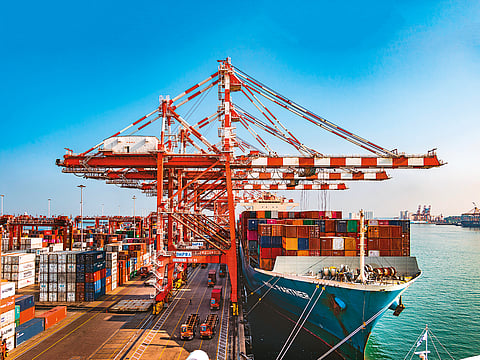
Gunasekera said the next opportunity lies in using both countries’ ports, logistics networks and investment platforms to create more two-way flows.
“We always consider UAE as a hub to enter into the other GCC countries, and also to Africa, and also to Europe,” he said.
CEPA could unlock investment flows
Sri Lanka is seeking UAE investment in construction, infrastructure, ports, shipping, logistics, transport, agriculture modernisation, IT, BPO and AI, with a particular focus on R&D centres that can create skilled jobs and help retain talent.
“We want the UAE to invest in the infrastructure sector, construction infrastructure, then it, it, BPO, AI, you know, Sri Lanka wants to digitalise its economy,” Gunasekera said.
He said the investment protection agreement had helped address one of the main concerns for UAE investors, which was whether their capital would be protected in Sri Lanka after the country’s economic crisis.
“They [UAE investors] were not quite sure if you invest in Sri Lanka, whether their investment is protected, but now that confidence we have given, now it's a matter of transforming that into reality,” he said.
A CEPA would add the trade framework needed to make those investments more effective. UAE investors could invest capital in Sri Lankan agriculture, logistics, or manufacturing, and export products back to the UAE, while Sri Lankan businesses could use the UAE for value addition and regional distribution.
“If CEPA is there, you can export that back to the UAE. If you manufacture something here, you can export that to Sri Lanka. It's a win-win situation,” he said.
Services may move first
Gunasekera said services are likely to see the earliest gains over the next 12 to 18 months because Sri Lanka already has a strong professional base in the UAE.
He pointed to Sri Lankan quantity surveyors, bankers, chartered accountants, doctors, hospitality workers, pilots and IT professionals already working in the country, saying the talent link can be expanded faster than capital-heavy manufacturing projects.
“Manufacturing sector, it takes time, but services sector won't take time,” he said. “Especially if you take it and professional services, even we'll see, even professionals like bankers, doctors, or chartered accountants, you name it.”
Manufacturing, construction and renewable energy are also on the investment agenda, but those projects are expected to take longer to structure and execute.
Confidence returning after crisis
Sri Lanka is still working to rebuild investor confidence after its currency and economic crisis, but Gunasekera said the country’s recovery has shown resilience and political stability.
“You have the political confidence, the stability is there. The government is very well, very powerful government,” he said. “The people are slowly getting to have this confidence in Sri Lanka. That's why we are having this.”
He said the recent UAE-Sri Lanka Joint Commission, which convened after 12 years, was an important step in restarting structured economic dialogue and converting political goodwill into investment.
“We have now put the ball on rolling, and in two, three years' time, it will start moving,” he said.
Food and labour links remain active
Food security is also part of the relationship, with Sri Lanka seeking to increase shipments of fresh fruits, vegetables, and perishables to the UAE despite logistics challenges stemming from regional disruptions.
“Trying to send more and more food, but there are some logistical issues as well,” Gunasekera said. “All these fresh fruits and vegetable perishables all come into UAE, but there are some challenges, but still people are exporting.”
Labour mobility remains another strong link. Gunasekera said Sri Lanka has not restricted workers from coming to the UAE and continues to see strong demand from its citizens to work in Dubai and other emirates.
“The target is, you said, 63,000 Sri Lanka to UAE. Last year we got 53,000 so we have not stopped,” he said. “So that means we are supporting UAE. Also, if they need manpower, if they need human capital, we are sending.”
He said Sri Lanka wants the same energy to flow in the other direction through UAE investment, with CEPA expected to become the next major mechanism for deepening trade, capital, and talent links between the two countries.