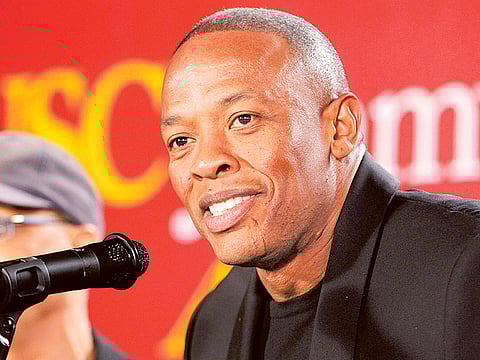
Dr Dre gets the beats going at Apple Music
But tech giant still has lots more ears and minds to penetrate with new service
When Apple introduced its new streaming service, Apple Music, at the end of June, one of the big questions hanging over it was whether it could compete with outlets like Spotify to deliver blockbuster results for big new albums.
In Apple Music’s first major test, the answer is a qualified yes. Dr Dre’s album Compton: A Soundtrack — a loose tie-in to the film Straight Outta Compton — had 25 million streams around the world in its first week, and also sold nearly half a million downloads through Apple’s iTunes store, Apple executives said.
“We’re beginning to show what we can do in terms of communicating music to a worldwide audience and helping artists at the same time,” said Jimmy Iovine, the former record executive who helped build the new service after Apple paid $3 billion (Dh11 billion) last year for Beats, the electronics company and music brand he started with Dr Dre.
Still, the album’s performance was not quite enough to send it to No 1 in the US. When Billboard’s latest album chart is released, Compton is expected to open in second place, beaten by Kill the Lights, from country star Luke Bryan. According to industry estimates, Compton — which is being offered only through Apple for its first two weeks — had about 11 million streams in the US.
In the intensifying contest over streaming music, all numbers related to Apple have been scrutinised for signs of whether its early performance represents fast or slow progress for a company of its vast scale. Apple, long the biggest retailer of music, has more than 800 million customer accounts around the world, but as a late entry to streaming it has to rely heavily on the heft of its brand to compete in an increasingly crowded market.
This month, Eddy Cue, Apple’s senior vice-president for internet software and services, said that since Apple Music was released June 30, it had attracted 11 million people to sign up for trial subscriptions, which are free for 90 days. Once those trials expire, the service costs $10 a month, the going rate for comparable subscriptions from outlets like Spotify, Rhapsody or Google Play.
“Eleven million is not bad,” said Russ Crupnick, an analyst at MusicWatch. “But it’s not a spectacular number if you take in the number of Apple users that exist worldwide.”
Compared with other big streaming hits this year, the showing for Compton is also modest. Drake’s If You’re Reading This It’s Too Late, released in February, had 48 million streams in one week, while Kendrick Lamar’s To Pimp a Butterfly had nearly 39 million in March. Those albums benefited from the popularity of Spotify, which has 20 million subscribers around the world, and another 55 million people who listen to the service free with advertising.
Compton is Dr Dre’s first album in 16 years, and its release has already had wide cultural impact. Made in secret by Dr Dre, one of hip-hop’s most celebrated innovators, it came out August 7, a week before the release of Straight Outta Compton, which tells the story of Dr Dre’s group N.W.A. and had $56.1 million in ticket sales in its opening weekend.
The album very likely benefited from the promotional push for the film. But for the music industry, it also demonstrated the reach and marketing power of Apple’s system. Dr Dre, who like Iovine is now a top consultant to Apple, was working on the album until just days before its release.
By keeping its existence closely held within Apple, the company was able to prevent it from leaking online, a fate that damages the release impact of many big albums. Dr Dre announced the album on Beats 1, Apple Music’s internet radio platform, and it was promoted heavily through Apple Music and iTunes.
So far Apple’s new service has had a mixed reaction in the music and tech press, and its impact on the music charts overall has been minimal. In a comparison of Nielsen streaming data for a dozen popular albums, most had increases of 10 to 20 per cent in the week that Apple Music’s numbers were first incorporated into the charts, but had flat results or even a loss the next week.
One of the few examples that shows the direct influence of Apple is Taylor Swift’s 1989, which Swift made available for streaming only on Apple Music. In the week that Nielsen added Apple’s streaming numbers, 1989 went from a statistically insignificant 5,000 streams a week to 2.4 million, a number roughly equivalent to the weekly streaming totals for comparable artists like Katy Perry and Lorde.
Apple is expected to begin an extensive marketing push for Apple Music this month, with television commercials and outdoor billboards that could help raise the service’s profile and put more pressure on Spotify, the leading streaming service, in the hunt to sign up new subscribers.
Another question for Apple is the effect of its streaming service on download sales, which have been declining rapidly for the past two years but remain one of the music industry’s top sources of revenue. This year, as streaming has grown, album sales are down 3 per cent from the same period last year, and last week’s No. 1, the soundtrack to Disney Channel’s TV movie Descendants, had the lowest sales for any top album since at least 1991.
So far, Apple Music’s effect on download sales seems minor, said David Bakula, a senior analyst at Nielsen, as millions of customers test out streaming but also continue to pay to download songs from iTunes. But that may change as customers change the way they consume music, and more listeners turn to streaming music.
As that happens, Apple’s challenge will be to make itself a consumer favourite at a time when various other streaming services have already begun to take hold.
“You’ve got really established services out there, like Pandora, Spotify and Deezer, that people really like,” Crupnick, the MusicWatch analyst, said. “It’s hard to penetrate the market as the second, third, fourth brand in, even if that brand is Apple.”


