Cyprus bailout will force loss on big deposits
Deal will prevent meltdown that threatened country’s euro membership
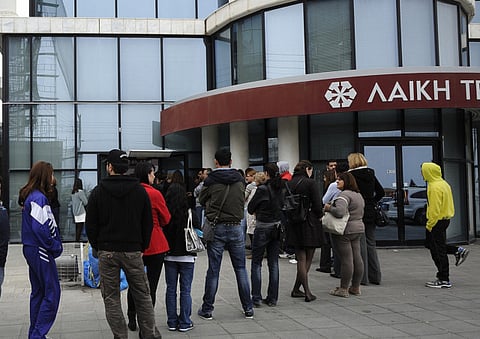
Brussels: Cyprus reached an 11th-hour €10 billion (Dh47.73 billion) bailout deal with international lenders on Monday morning that avoids a controversial levy on bank accounts but will force large losses on big deposits in the island’s two largest lenders.
The deal will allow the European Central Bank to keep its emergency lifeline open to Cypriot banks on Monday, preventing a meltdown of the financial sector that threatened the country’s euro membership.
It was reached in the early hours of Monday after a stormy meeting of 17 eurozone finance ministers that lasted almost 12 hours, and included a threat by the Cypriot president to pull his country out of the euro.
“It’s been a particularly difficult road to get here,” said Jeroen Dijsselbloem, the Dutch finance minister who chairs the committee of finance ministers. “We’ve put an end to the uncertainty that has affected Cyprus and the euro in recent days.”
The plan does not need approval from the Cypriot parliament because the losses on large depositors will be achieved through a restructuring of the island’s two largest banks and not a tax. The parliament passed a new law governing bank failures just three days ago at Brussels’ urging.
Markets responded positively to news of the deal, with Japan’s Nikkei index rising 1.7 per cent, recovering most of last week’s losses, and South Korean shares rose 1.9 per cent. Germany’s Dax equity index was up 1.1 per cent shortly after opening and London’s FTSE 100 was up 0.5 per cent. The euro was little changed at just above $1.29.
Dijsselbleom said it remained to be decided whether Cypriot banks would reopen on Tuesday, something that Nicosia and international monitors were scheduled to discuss on Monday.
In addition to scrapping the countrywide levy and the fact that the new deal does not require parliamentary approval, the biggest difference between the two agreements is that the new programme spares all deposits below €100,000.
The previous bailout agreement included a 6.75 per cent levy on these small deposits, spurring outrage that accounts covered by the EU’s €100,000 legal guarantee were being raided.
Instead, the new programme will see Laiki Bank, the country’s second-largest and most troubled financial institution, close. Its €4.2 billion in deposits over €100,000 will be placed in a “bad bank”, meaning they could be wiped out entirely.
Both junior and senior bondholders in Laiki will be wiped out, a first for a eurozone bailout country; in other bailouts, senior bondholders have not faced such losses.
The remaining smaller deposits at Laiki will be transferred to Bank of Cyprus, the nation’s largest lender, which in turn will be shrunk and completely restructured. Deposits over €100,000 in Bank of Cyprus will be frozen and could see significant losses once the lender is restructured and recapitalised.
Unlike the original deal signed a week ago, only large deposits in Laiki and Bank of Cyprus will suffer losses. Combined, the two banks account for about half of all deposits in the country.
Bank of Cyprus will also inherit the €9 billion that Laiki owes the eurosystem for the cheap central bank loans that have kept it on life support in recent months.
Dijsselbloem said no bailout money would be used to recapitalise Bank of Cyprus, meaning authorities must now calculate how much cash from the bank’s large deposit holders must be “bailed in” to get the lender up to healthy, EU-mandated capital levels.
Senior officials said such deposit losses had not yet been calculated. But one person involved in the talks said it would be significantly higher than the 20 per cent estimated by the International Monetary Fund last week.
“I’m happy because we shall have a programme and it’s in the best interests of the Cyprus people and the European Union,” Nicos Anastasiades, the Cypriot president, said as he left the Brussels summit building.
Although Cypriot authorities spent the last week in a desperate attempt to escape forcing large losses on its banks’ depositors, the negotiations in many ways turned full circle.
The agreement closely resembles a proposal advocated by the IMF and Berlin going into last week’s bailout negotiations, though under that plan both Laiki and Bank of Cyprus would have been liquidated.
At the time, opponents of the plan expressed concern that forcing such big losses on large deposit holders in the country’s two biggest banks would lead to massive capital flight, wrecking the country’s banking system, which is its primary industry. In the end, however, the chaos of the last week made such flight inevitable, weakening the plan’s resistance.
Keeping Bank of Cyprus alive was one of the core demands of the Cypriot government, making it the one concession Nicosia was able to achieve after rejecting the first bailout offer.
Olli Rehn, the European Commission’s economic chief, said the week-long upheaval was expected to deepen the island’s recession.
“It’s clear the depth of the financial crisis in Cyprus means the near future will be very difficult for the country and its people,” Rehn said.
The all-night meeting at times appeared to break down entirely. Officials involved said preparations were made in case no deal was reached, which would have forced the ECB to act on a threat to cut off all emergency funding to Cypriot banks on Monday.
One senior official involved in the talks said negotiators continued to be flummoxed by Anastasiades, who until the last minute attempted to protect large depositors in the two banks and threatened to take his country out of the euro.
“He was talking exit,” the official said. “I don’t think Anastasiades could understand what was going on.”
After being delayed for nearly four hours as Anastasiades met with EU and IMF leaders, the eurozone finance ministers’ meeting was forced to repeatedly break up as the Cypriot president met on the sidelines with leaders of the so-called “troika” of international lenders: ECB president Mario Draghi, IMF managing director Christine Lagarde and European Commission president JosE Manuel Barroso. Herman Van Rompuy, the European Council president, also participated in the meetings.
Once a deal was reached between the troika leaders and Anastasiades around midnight, it was approved by the 17 eurozone finance ministers comparatively quickly, after about two hours of further deliberations.
— Financial Times


