Neumann János University develops hydrogen-powered fuel cell vehicle
The prototype is a three-wheeler like the tuk-tuk vehicles
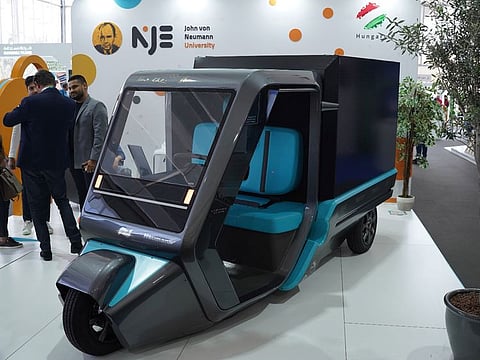
A unique hydrogen-powered multifunctional vehicle has been developed by the John von Neumann University (JvNU) in Kecskemét, Hungary, and presented at the UN Global Climate Change 2023 COP28 conference in Dubai. The focus of the event is the "Road to Zero" campaign, which aims to make the use of renewable energy sources in the mobility and energy sectors a priority for Member States to curb global warming. Alternative energy sources in mobility, such as electric, solar or hydrogen, are the cornerstones of the campaign's objectives, but their deployment is progressing more slowly than desired without convincing users and the public. COP28 is an event with a huge reach, attended by Heads of State, leaders of Member States and representatives of the largest multinational companies.
In automotive industry, the electric cars have dominated the media so far. However, prospective users cite charging times, large batteries and the deployment of a charging stations as a counter-argument. Hydrogen offers a solution to these areas in future. The Hungarian university JvNU has named its development Neumann H2, which is a demonstration and research platform.
It integrates state-of-the-art energy storage systems, demonstrating the benefits of solar, battery and hydrogen propulsion. The vehicle generates electricity from high pressure hydrogen using a fuel cell. The system is then equivalent to an electric car, but with a much smaller high voltage battery. The electricity generated by the PEM fuel cell is a by-product of the process, which only produces heat and water. The necessary charging of the battery can be achieved not only from the electricity generated from the hydrogen, but also from the solar panels mounted on its body.
The vehicle is not primarily designed for sale, although experience shows that a market-oriented version would be absolutely justified, for which the university is looking for investors. In addition to utility patents, the aim of the project was to make hydrogen-powered vehicles acceptable to the wider public by dispelling unfounded fears. The aim of the John von Neumann University is to give students a practical example of the future mobility.
The vehicle is a great opportunity to do this, as it enables the university to become involved in the development of hydrogen technology at a time when there are still many question marks and potential dead ends. But thanks to this project, many of these problems have been identified and the best solutions found.
By the time this form of propulsion is on the automotive industry's agenda, Neumann H2 will have helped students to be better informed about alternative options and will have helped engineers coming out of the JvNU to update their knowledge in preparation for future mobility needs.
The prototype is a three-wheeler like the "tuk-tuk" vehicles popular in India, of which more than 8 million are on the roads of this region. Dr. Krisztian Kun, head of development, explained the design by saying that such an educational platform is much more user-friendly and visual in this form, which greatly helps to adapt it to educational needs.
The Neumann H2 has a total range of 250 kilometers (155 miles), of which it can travel 150 kilometers on hydrogen and a further 100 kilometers on battery power. It has a peak power of 12 kW and a maximum speed of 60 km/h (~40 mph). Its zero emissions make it particularly suitable for urban transport and green materials handling in factory areas. The shape of the vehicle was created by MOME University designers based on instructions from JvNU colleagues.
As we are talking about an R&D platform, it is very important that the system is able to record its internal states in time-synchronous relation to each other, which allows it to provide data to researchers. Given that the platform is equipped with ROS2 Open-Source interface, the data is recorded in a standardized format. Energy management is supported by artificial intelligence of the "Reinforcement Learning" type, which selects the optimal energy source for operation based on different layers (Static, Dynamic) of high accuracy maps (HD Map). In addition to drive train control, the vehicle also uses AI for environment detection. Neumann H2's environment sensing system is essentially designed to detect, distinguish and select environmental elements using camera images and then provide feedback to the user via displays. This function also makes the vehicle suitable for emergency braking.
Researchers at Neumann University are looking for opportunities to collaborate with other universities and research institutes in the fields of hydrogen research and development and custom vehicle design. They would also support the development of a marketable model in case of an investment.


