Chinese goods cost more at home
Cheap Yuan and import tariffs have made products more expensive than in US
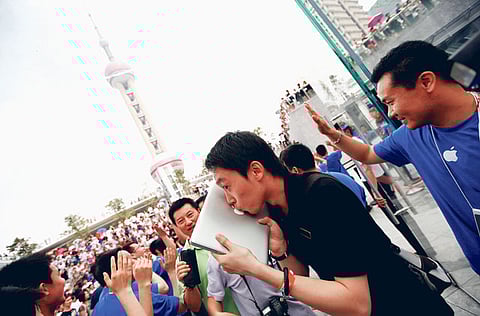
Beijing: The laptop computer Luo Guangli carried out of the Apple flagship store in Beijing was no different from the models sold in the United States.
It had the same high-resolution screen, an identical processor and the same printed label on the back: "Assembled in China."
The only difference — besides a manual written in Chinese — was the price. Luo paid $2,760 (Dh10,124). That's about $460, or 20 per cent, more than an American buyer would spend at an Apple store or buying it online.
"It's a huge expense, but what can I do?" said Luo, a 24-year-old professional photographer who wears glasses with Buddy Holly frames.
The premium prices aren't limited to foreign-branded computers. Kobe Bryant's Nike sneakers with the ‘Made in China' label go for $165 in the United States. But at an official Nike store in China? $190.
A flat-screen Sony TV assembled in China costs $800 at a Best Buy store in the United States. But you'd pay 30 per cent more at the popular Chinese appliance chain Gome.
The same goes for that Maclaren Techno XT infant stroller. It's also manufactured here, but you'll typically pay 40 per cent more for one at a Beijing mall than you would in the United States.
Paradox
It's a paradox of life here in the world's factory floor. The place known for delivering low-cost goods to Western consumers doesn't always do the same for its own people.
This may have been of little consequence to economists and world leaders a few years ago. But today, getting China's consumers to open their wallets is crucial to balancing a wobbly global economy grown too dependent on American and European shoppers.
It won't be easy. Chinese households are already famously frugal — and with good reason. A flimsy social safety net means tens of millions must save for their own education, health care and retirement. And while consumer spending has been rising along with China's prosperity, it has done so almost in spite of an economic model geared almost exclusively toward production rather than domestic consumption.
For example, US manufacturers have long complained that the Chinese government keeps the value of its currency, the yuan, artificially low.
That has boosted China's exports by making its goods cheap for foreigners to buy. But it also makes imported products expensive for Chinese consumers.
Then there are taxes and levies. That Apple laptop is made at a factory that's granted a rebate on China's 17 per cent value-added tax, as long as those computers are exported and sold abroad.
Chinese buyers aren't so fortunate. Before that same machine can be sold domestically, it is first sent to Hong Kong, a special administrative region of China, then returned to the mainland with a 20 per cent import tariff, industry experts said.
Price penalty
The price penalty is frustrating to savvy Chinese consumers who know what things cost elsewhere thanks to the internet and their own shopping trips abroad.
"When I saw the prices at an outlet mall in New York, I thought it was crazy how much we were paying in China," said Joanna Tong, 22, a Beijing native who has vacationed in the United States.
"It's not fair. Now that I know the prices in the United States, I've been reluctant to shop here at all."
Still, some foreign companies have made a conscious decision to raise their prices in China, or they've adopted a strategy of marketing their products as luxury items to make up for the higher cost of doing business.
That might seem counterintuitive in a nation where the typical urban resident last year earned about $2,800. However, high-priced goods carry cachet here, while China's consumer class is burgeoning.
High prices can boost the prestige of some products while fattening the manufacturer's bottom line.
"In China, people equate high prices with high quality," said Shuan Rein, managing director of China Market Research.
"Brands know that if their products are too cheap it will push consumers away."
The psychology, analysts say, is about making aspiring consumers feel like they're buying a piece of the middle class. The pull can be even stronger when Chinese purchase gifts to show respect.
"If I'm buying for friends or clients, I could never buy a Chinese brand," advertising agent Liu Hao said. "It's about face."
The painstaking task of moving goods around the country is another factor driving up prices.
Logistics companies rarely consist of more than a handful of employees and a single truck, said William McCahill, vice-chairman of Pacific Epoch, a Shanghai-based research firm.
Freight carriers often are reluctant to cross provincial borders because of local fees, meaning that goods often have to pass from one distributor to another, depending on geography.
"There is no national logistics system," McCahill said. "Dell has a plant in Xiamen where all the suppliers have to be a bicycle ride away."
Still, there is some hopeful news for Chinese consumers. The government said last month that it would allow a more flexible exchange rate for the yuan.
Trading partners hope that will lead to a stronger currency, enabling Chinese businesses and households to purchase more imported goods. And a wave of labour unrest in recent months in China has heightened calls for wage increases to boost domestic purchasing power.
"An economy with weak consumption is not sustainable," said Wang Xuanqing, a Ministry of Commerce official, at a conference of retailers last month.


