The big debate: In defence of the super-jumbo
With the number of commercial flight passengers forecast to increase, size matters for the aviation sector
With the future of the aviation industry facing some of its most exciting opportunities and challenges, it is perfect timing that we are about to celebrate a centenary of commercial flights.
It was on January 1 1914 that Abram C. Pheil paid the equivalent of $5,000 (about Dh18,365) to travel 21 miles of the Florida coastline — the first man ever to pay for his ticket.
Since then, the battle for passenger aviation has been one of accessibility and affordability, to make flying a means of transport rather than a badge of prosperity. Of course, that battle was won long ago and the industry is now driven firmly by the demands of mass consumers.
Today is another era and we have a new battle. Consumers have both the desire and the means to travel by air and the skies and airports are often struggling to cope. So, as aircraft manufacturers, how do we provide the aviation industry with the tools and technology to meet a market experiencing such exponential growth?
Let the numbers speak
Whether you want to call them very large aircraft or super-jumbos is a matter of taste, but what they will do for the future of aviation is a matter of fact. Latest figures from the International Civil Aviation Organisation show that three billion passengers were carried by air in 2012, and by 2030, that number will have risen to a massive 6.1 billion.
To cope with this, expanding existing airports and building new ones is not a realistic option — after all, we are talking about the doubling of passenger numbers. And there’s the key; passenger traffic will double, aircraft traffic will not.
Aircraft with a much larger passenger capacity than conventional jetliners can certainly help to clear the crowded skies and sweep the stockpiled runways. To carry 525 passengers on a standard three-class configuration and up to 850 on a single-class configuration on a non-stop flight for a distance of 8,500 nautical miles is not only impressive, it is vital for the future of a healthy aviation industry.
Over the coming years, the number of passengers travelling to the most popular locations will increase drastically. Using very large aircraft on established routes will give the option to reduce the number of flights while carrying the same volume of passengers, or expand frequency and increase market share.
Room to expand
In the Middle East and the UAE in particular, where passenger traffic for Dubai International Airport reached nearly 58 million last year, aircraft such as the A380 will ensure that there is a smoother flow of traffic as well as room for expansion.
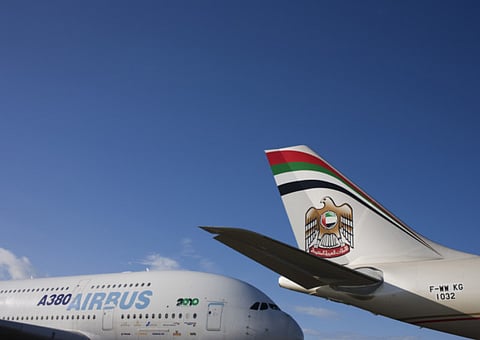
Dubai’s Al Maktoum International Airport is slated to be one of the largest in history. It already has the runway capacity to handle four A380s landing simultaneously. With more than 110 A380 orders from the region’s major carriers such as Emirates, Qatar Airways and Etihad Airways, > the potential to receive more orders from other global airlines is substantial. Combining optimum capacity with maximum comfort and minimum costs is not an easy task, but it is one that the industry has demanded and we have provided.
The design of the aircraft had to meet strict criteria to ensure that was not only a viable option for the future but a preferred one. Since its launch in 2007, the A380 has received accolades across an enormous range of stakeholders, from environmentalists who applauded its reduction in CO2 emissions by almost 20 per cent per seat to its passengers who praised its comfort and space. And the airlines are realising its potential as a revenue generator.
Airbus A380 either lands on or leaves a runway every five minutes, demonstrating clear demand for an aircraft of this dimension, technology and innovation.

