Arab parties hold key to Israel vote as oil nears $115
Arab parties set for record 19 seats as Brent near $115 and Iran talks stay stalled
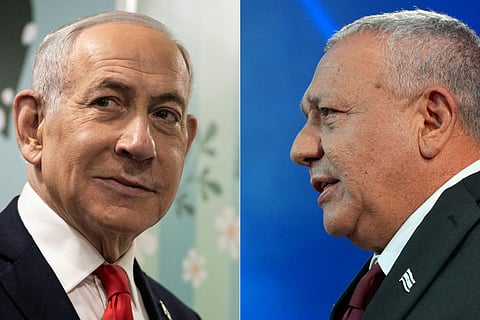
Dubai: Israel’s election has produced no clear winner, and a record Arab vote now sits at the centre of coalition talks. With 85.6 percent of votes counted, Prime Minister Benjamin Netanyahu’s bloc holds 53 seats, Gadi Eisenkot’s bloc 48 and the Arab parties 19. A majority needs 61 of 120 seats. Late double-envelope ballots could still shift the count.
Why do the different blocs matter?
Netanyahu’s bloc groups Likud, the largest single party, with right-wing and ultra-Orthodox allies. Eisenkot leads Yashar and an anti-Netanyahu alliance that ranges from the centre-left to the hard right. Neither side can govern alone.
Get updated faster and for FREE: Download the Gulf News app now - simply click here.
The Arab parties form the third group. They go by the nomenclature of ‘Joint List’. It consists of members from Hadash, Ta’al and Balad, who were reunited in August under Yousef Jabareen, who succeeded Ayman Odeh as Hadash leader. Ra’am, the Islamist party led by Mansour Abbas, runs separately. They had joined the Bennett-Lapid coalition in 2021. Projections give the Joint List about 13 seats and Ra’am about six.
How much influence do they hold?
Going by just the seats, they could swing the maths. Eisenkot’s bloc plus the Arab parties together would clear 61 seats. In practice, observers say a political veto stops them from acting as kingmakers. Major opposition parties have ruled out sitting with them. Netanyahu has called such a coalition “a shame and a disgrace.” Likud went further and accused the Arab parties of stealing the election.
The likelier route is a minority government that survives on outside votes. Jabareen says the Joint List will back a government without Netanyahu from outside the coalition. Ahmad Tibi adds that the bloc would vote with Eisenkot to set up an October 7 commission of inquiry.
On the ground, Arab citizens make up about 20 percent of the electorate and have traditionally voted at lower rates than Jewish Israelis. According to a CNN report any government that leans on Arab votes would face pressure over crime and marginalisation in Arab towns. These were the same issues that drove protest strikes earlier this year.
A minority government under Eisenkot would need Arab votes or abstentions to survive confidence votes. The Joint List could press for restraint on Iran, but it cannot veto a military decision.
Iran, Vance and Hormuz
Netanyahu has threatened fresh strikes on Iran. Tehran has warned of devastating economic consequences if Israel attacks, while saying mediation over reopening the Strait of Hormuz continues.
In the latest talks with Iran Vice President JD Vance has come to the fore. The Wall Street Journal reported that he wrote to Mohsen Rezaei, the secretary of Iran’s Supreme National Security Council, to restart talks. However, Trump has also threatened to resume hostilities after the November 3 midterms. Iran says it can meet half way but says its conditions must be met first.
Back in September, Rezaei had put forth a few conditions which included ending the US blockade and releasing frozen Iranian assets. Foreign Minister Abbas Araghchi has said Iran could reopen Hormuz within seven days if Washington eases pressure.
Hormuz is a matter between Iran, the US, Oman and the Gulf states. Oman and Iran have discussed a temporary shipping framework, and Qatari mediators have tabled a new draft deal. Tehran is also asserting its own control through its Persian Gulf Strait Authority, which manages passage requests and has threatened legal action against South Korea’s Sinokor vessels from November 1.
What comes next?
Crude oil prices like that of Brent traded at $114.14 a barrel on October 29, while WTI at $101.45. Both slipped from Wednesday but remain well above early October levels. Kpler data shows at least 10.1 million barrels a day still crosses the strait. But about 40 percent of regional crude bypasses it now.
Saudi Arabia has been sending crude west through the East-West Pipeline to Yanbu. The UAE uses the Habshan-Fujairah line, which carries roughly 1.8 million barrels a day. Both routes still stand exposed. The Saudi line was shut from September 11 to September 22, and the Houthis keep targeting Saudi infrastructure.
A deal would let the Gulf producers move fast. OPEC+ has finished unwinding its 1.65 million barrel a day cuts in September, and spare capacity is ready to move. Relief would still be partial.
A stalemate keeps the bypass routes carrying the load. Their weak point is the Red Sea. Crude loaded at Yanbu must still exit through the Suez Canal or Bab el-Mandeb. With threats to resume hostilities after the November 3 midterms hanging overhead, renewed fighting would put the pipelines and Yanbu under greater strain.


