Reshaping the rules of social engagements
Digital connectivity creates new faultlines and opportunities for families
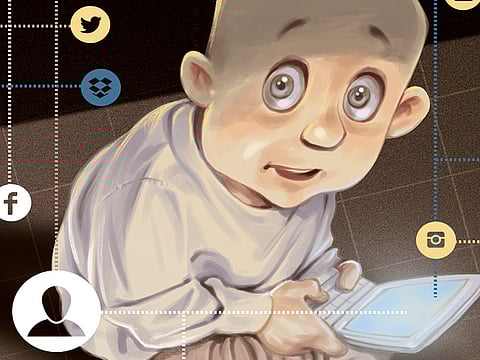
Recently, a friend showed me her mobile phone, with a despairing sigh. The screen was a mosaic of photos of a goggle-eyed baby, taken from every conceivable angle, sometimes holding chirpy, handwritten messages.
“It’s overwhelming my inbox!” she muttered, explaining that four months earlier she had become a grandmother to the infant, who lived in a different city. A decade ago, that would have meant she only saw the baby every month — say, over a holiday meal.
But not in 2015. In the past month, the doting parents have taken to dispatching baby photos to all their friends and family on a daily basis. And now — to her utter bewilderment — my friend has been asked to send text messages to the infant.
The idea is that these “texts” can be posted online to show that the grandparents are constantly thinking about their new grandson, and thus enable the family to “connect”. “It’s crazy,” she giggled, explaining that she didn’t want to cause offence but could not quite bring herself to send texts to a four-month-old. “What do I do?”
It is a peculiarly 21st-century dilemma. As linguists and anthropologists know well, the way that human families define themselves and communicate with each other has changed numerous times over the millennia. But the past decade has produced a shift in the pattern of family communications that is more speedy and intense than anything seen before.
Never mind the fact that the internet has suddenly linked the entire globe; social media and mobile phones have enabled us all to disappear into cyber space, colliding and connecting — however we choose. That is not just reshaping work but altering domestic space, creating new forms of cyber family traditions, even during the holidays.
For many people, this shift seems frightening. Last month, for example, Newmarket Holidays, one of the UK’s largest tour operators, conducted a survey of grandparents that showed that more than three-quarters thought that their relationship with their grandchildren was different from the relationship they had with their own grandparents — and that more than half feel that the difficulty in sharing Christmas traditions is due to computer games taking the attention of their grandchildren.
Another third blamed mobile phones and TV for distracting the kids and undermining the type of traditional Christmas activities that the grandparents thought were crucial to maintain family ties (such as talking, playing board games or singing songs).
Other surveys in the US reflect this concern. Between half and two-thirds of adults today say that children are too obsessed with social media, and fear that the rapid proliferation of electronic gadgets is creating a more individualistic, alienated society. It is little wonder, then, that one of the fastest-growing categories of self-help books is the one which tells people how to maintain social connections — and quality family time — in the face of this digital onslaught.
No doubt some of those books have been handed around as Christmas presents (along with a vastly bigger mountain of electronic gadgets).
But while it is easy for parents (like me) to worry that iPads, iPhones and Instagram are undermining the family, it is not always that simple. As Danah Boyd, a digital anthropologist, points out, our cyber behaviour needs to be viewed in a much bigger social context. Take the oft-cited concern that electronic media are separating children from their parents (or grandparents).
To a casual observer, this might seem self-evident, given how much time children tend to spend online, roaming cyber space or chatting with friends.
But, as Boyd points out, what children are doing online today is simply an extension of what they used to do in the real world. In the past, kids often wandered the streets (or woods and fields) with relative freedom, and used that time to explore boundaries and congregate with friends. But now that this has been curtailed by protective parents, children are roaming in cyber space instead.
While Twitter or Instagram might be new, what is not new is the idea that teens want to escape — even at Christmas.
Similarly, while the rise of social media might undermine the type of family traditions that grandparents say they love, it is also creating new links. Parents today can monitor what teenagers are saying to each other far more closely than before. Kids can talk — or Skype or FaceTime — with their relatives all over the world. Family news or holiday snaps can be shared on social media platforms.
Then there is the innovation of sending “texts” to babies. To some people (such as my friend) that might sound bizarre; to others (like my friends’ children) it seems normal. Either way, the key point is this: in today’s cyber world we have extraordinary freedom to reshape our family web as we choose.
And that is rather an inspiring development to consider.
— Financial Times


